

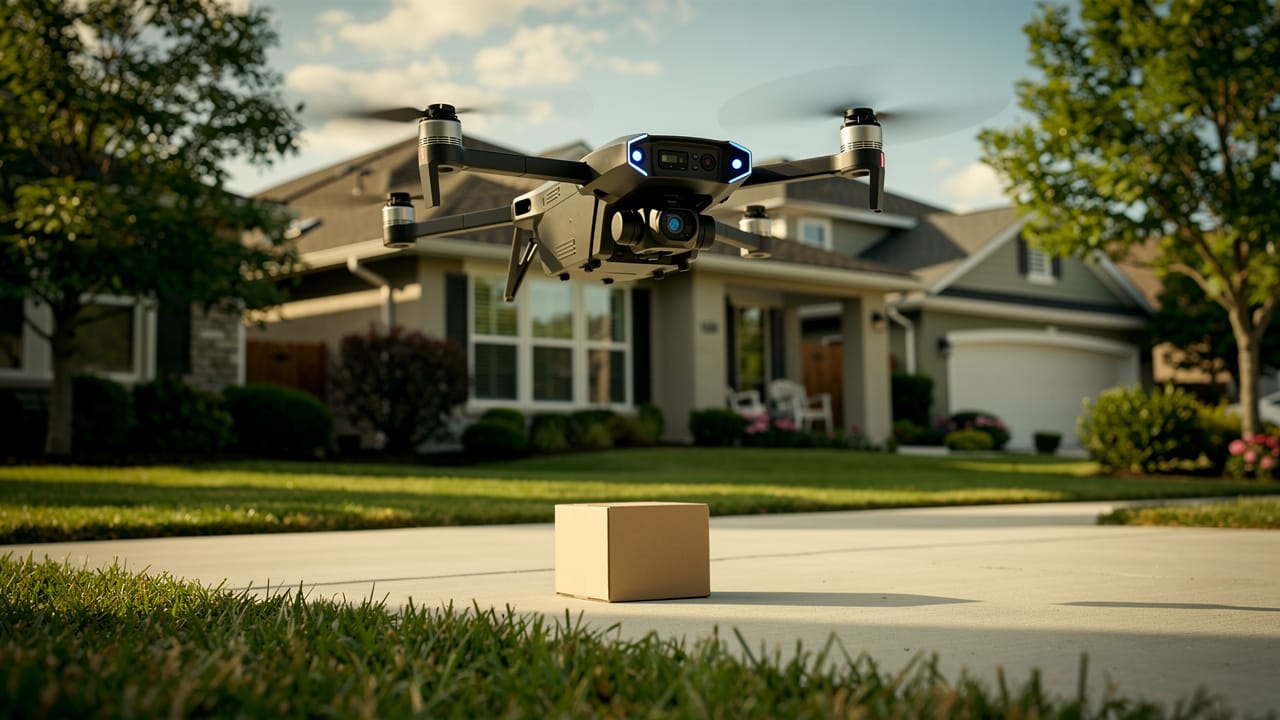
Walmart delivery drones are being sold as the future of convenience, but the harder truth is this: fast aerial delivery is easy to demo and much harder to make useful at scale. The drone buzz over cities and suburbs is not just about speed, it is about whether retailers can train customers to care about shaving an hour off errands that were never urgent to begin with.
Quick Summary
- Walmart delivery drones are part of a broader retail push to make ultra-fast delivery feel normal, even as the business case remains unsettled.
- In New York City, drone flights are now being tested in one of America’s busiest airspaces, with healthcare cargo crossing the East River on weekday runs.
- In the UK, Amazon has begun a limited consumer service delivering parcels under 5 pounds within a 7.5-mile radius, with a stated ceiling of 10 flights an hour or 100 deliveries a day on weekdays.
- The bigger issue is not whether drones can fly, it is where they make economic sense: dense cities, quiet suburbs, or niche routes like healthcare and remote communities.
- The latest policy shift from the FCC, allowing certain banned drones and routers to receive critical updates until 2029, shows that regulation and infrastructure still shape this market as much as technology.
- Walmart delivery drones may win in selective use cases, but broad everyday adoption will depend less on novelty and more on reliability, noise, safety, and cost.
What Happened With Walmart Delivery Drones and the Wider Drone Race
The latest drone delivery headlines are coming from multiple directions at once, which is why this market suddenly feels more real. A New York pilot is putting delivery aircraft into a crowded urban corridor, while Amazon has launched a limited UK service for ordinary household orders. That combination matters because it shifts the conversation from science-project hype to operational testing.
For Walmart delivery drones, this creates pressure and opportunity. Retailers are watching whether drone delivery can move beyond promotional clips and become a real logistics layer. The current experiments suggest that the first durable wins may not come from dropping snacks onto suburban lawns, but from highly controlled routes where speed and predictability actually justify the complexity.
Key Details on Walmart Delivery Drones, Skyports, and Amazon Delivery by Drones
In New York, Skyports is operating weekday flights between lower Manhattan and Brooklyn for a healthcare system, according to Wired. The aircraft are not hauling big consumer boxes. For now, they are moving very light cargo, initially just a few pounds of paper, with the possibility of later carrying nonhazardous pharmaceutical items if the trial proves dependable.
That detail is easy to miss, but it matters. The industry’s strongest early use case is not impulse shopping. It is specialized, time-sensitive transport with lightweight payloads and repeatable routes. In that sense, walmart drones delivery ambitions and hospital drone logistics are related, but not identical businesses.
Why the first winners may be boring
The New York drones reportedly have six propellers and an almost eight-foot wingspan, which tells you something important: these are not toy gadgets scaling effortlessly into city skies. They are aircraft entering already complicated airspace. Every route, launch site, safety procedure, and handoff has to work in the real world, not just in a product video.
Amazon’s UK rollout makes the consumer angle clearer. As the BBC reported, the company is delivering packages weighing less than 5 lb (2.2 kg) within a 7.5 mile (12 km) radius of its Darlington fulfillment center. Amazon says the service can support up to 10 flights per hour or 100 weekday deliveries per day in this limited launch. That is meaningful as a test, but still tiny by the standards of mainstream e-commerce.
This is where comparisons between drones Amazon delivery plans and Walmart delivery drones can get sloppy. The technology may be similar, but the economics are route-dependent. A few dozen or even a hundred successful deliveries a day prove capability. They do not yet prove a profitable mass-market model.
The policy layer is not optional
Another underappreciated piece of the story comes from Mashable, which reported that the FCC will allow certain banned drones and routers to receive critical updates until 2029. That sounds distant from retail, but it is not. Drone delivery depends on trusted communications gear, secure updates, and regulatory stability. If the rules around hardware, connectivity, or supplier eligibility keep shifting, scaling becomes slower and more expensive.
That means amazon delivery by drones and Walmart delivery drones are not just retail experiments. They are also infrastructure bets.
What Walmart Delivery Drones Mean for Shoppers, Workers, and Cities
For consumers, the appeal is obvious. If Walmart delivery drones can bring a forgotten ingredient, cold medicine, or baby supplies in under an hour, some people will love it. Convenience is powerful, especially for parents, older adults, and anyone without easy access to a car.
But usefulness depends on limits that retailers rarely emphasize in big marketing moments.
What customers gain, and what they may not
Drone delivery works best when items are small, light, and urgent enough to justify premium handling. That means groceries in full weekly loads are still better suited to vans. Furniture is out. Multipack household basics may be out too, depending on weight and packaging. The likely sweet spot is a narrow basket of high-need items.
That is why walmart delivery drones could become a feature customers use occasionally, not a replacement for regular delivery. Think pain reliever, charging cable, pet medication, or a missing dinner ingredient. Not a full cart.
Noise is another issue. People like fast delivery in theory. They like buzzing aircraft over backyards far less. If drones delivery Amazon style services and Walmart-style equivalents expand in suburban neighborhoods, local resistance could become a bigger brake than engineering.
Who benefits financially
Retailers benefit if drones lower last-mile costs on specific routes. They also benefit if faster delivery increases customer loyalty or pushes more shoppers into paid memberships. Healthcare systems benefit if lightweight medical items can move faster between facilities. Remote communities benefit when drones replace slow or impractical transport.
Workers face a more mixed future. Drone systems create jobs in operations, maintenance, compliance, and remote piloting. They may also reduce some demand for certain short-distance courier trips. The likely result is not labor disappearing overnight, but labor shifting toward more technical and supervised roles.
What Others Missed About Walmart Delivery Drones
The biggest blind spot in this conversation is that drone delivery is not one market. It is at least three.
First, there is institutional logistics, like hospital networks and lab transport. Second, there is consumer convenience, the world of toothpaste, batteries, and forgotten groceries. Third, there is hard-access geography, where islands, rural areas, and remote communities can gain the most from aerial delivery.
Those markets should not be judged by the same yardstick.
Walmart delivery drones are really a retail psychology test
The smartest thing retailers may be learning is not flight performance. It is customer behavior. Do people truly value faster delivery enough to change habits? Will they accept tighter product limits? Will they tolerate landing pads, app scheduling, and weather-related failures?
That makes Walmart delivery drones less of a pure logistics story and more of a consumer psychology experiment. If shoppers only use drones in edge cases, the technology may still survive, but as a premium niche rather than a daily utility.
There is also a branding play here. Retailers want to look modern, efficient, and technically ambitious. Drone programs generate headlines even before they generate serious volume. That does not mean they are fake. It means they carry marketing value long before they carry financial certainty.
The other missed angle is urban complexity. New York is not useful because it is easy. It is useful because it is hard. If aircraft can operate safely and predictably there, companies and regulators learn much more than they would from another wide-open suburban test bed. That is why the middle of this story may belong less to splashy consumer drops and more to platforms like Skyports Delivery Drones, which are built around structured operational environments.
Real Examples of Where Walmart Delivery Drones Could Actually Work
A parent realizes at 7:15 pm that the baby formula tin is nearly empty. A pharmacy item is needed fast, but not fast enough to justify an ambulance-style response. A customer ordering a phone charger before a next-morning flight values speed more than price. These are plausible use cases for Walmart delivery drones.
By contrast, the average weekly grocery order is a bad fit. Too heavy, too bulky, too variable.
Healthcare gives the clearest real-world example. The New York flights are not glamorous, but they are rational. Repeated short trips, low payloads, clear urgency, and fixed endpoints are exactly where drone systems have a chance. The same logic applies to remote mail and supplies, which helps explain why drone adoption has also appeared in non-retail settings before broad consumer shopping.
Amazon’s UK launch is useful as a consumer stress test. If drones for delivery Amazon style service can reliably handle a modest number of orders inside a 7.5-mile zone, competitors will study the behavior closely. If customers love it but only for certain products, expect Walmart and others to narrow their offerings rather than go broad.
Near the end of that path, companies offering specialized systems, including Skyports Delivery Drones, may matter more than flashy storefront brands. Retailers win headlines, but operational partners often determine whether the service actually works.
Pros and Cons of Walmart Drones Delivery
Pros
- Faster delivery for small, urgent items
- Potentially lower last-mile costs on selective routes
- Useful for healthcare, remote access, and high-priority deliveries
- Can reduce dependence on road traffic in some scenarios
Cons
- Strict weight and distance limits
- Weather, airspace, and regulatory constraints
- Noise and privacy concerns for neighborhoods
- Economics remain uncertain outside narrow use cases
- High visibility means every failure becomes public
Conclusion on Walmart Delivery Drones
Walmart delivery drones are not a gimmick, but they are not a universal answer either. The companies that win this race will be the ones that stop pretending every package belongs in the sky and focus on the routes where drones solve an actual problem.
What Happens Next (2026-2030)
Between now and 2030, expect Walmart delivery drones and competing services to expand slowly, not explosively. Healthcare networks, remote communities, and small high-urgency consumer orders will benefit first, while broad suburban everyday retail will remain constrained by noise, cost, and regulation. Amazon will keep pushing consumer visibility, but the quieter winners may be infrastructure players and operators that make flights routine rather than flashy. The losers will be companies that mistake public curiosity for durable demand.
Sources
About the Author