

The hottest take in tech right now is not that quantum computing is arriving tomorrow. It is that quantum computing developments are finally starting to look less like physics demos and more like infrastructure battles, manufacturing bets, and platform wars. If that sounds less glamorous, good, because that is usually what real technological change looks like right before it matters.
Quick Summary
- Neutral-atom quantum computing is emerging as one of the most credible paths to scaling useful quantum machines.
- The latest quantum computing developments are not happening in isolation, they are colliding with bigger fights over AI infrastructure, power demand, and national industrial policy.
- Infleqtion and other neutral-atom players are drawing attention because this approach may offer a cleaner route to larger qubit systems.
- China’s proposed $295 billion AI data center grid shows how aggressively nations are building compute capacity, and that matters for quantum too.
- Energy is becoming a hidden constraint in advanced computing, especially as utilities and companies rethink how to support power-hungry data systems.
- The real story in recent developments in quantum computing is not one miracle breakthrough, it is which architectures can survive contact with cost, scale, and operations.
What Happened in Quantum Computing Developments This Week
A fresh wave of quantum computing developments is being driven by a simple but important idea, the industry may be moving from “Can this work in a lab?” to “Which hardware model can scale in the real world?”
That is why neutral atoms are getting so much attention. Forbes highlighted the case that neutral atoms could represent a “transistor moment” for quantum computing, meaning not just a scientific leap, but a hardware simplification that changes what becomes commercially possible. The argument is that if you can trap and control arrays of atoms with enough precision, you may have a more natural path to building larger, more capable systems than some rival approaches.
At the same time, adjacent industries are sending a clear signal. China is reportedly drafting a $295 billion plan for a national AI data center grid built around 80% domestic silicon, with a projected 2028 timeline. That is not a quantum story on its face, but it is absolutely part of the same compute arms race. And on the energy side, GM says there are already more than a quarter-million V2G-capable GM EVs on the road, a reminder that future compute growth will be constrained as much by electricity and grid design as by chips.
Key Details on the Latest Developments in Quantum Computing
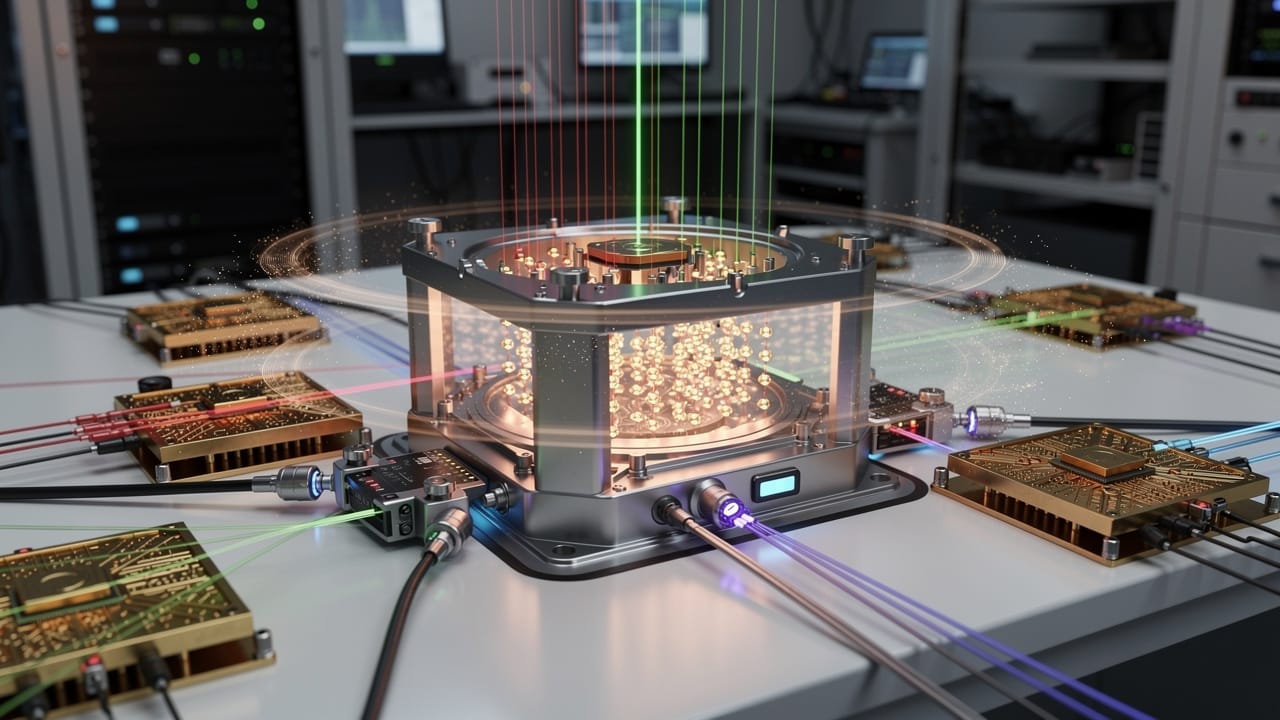
The appeal of Neutral-Atom Quantum Computing is straightforward. Instead of relying on fabricated superconducting circuits or trapped ions alone, this model uses individual atoms positioned and manipulated with lasers. In theory, that offers an elegant scaling story, because atoms are naturally identical. In practice, that matters a lot. One of the dirtiest secrets in hardware is that manufacturing variation kills performance, reliability, and cost.
Why neutral atoms are suddenly central to quantum computing developments
In the current wave of developments in quantum computing, the market is looking for architectures that do not just produce better headlines, but better economics. Neutral atoms fit that demand because they promise dense qubit arrays and more flexible connectivity. That does not guarantee victory, but it does explain why investors and operators are paying closer attention.
This is also why the conversation is shifting away from raw qubit counts alone. If you followed our earlier analysis in Quantum Computing Advancements 2024: Why the Biggest Breakthroughs Aren’t Coming From Bigger Chips Alone, this moment should feel familiar. Scaling quantum hardware is not merely a matter of stacking more components, it is a systems problem involving error rates, control complexity, cooling or trapping requirements, software tooling, and eventually price.
The broader compute race is shaping quantum computing industry developments
The Tom’s Hardware report matters here because it shows how governments increasingly see compute as strategic infrastructure. AI is driving the spending today, but the logic carries over to quantum computing industry developments as well. Countries want sovereign control over the technologies that define defense, research, drug discovery, logistics, and finance.
Then there is the energy issue. Ars Technica’s GM report might seem unrelated, but it points to something bigger. Advanced computing is colliding with grid limits. GM’s push for vehicle-to-grid support, with utility partners like PG&E and DTE Energy, reflects a future where balancing electricity demand becomes part of the tech stack. If AI data centers are already stressing the grid, large-scale quantum facilities and hybrid compute campuses will not get a free pass.
What Quantum Computing Developments Mean for You
Most readers do not need a quantum computer on their desk, and they will not get one. But the latest developments in quantum computing still matter because they shape the industries that shape your life.
If you work in tech, finance, logistics, or pharma
You should read recent developments in quantum computing as an early signal about future competitive advantage. The first serious commercial impact will likely show up in optimization, simulation, materials science, and chemistry. That means drug companies, battery researchers, supply chain operators, and financial modelers all have reason to watch which hardware approaches mature first.
If neutral atoms continue gaining traction, businesses may end up with a quantum option that is easier to scale into meaningful workloads. That would not instantly replace classical systems. It would create hybrid workflows, where traditional computing does most of the work and quantum handles specific hard problems.
If you are an investor or policymaker
The bigger lesson is that compute is no longer just a chip story. It is a stack story. Hardware, energy, software, fabrication, national policy, and talent pipelines now move together.
That is why quantum computing recent developments should be read alongside AI infrastructure spending and utility modernization. China’s proposed $295 billion AI grid is not just about training models. It is about securing future leverage in computation. Likewise, grid-support moves like GM Energy’s V2G push suggest power flexibility could become an economic advantage for any region trying to host next-generation compute clusters.
If you are a normal consumer
The effects will reach you more slowly, but they will still arrive. Better batteries, new materials, faster drug discovery, and more efficient logistics are all plausible downstream benefits. The risk is that the hype outruns the utility, which has happened before in quantum. The opportunity is that the grind may finally be paying off, a point we argued in Quantum Computing Advancements 2024: The Biggest Story Isn’t a Breakthrough, It’s That the Grind Is Finally Paying Off.
What Others Missed About Recent Developments in Quantum Computing
The flashy angle is “neutral atoms could be huge.” True enough. The more important angle is why the market is suddenly receptive to that claim.
For years, quantum coverage focused too heavily on milestone theater, who hit a benchmark, who published a paper, who announced more qubits. That made the field sound like a sprint. It is not. It is a manufacturing and control problem dressed up as frontier science.
The real test behind quantum computing developments is operability
A hardware architecture does not win because it is beautiful in a diagram. It wins because teams can build it repeatedly, control it reliably, and improve it without the whole machine becoming unmanageable. That is where neutral atoms have a chance to punch above their current market profile.
The analogy to the transistor is powerful precisely because the transistor did not just improve performance. It changed manufacturability and system design. If neutral atoms deliver anything close to that kind of simplification, then these quantum computing developments will look obvious in hindsight.
Another missed point is that AI may actually accelerate quantum, even if the two fields compete for money. AI is forcing governments and enterprises to treat computation as strategic capacity. Once that mindset takes hold, quantum stops being a science project and becomes part of a national and corporate roadmap.
Real Examples of How These Quantum Computing Developments Could Play Out
Imagine a pharmaceutical company trying to model molecular interactions that are painfully expensive for classical supercomputers. A mature neutral-atom platform could become a specialist engine for pieces of that workflow, reducing the time needed to test promising compounds.
Think about battery design next. Energy storage chemistry is still full of ugly trade-offs, cost, density, safety, longevity. Better quantum simulation could help companies narrow the search space faster. That sounds abstract until you remember how much money is being poured into grid resilience and storage right now.
A third example is logistics. Retailers, shippers, and manufacturers already use optimization software, but many real-world routing and scheduling problems remain computationally nasty. As quantum computing developments move from experiments to usable services, these sectors could be among the first practical adopters, not because it is futuristic, but because shaving small percentages off giant networks is worth millions.
Pros and Cons of the Current Quantum Computing Recent Developments
Pros
- Neutral atoms may offer a more scalable path than some competing architectures.
- The field is maturing from lab milestones to industrial questions, which is healthy.
- National investment in compute and energy infrastructure could indirectly support quantum progress.
- Hybrid use cases in chemistry, materials, and optimization look increasingly plausible.
Cons
- Quantum hype still runs ahead of real commercial deployment.
- Scaling a promising architecture is not the same as proving fault-tolerant utility.
- Infrastructure competition, especially for power and specialized talent, could slow adoption.
- Geopolitical competition may fragment supply chains and research collaboration.
Conclusion on Quantum Computing Developments
The smartest way to read today’s quantum computing developments is not as proof that useful quantum machines are here. It is as proof that the field is finally being judged by the standards that matter, scale, operability, economics, and infrastructure. That is a much better sign than another flashy lab demo.
What Happens Next (2026-2030)
Between now and 2030, the winners in quantum computing developments will not necessarily be the companies with the loudest claims. They will be the ones that can turn fragile physics into repeatable systems, useful developer tools, and commercially credible services. Neutral-atom firms could gain serious ground if they keep showing cleaner scaling and lower operational complexity. The losers will be architectures that look impressive in controlled conditions but become too expensive or unwieldy to industrialize. Expect the next phase of recent developments in quantum computing to be shaped as much by power, manufacturing, and geopolitics as by pure science.
Sources
About the Author