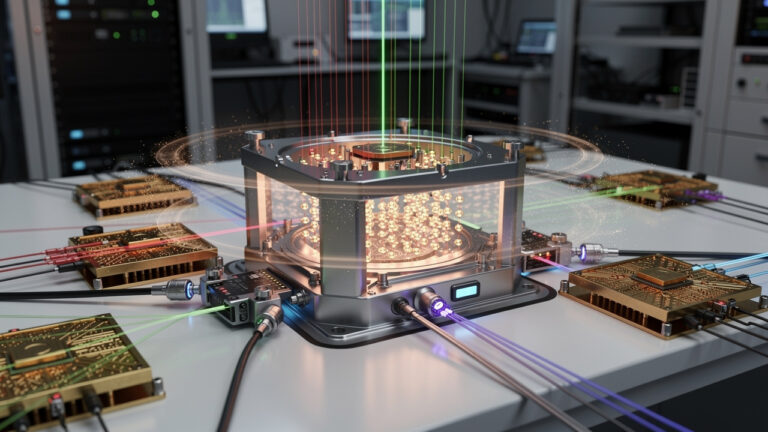

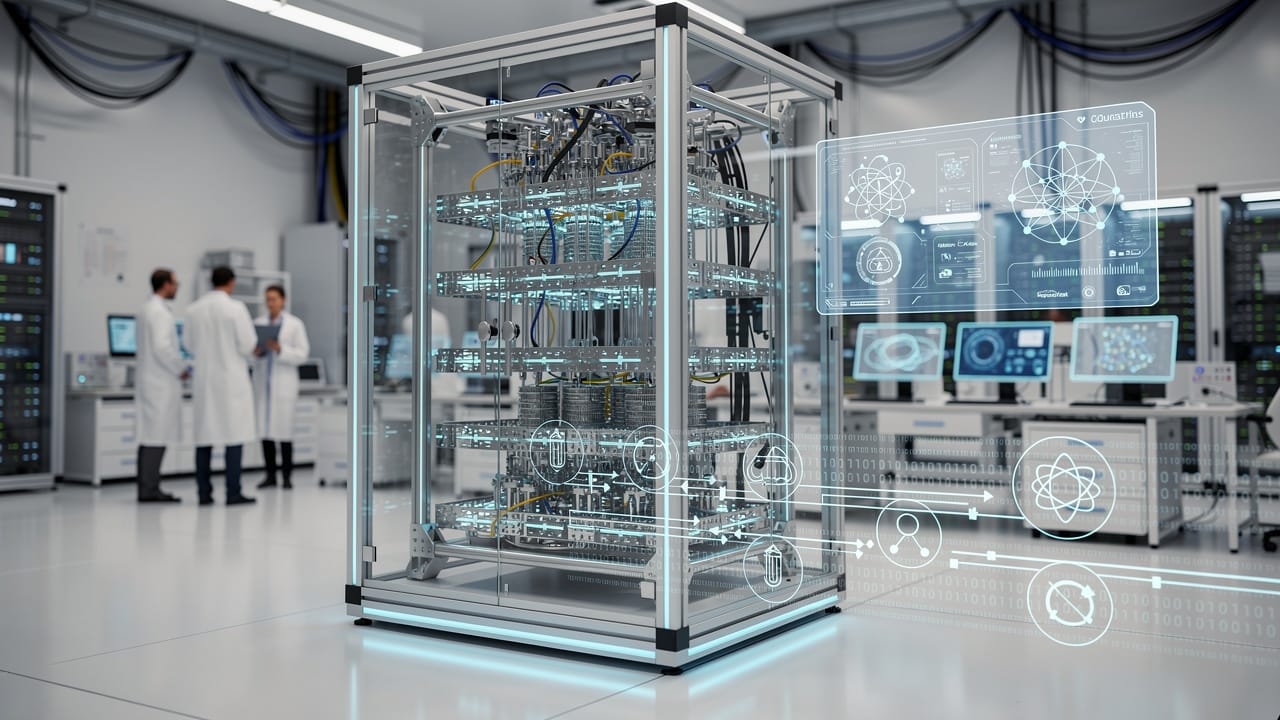
The most important story in quantum computing advancements 2024 is not raw qubit bragging rights. It is the quiet buildout of the hardware around quantum machines, the sensors, materials, control systems, and access models that turn a lab curiosity into something industries can actually use.
Quick Summary
- Quantum computing advancements 2024 are increasingly about the full stack, not just the processor itself.
- A new terahertz detector design reportedly improved efficiency by about 20 times, a reminder that quantum progress also depends on better sensing hardware.
- In the UK, a King’s College London team became the first academic group there to access Google’s Willow chip, widening who gets to test cutting-edge quantum systems.
- Google has claimed Willow can solve a benchmark problem in five minutes that would take classical supercomputers 10 septillion years, though that does not mean general-purpose commercial supremacy is here.
- The next phase of recent advancements in quantum computing will likely come from better interfaces between quantum devices and the real world, especially in imaging, communications, and measurement.
- The winners will be teams that combine quantum theory with practical engineering, not the ones that simply shout the loudest about qubit counts.
What Happened in Quantum Computing Advancements 2024
Two developments, on the surface unrelated, point in the same direction. First, researchers reported a new quantum metasurface approach for detecting terahertz radiation, one of the most stubbornly difficult parts of the electromagnetic spectrum to work with. Their compact detector concentrates incoming energy into tiny active zones, dramatically strengthening the electrical response.
Second, King’s College London secured access to Google’s Willow quantum chip through a UK research scheme. That matters because access, not just invention, is becoming a bottleneck in the field. A breakthrough no one outside a corporate lab can test is not much of a platform.
Together, these developments show why quantum computing advancements 2024 should be understood more broadly. The field is no longer just about building a quantum processor. It is about building the ecosystem that makes those processors measurable, controllable, and useful.
Key Details on Recent Advancements in Quantum Computing
The terahertz news deserves more attention than it will probably get. According to the Science Daily report, the new detector architecture boosted efficiency by roughly 20x compared with earlier designs. That is not a cosmetic gain. In an area where existing detectors are often slow, insensitive, expensive, or dependent on cryogenic cooling, a jump like that changes what engineers can realistically build.
Terahertz technology sits in an awkward zone between microwaves and infrared. It has long promised better imaging, sensing, and communications, but practical detection has lagged. The new photoelectric tunable-step terahertz detector suggests a way around that by using a metasurface to funnel weak incoming radiation into small active regions that produce a stronger signal.
Why quantum computing advancements 2024 now include sensing hardware
This matters to quantum computing because quantum systems do not live in isolation. They rely on exquisitely precise control, readout, calibration, and environmental monitoring. Better detectors and better materials often unlock progress faster than another marketing slide about future qubit targets.
Then there is access. The BBC Technology report notes that King’s researchers are the first UK academic team to get access to Willow. Google has said the chip can complete a theoretical task in five minutes that would take today’s fastest supercomputers 10 septillion years. Impressive, yes, but also familiar. Quantum companies have been making benchmark claims for years, and those claims often describe narrow problems designed to highlight quantum advantage.
Still, access to a frontier chip matters even when the benchmark is limited. It gives outside researchers a chance to test algorithms, error behavior, and workflow assumptions on a genuinely advanced platform instead of a simplified simulator.
The broader engineering pattern
A third source, from MIT Technology Review, is not about quantum computing directly, but it highlights the same industrial pattern. A new lithium extraction process aims to reduce cost and carbon intensity, proving that breakthrough technologies often depend on overlooked enabling systems. Batteries need minerals. Quantum hardware needs cooling, materials, detectors, fabrication, and clean access to compute time.
That is why the latest advancements in quantum computing look less like a single moonshot and more like a supply chain coming into focus.
What This Means for You as Quantum Computing Advancements 2024 Accelerate
If you are a researcher, this is good news. Better detector technology can make high-sensitivity imaging and sensing more practical. Wider access to top-tier chips means more universities can experiment without having to build everything in-house. The field becomes less exclusive and, potentially, less dominated by whichever company has the biggest PR budget.
If you are in healthcare, telecom, or industrial sensing, the terahertz angle is especially important. Terahertz systems have long been tempting for non-invasive imaging and specialty inspection, but the hardware has often been too bulky or fragile for widespread deployment. A compact detector with a much stronger signal changes that calculation.
Where the real commercial value may emerge
For businesses, the practical lesson is simple: stop thinking about quantum purely as a replacement for classical computing. Some of the most valuable advancements in quantum computing may show up first in adjacent products, better sensors, better measurement tools, better security hardware, or niche communications components.
That is also why quantum computing advancements 2025 may look surprisingly different from the hype cycle people expect. We may not get a sudden consumer-facing “quantum app” moment. Instead, we could see quieter wins in scientific instruments, materials discovery pipelines, and specialized industrial platforms.
For everyday users, the immediate effect is indirect but real. Better quantum-enabled sensing could improve medical diagnostics, airport and factory scanning, and advanced wireless systems. More open academic access to cutting-edge chips could also accelerate breakthroughs in chemistry, optimization, and cryptography research that later filter into consumer products.
Who should be cautious
Not everyone benefits equally. Legacy hardware vendors built around older detection systems could face pressure if compact high-efficiency terahertz components become viable. Classical-only compute providers also face a strategic challenge, not because they are about to disappear, but because more clients will expect hybrid workflows that combine classical systems with quantum resources.
And there is a risk of overselling timelines. A benchmark victory is not the same as a robust commercial service. A 20x gain in detector efficiency is not the same as mass production at low cost. The field still has to cross the ugly bridge between prototype and product.
What Others Missed About the Latest Advancements in Quantum Computing
Most coverage of quantum still defaults to a simplistic narrative: company unveils chip, company claims impossible speed, industry transformed. That framing misses the harder truth. Quantum progress is being constrained less by imagination than by interfaces.
The terahertz detector story is a perfect example. If you cannot reliably detect, guide, and convert subtle signals, your grand quantum system remains temperamental and expensive. The bottleneck is not always the qubit. Sometimes it is the readout, the sensing layer, or the surrounding electronics.
Quantum computing advancements 2024 are really about bottlenecks
This is why the quantum computing advancements 2024 conversation should be less about “who won” and more about “which bottleneck moved.” In this case, one bottleneck is terahertz detection. Another is who gets access to leading hardware. When those bottlenecks loosen, innovation spreads.
There is also a geopolitics angle. The UK team’s access to Willow is not just an academic footnote. It reflects a broader competition over who gets to participate in the next generation of computing infrastructure. Countries that lack top-tier fabrication or quantum platforms will increasingly seek partnerships, access agreements, and public research channels.
A final overlooked point: the most durable companies in this space may not be the ones with the flashiest processor announcement. They may be the ones building the tools everyone else depends on, detectors, control stacks, materials systems, and cloud access layers. That is a much less glamorous story, and probably the more important one.
Real Examples of How Advancements in Quantum Computing Could Show Up
Start with healthcare. A stronger terahertz detection platform could help push non-invasive imaging systems from specialist labs into more practical clinical tools. That does not mean your local hospital is getting one next year, but it does mean one of the longstanding hardware excuses is getting weaker.
In communications, terahertz frequencies have been discussed for future ultra-high-bandwidth links. The problem has never been ambition. The problem has been making the hardware sensitive and compact enough to work outside pristine lab settings. The new photoelectric tunable-step terahertz detector points toward more realistic components.
Research labs may feel the change first. A university team with access to Willow can test ideas that previously lived on whiteboards or in simulations. That shortens the distance between theory and failure, which is useful, because fast failure is how serious science actually improves.
You can see a similar pattern in other deep-tech sectors too. Energy storage did not move forward only because battery chemistry improved. It also moved because extraction, processing, and manufacturing changed. Quantum is headed down the same road.
Pros and Cons of the Current Quantum Computing Advancements Push
Pros
- Better supporting hardware can make quantum systems more usable, not just more impressive on paper.
- Wider academic access reduces concentration of power inside a few corporate labs.
- A 20x efficiency improvement in terahertz detection could unlock real products in imaging, sensing, and communications.
- Stronger tools around quantum systems may create commercial value sooner than fault-tolerant computing alone.
Cons
- Benchmark claims can create unrealistic public expectations.
- Prototype success does not guarantee scalable manufacturing.
- High-end access is still limited, even if it is improving.
- The field remains expensive, technically fragile, and highly dependent on specialized infrastructure.
Conclusion on Quantum Computing Advancements 2024
The smartest way to read quantum computing advancements 2024 is this: the center of gravity is shifting from spectacle to infrastructure. That is healthier for the industry, and far more useful for everyone waiting for quantum to become something more than a headline.
What Happens Next (2026-2030)
Expect the biggest winners to be universities, national labs, and startups that can plug into elite quantum hardware without having to own it. Detector makers, materials engineers, and companies building the surrounding toolchain will probably capture more near-term value than many pure-play quantum software hopefuls. Some overhyped processor vendors will lose ground as customers demand proof of workflows, not just proof of concept. By 2030, the most meaningful change may not be a single machine beating a supercomputer, it may be quantum systems quietly improving sensing, security, and industrial R&D in ways that finally feel normal.
Sources
About the Author