

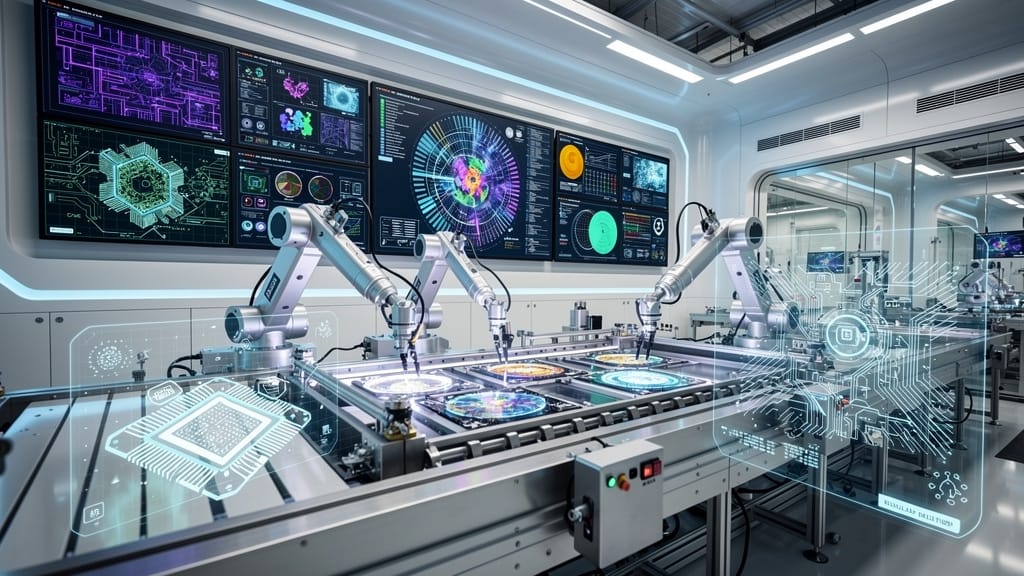
If you want to understand where the chip industry is heading, don’t just watch who designs the next AI processor. Watch who is trying to build the factories. That is why this china chip technology news moment matters far beyond one headline about Intel and Elon Musk.
Quick Summary
- Intel has joined a U.S. chip manufacturing effort tied to Musk’s ecosystem, alongside SpaceX and Tesla
- The project aims to build large-scale semiconductor production capacity in Texas
- The stated ambition is enormous, producing enough advanced compute to support AI, robotics, satellites, and autonomous systems
- Intel’s exact role is still unclear, which is important because chip fabs live or die on process expertise, packaging, and capital discipline
- In the context of china chip technology news, this looks like a direct sign that the U.S. tech stack wants more control over where advanced chips are made
- The real story is not just one fab, it is the emerging alliance between chip manufacturing, AI infrastructure, and industrial policy
What Happened in china chip technology news and Intel’s Texas Move
Intel signed on to a semiconductor manufacturing project called Terafab, a Musk-backed initiative involving SpaceX and Tesla. The broad idea is straightforward, build a major U.S. chip facility in Texas that can support future demand for AI computing, robotics, satellite systems, and autonomous machines.
That sounds simple on paper. It is not. A modern chip fab is among the hardest industrial projects on Earth. It demands massive capital, years of construction, specialist tools, process engineering, supply chain coordination, and customers willing to bet on unproven output. So when Intel joins, the significance is not just symbolic. It suggests the project wants serious manufacturing credibility.
This is also why the story landed hard in china chip technology news circles. Every major chip move is now read through a geopolitical lens, and a new U.S. fab effort involving Musk and Intel naturally raises questions about supply chains, sovereignty, and who controls next-generation compute.
Key Details on Intel, Musk, and china chip technology news
Intel has publicly said it will contribute its ability to design, fabricate, and package ultra-high-performance chips at scale. That wording matters. It hints that Intel may be offering more than branding or a minority technical role. The company could potentially contribute process knowledge, advanced packaging, or manufacturing systems expertise.
Why the scale claim matters in china chip technology news
The ambition attached to Terafab is striking. The project has been framed around producing enough compute to support future AI and robotics at an immense scale. That kind of output target is not just about selling chips. It is about controlling the physical infrastructure behind the next computing era.
Three details stand out.
First, the customer base is unusually concentrated and unusually strategic. SpaceX needs compute for satellites and potentially for orbital data infrastructure. Tesla needs chips for autonomy, vehicles, and robots. Musk’s AI ambitions add another layer, because training and inference both require enormous volumes of silicon.
Second, Intel’s involvement may be a practical response to the reality that chip production is no longer only a merchant business. The biggest buyers increasingly want custom silicon, tighter control, and less dependency on distant foundries.
Third, the timing is no accident. In the wider china chip technology news environment, governments and companies are trying to reduce exposure to geopolitical choke points, especially around advanced manufacturing and packaging.
What we still do not know
There are still large unanswered questions.
We do not know whether Intel will provide process technology, manufacturing tools integration, advanced packaging, foundry services, or simply engineering support. We also do not know the financing structure, timeline, or whether the fab will target bleeding-edge nodes or a more mixed portfolio of advanced and specialized chips.
That uncertainty is not trivial. In semiconductors, the distance between “strategic partnership” and “working factory” is measured in billions of dollars and years of execution.
What china chip technology news Means for You, the AI Market, and Device Prices
This matters even if you never buy a server rack or think about wafer yields.
More domestic chip capacity could reshape prices and supply
If projects like this succeed, the long-term effect could be more resilient supply for AI hardware, automotive chips, robotics platforms, and cloud infrastructure. That would not necessarily make chips cheap overnight, but it could reduce some of the extreme concentration risk that has haunted the industry.
For businesses, that means a better shot at securing advanced components without waiting behind hyperscalers or fighting over constrained supply. For consumers, it could eventually influence the cost and availability of products that now depend heavily on AI accelerators or custom silicon, from cars to smart devices.
The upside for Musk’s companies is obvious
Tesla would benefit from a closer line to custom chips for self-driving and robotics. SpaceX could gain strategic control over hardware for satellite networks and data-heavy space systems. Intel, meanwhile, gets a fresh chance to prove it still belongs at the center of advanced manufacturing conversations.
There is also a broader signal to enterprise buyers. If industrial giants start knitting chip design, packaging, and manufacturing into a tighter in-house or partner-controlled stack, more companies may follow. We already see hints of that trend in custom AI silicon across the market. A useful example is this breakdown of how AI chip technology is entering a new phase, where control of the compute stack becomes a competitive weapon, not just a procurement decision.
The risks are real
Chip fabs are notorious money pits when timelines slip or yields disappoint. If this project overpromises, it could become another reminder that ambition does not equal execution. That matters for investors, suppliers, and any industry customer counting on future capacity.
And in the context of china chip technology news, there is another practical point. More U.S. manufacturing can strengthen resilience, but it can also deepen global fragmentation. That could mean duplicated investment, higher costs, and a less efficient global chip market.
What Others Missed About Intel, Terafab, and the New Power Map
Most coverage focuses on the celebrity angle, Intel plus Musk equals big headline. That is the least interesting part.
This is really about vertical control
The deeper story is that the biggest tech ambitions now depend on owning the bottlenecks. AI models need compute. Robots need edge silicon. Satellites need hardened, efficient processing. If your roadmap depends on chips, relying entirely on outside foundries starts to look like a strategic weakness.
That is why this story fits so neatly into the bigger china chip technology news conversation. The world is moving from globalization-first chip logic to security-first chip logic. Efficiency still matters, but control matters more than it used to.
Intel may be buying relevance, not just revenue
Intel has spent years trying to convince the market that it can be both a product company and a manufacturing powerhouse again. Joining a high-visibility project like Terafab gives it something valuable even before a wafer ships, relevance in the future-facing narrative of AI infrastructure.
That does not guarantee success. But it does suggest Intel understands where prestige in semiconductors now comes from. It is not just benchmark wins. It is being seen as essential to the industrial base behind the next wave of computing.
Real Examples of How This Could Change Products and Infrastructure
Think about autonomous vehicles first. If Tesla can source more specialized silicon through a tightly aligned manufacturing ecosystem, it may iterate faster on self-driving hardware and robotics controllers. That could shorten development cycles, especially when software and silicon are co-designed.
Now consider satellite infrastructure. SpaceX runs a business that increasingly depends on moving and processing massive amounts of data. More direct access to custom chips could improve satellite networking, onboard compute, and perhaps future orbital data services.
AI data centers are the third obvious example. If Intel and Musk-linked companies build a serious domestic path for advanced chips and packaging, cloud providers and enterprise AI customers may get an alternative source of capacity. In a market where compute shortages can delay product launches, that matters immediately.
This is why china chip technology news readers should pay attention. The impact is not abstract. It touches vehicles, internet access, factory robots, data centers, and eventually the prices and capabilities of everyday tech.
Pros and Cons of Intel Joining the Terafab Effort
Pros
- Adds real manufacturing credibility to an ambitious project
- Could strengthen U.S. chip supply resilience
- Aligns chip production more closely with AI, robotics, and space demand
- Gives Intel a chance to expand its role in advanced packaging and foundry work
Cons
- The project’s scope is still vague
- Fab construction is brutally expensive and slow
- Execution risk is very high, especially at advanced nodes
- More regional chip competition can increase global inefficiency and cost
Conclusion on Intel, Terafab, and china chip technology news
Intel joining Terafab is not just another partnership announcement. It is a sign that the battle for AI and robotics leadership is shifting from software headlines to industrial muscle.
My read is simple, this will either become a landmark example of vertically integrated chip ambition or a cautionary tale about how hard semiconductor manufacturing really is. Either way, china chip technology news will keep circling back to moves like this, because the future of tech now depends as much on factories as on code.
Sources
About the Author