

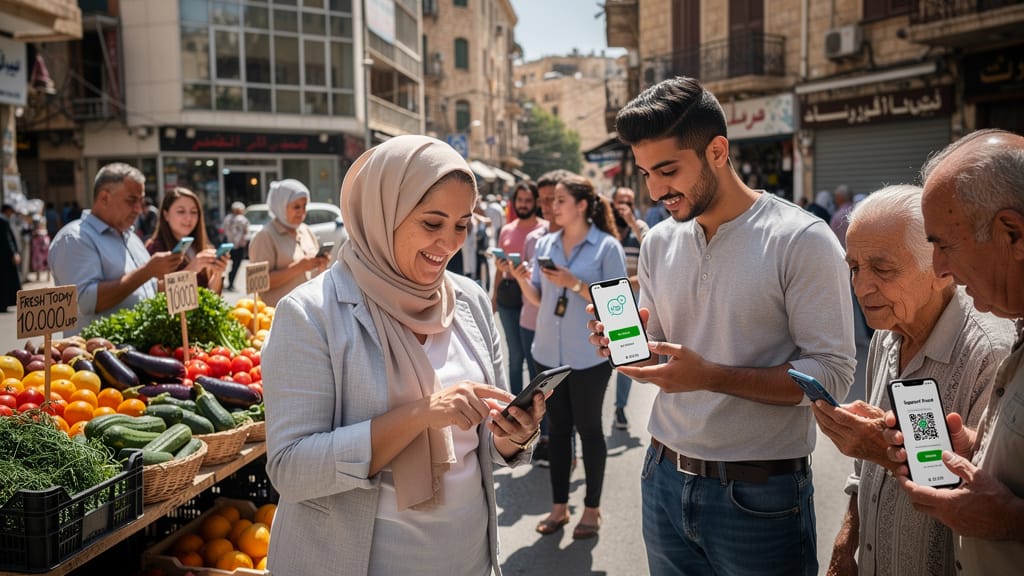
A New Front Line for Digital Finance
In Lebanon, a brutal escalation of conflict has uprooted daily life at staggering speed. Since March, Israeli strikes on Beirut and the occupation of southern Lebanon have displaced over 1 million people, pushing families into public parks, school buildings, sports stadiums, cars, and improvised camps. According to the International Organization for Migration, more than 130,000 people have also crossed into Syria, often with no more than the clothes they are wearing and a phone in their pocket.
In this environment of mass displacement and eroding trust in public institutions, a quiet but profound shift is taking place in how help moves. Instead of relying mainly on large charities or bank-based transfers, more and more assistance arrives through digital wallets and other fintech tools. Relatives and friends abroad, along with wider diaspora communities, are sending money straight to individuals and small networks on the ground, who convert it into food, rent, medicine, and cash handouts.
Lebanon has become a live test case for what happens when a country in crisis leans heavily on mobile financial tools for survival.
Why Digital Wallets Are Becoming Lifelines
Lebanon already depended heavily on external money before the current escalation. The country receives an estimated 6 to 7 billion US dollars in remittances each year from citizens and expatriates abroad. In the absence of a real time data feed on war related donations, those remittance flows are one of the best indicators of how much private aid is now moving into the country.
Several overlapping pressures are pushing people toward digital solutions:
- Institutional mistrust: Years of financial turmoil and political paralysis have hollowed out confidence in banks and state systems. When people abroad do not trust local institutions, they look for ways to bypass them.
- Speed and flexibility: Digital wallets can receive funds within minutes. Families that are moving from shelter to shelter can still access help through a phone account, even if they cannot safely reach a bank branch.
- Direct targeting: Diaspora senders can route money to specific relatives or to trusted coordinators in a neighborhood or camp. Those local actors then purchase food, pay rent, or distribute cash inside their communities.
In practical terms, a cousin in Europe or the Gulf might open an app, select a recipient in Beirut, and send a modest amount that covers a week of groceries. Multiply that simple interaction by hundreds of thousands of people, and digital payments start to rival or even eclipse traditional aid channels in their impact.
The Rise of Peer Networks as Aid Channels
One of the most striking developments is the emergence of informal digital aid networks. Instead of sending money to a large nonprofit, many donors now move funds to individuals they know, or to volunteers they follow on social media, who document local needs.
In Lebanon this can look like:
- A volunteer using a digital wallet to receive small donations from dozens of diaspora contacts, then buying bulk food to distribute at a school turned shelter
- A landlord accepting wallet payments from relatives abroad on behalf of displaced tenants, which keeps families in temporary housing
- Community organizers in the occupied south acting as micro treasurers, using their phones as a hub for incoming support and local spending
Digital wallets effectively turn these people into micro financial hubs. They become both recipients and distributors of aid.
This model is particularly attractive in a fragmented crisis landscape. With displacement spread across homes, public spaces, and informal shelters, there is no single camp system where aid can be centrally coordinated. Grassroots digital networks fill some of that gap, connecting money from abroad with dispersed households inside the country.
Advantages and Frictions in a War Zone
The Lebanese experience highlights both the strengths and the limits of digital approaches in emergencies.
Key advantages include:
- Reach into unstable areas: Where physical access is risky or blocked, money can still cross borders digitally.
- Lower overhead on small transfers: Traditional remittance services often charge significant fees, especially on low value payments. Some wallet based platforms can be cheaper for modest amounts.
- User control: Recipients can prioritize their most urgent needs, instead of receiving only in kind aid like food parcels.
At the same time, several structural challenges remain:
- Connectivity dependence: Digital wallets require at least intermittent mobile or internet access. Shelling, power outages, or damaged infrastructure can cut people off from their funds at exactly the wrong moment.
- Regulatory and banking constraints: Many platforms ultimately sit on top of formal financial rails. In a country facing capital controls or sanctions risk, cashing out or sending money in and out can be complicated.
- Security and fraud risks: When informal networks handle large flows of money, there is a real risk of scams, theft, or simple mismanagement. Without robust oversight, it is difficult to know where every dollar goes.
Despite these frictions, the scale of displacement and the speed of need in Lebanon have made digital wallets less a convenience and more a necessity.
A Broader Context of Global Instability
The story in Lebanon is unfolding against a wider backdrop of regional conflict and economic volatility. As noted in a recent MIT Technology Review newsletter, the ongoing war in Iran is already pushing fossil fuel prices higher, which could ripple into petrochemical and plastic supply chains. Rising energy and materials costs strain humanitarian operations worldwide, from transporting food to sourcing basic supplies for camps.
At the same time, global capital markets remain focused on high profile technology stories, like SpaceX moving toward a blockbuster initial public offering, potentially at a 1.75 trillion dollar valuation. While investors debate the fortunes of a private space company and governments fund new lunar missions, millions of people rely on basic mobile finance tools for daily survival.
That contrast underlines a key point. Some of the most transformative uses of technology are not headline grabbing rockets or futuristic materials, but the quiet spread of relatively simple financial apps into crisis hit communities.
What Lebanon’s Experience Signals for the Future of Aid
Lebanon offers a glimpse of how financial aid might evolve in other crisis zones.
If displacement continues to grow worldwide, and if trust in institutions keeps eroding in fragile states, we can expect:
- Greater reliance on diaspora and peer to peer transfers, with remittances blending more explicitly into the humanitarian landscape
- Hybrid models of aid, where large organizations work alongside, or even plug into, local digital wallet networks rather than trying to replace them
- Increased scrutiny of fintech platforms, including their fees, data practices, and contingency plans for operating in conflict areas
For policymakers and aid groups, the Lebanese case raises a practical question. Instead of treating digital wallets as an informal, marginal channel, should they be integrated more directly into crisis planning? That might mean negotiating with providers to lower fees on humanitarian transfers, building training for at risk communities on safe wallet use, or developing oversight mechanisms that respect local autonomy but still track outcomes.
For people on the move in Lebanon, these debates are abstract. What matters today is whether a phone ping from abroad translates into rent for one more week under a real roof, or into a bag of groceries that sees a family through to tomorrow. Digital wallets are making that possible at unprecedented scale, and in doing so, they are quietly reshaping the architecture of financial aid.
Sources
About the Author