

A New Chapter in Human Spaceflight
Artemis II is more than a return trip around the Moon. It is the critical bridge between the uncrewed Artemis I test flight and the first lunar landing of the modern era, Artemis III. This mission will send four astronauts farther from Earth than any humans have ever traveled, looping past the Moon to a distance of about 10,300 kilometers beyond the lunar surface.
That trajectory is not just a dramatic stunt. It is a carefully sculpted path that must keep the crew safe, test every major system of the Orion spacecraft, and prepare for a sustained human presence in deep space.
As Artemis II heads toward launch, it is capturing attention far beyond the usual space enthusiast circles. Progress on the mission intersects with big themes, such as geopolitical competition in space, the rise of commercial launch providers like SpaceX, and the long term goal of reaching Mars.
Why Artemis II Matters Right Now
The Artemis program is NASA’s flagship human spaceflight initiative for the coming decades. Artemis II is the first time astronauts will ride the Space Launch System (SLS) and the Orion capsule together, so it is the program’s make or break human test.
This mission is trending for several reasons:
- It pushes human travel to record distances from Earth
- It stress tests complex trajectory design and life support systems
- It is the main precursor to putting humans back on the lunar surface
- It unfolds in parallel with the explosive growth of SpaceX and commercial space
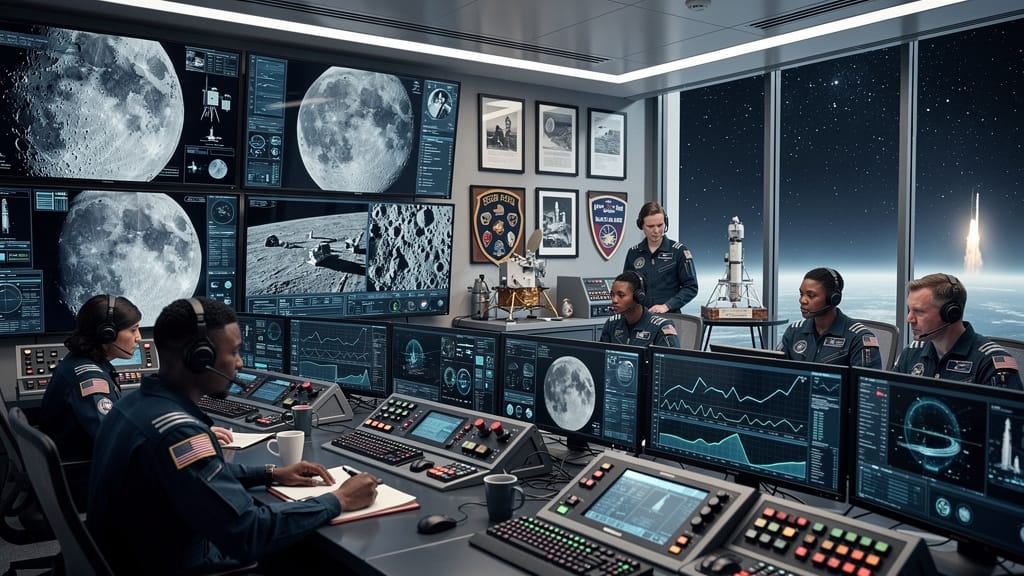
Artemis II is not intended to land on the Moon. Instead, it focuses on crewed operations in deep space, verifying that Orion can keep astronauts alive, healthy, and safe for a multi day mission far beyond low Earth orbit.
The Trajectory: A Deep Space Ballet
Designing the Artemis II trajectory is a feat of orbital engineering. The crew will not simply circle the Moon in a tight loop. Instead, the flight plan sends them into a large, sweeping path that carries Orion past the far side of the Moon, then out even farther before gravity and propulsion guide them back toward Earth.
Key design goals shape this route:
- Safety margins: The path must provide multiple options for abort and return in case of serious malfunction.
- Radiation exposure: The trajectory is tuned to limit time in the harshest regions of Earth’s radiation belts while still achieving deep space objectives.
- System testing: Engineers need a profile that challenges propulsion, navigation, power, communication, and life support, without exposing the crew to unreasonable risk.
- Record distance: Going beyond the Moon by roughly 10,300 kilometers lets NASA validate Orion in a regime that is representative of future Mars-bound operations.
The mission uses a free return component, a classic concept from Apollo. In a free return path, if the spacecraft loses propulsion capability at a critical phase, gravity alone can still swing it around the Moon and send it back toward Earth. Modern trajectory design improves on this with targeted maneuvers, but the underlying philosophy is the same: build in passive safety when possible.
What Needs To Go Right
From a technical standpoint, Artemis II is a massive integrated test. Almost every part of NASA’s modern human spaceflight stack is involved.
Some of the key systems and challenges include:
- Space Launch System (SLS): This is NASA’s heavy lift rocket that carries Orion into space. It must perform at full power while meeting strict structural and vibration constraints that protect the crew.
- Orion spacecraft: Life support, navigation, radiation protection, and thermal control all have to function for the entire mission. Artemis II will be the first time these systems operate together with people on board for a deep space journey.
- Service module propulsion: Orion’s European built service module provides the main engine burns for trajectory corrections and the crucial lunar flyby sequence. Any underperformance would complicate the return path.
- Communications and tracking: The spacecraft will travel far beyond typical satellite orbits. NASA’s Deep Space Network must maintain reliable links for navigation, telemetry, and communication with the crew.
- Crew operations: The astronauts must validate procedures for manual control, emergency protocols, and routine tasks like sleeping, exercising, and managing consumables in deep space conditions.
If all goes well, Artemis II will end with a high speed reentry into Earth’s atmosphere and splashdown, another major test. Orion must withstand extreme heating and deceleration after returning from lunar distance, which is significantly more intense than reentry from low Earth orbit.
Learning From Artemis I, Building Toward Artemis III
Artemis II builds directly on the lessons of Artemis I, which flew uncrewed around the Moon and validated many aspects of the hardware. Engineers have spent months analyzing sensor data, assessing performance margins, and updating models.
Key learnings that shape Artemis II include:
- Refinements to Orion’s heat shield modeling and thermal protection
- Updates to software that manages guidance, navigation, and flight operations
- Adjustments to the trajectory to improve fuel margins and abort options
- Better understanding of communication performance in different deep space geometries
Artemis II becomes a stepping stone for Artemis III, which intends to place astronauts on the lunar surface near the south pole. That landing will depend heavily on data from Artemis II about Orion’s performance, human factors in deep space, and the readiness of mission control to support complex lunar operations.
The Commercial Context: NASA, SpaceX, and the New Space Race
While NASA leads Artemis, the mission unfolds within a much broader ecosystem shaped by commercial space companies. SpaceX, in particular, is deeply intertwined with Artemis even though it does not launch Artemis II.
SpaceX is developing the Starship Human Landing System that is slated to ferry astronauts from lunar orbit down to the surface for Artemis III. At the same time, the company is moving toward a potential public offering and could reach a valuation so large that analysts speculate about Elon Musk becoming the world’s first trillionaire.
This context affects Artemis II in several ways:
- Public attention is divided between government programs like Artemis and commercial ventures that move very quickly.
- NASA leans on industry partners, including SpaceX, for key mission elements, which ties the program to commercial timelines and risks.
- Success of Artemis II could strengthen NASA’s position as an anchor customer for advanced commercial systems in cislunar space.
The result is a hybrid model of exploration. Government missions conduct high profile, safety critical flights like Artemis II, while commercial providers fill in infrastructure and eventually offer independent services in Earth Moon space.
What Success Would Mean
If Artemis II completes its mission objectives, it will:
- Prove that SLS and Orion can safely carry astronauts to lunar distance and back
- Validate life support and operations for multi day deep space missions
- Build confidence for Artemis III and later long duration lunar activities
- Demonstrate international collaboration, particularly through Orion’s European service module
- Reinforce the role of crewed exploration in a rapidly changing, commercially driven space economy
Beyond the technical achievements, Artemis II has symbolic weight. It represents a renewed global commitment to exploration beyond low Earth orbit, not as a brief race but as the start of a long term presence beyond our home planet.
The Road From the Moon to Mars
NASA repeatedly stresses that Artemis is not a dead end lunar program. It is intended as a proving ground for Mars. Long distance trajectories like the one used on Artemis II, deep space radiation exposure, and autonomous operations far from Earth are all directly relevant to eventual Martian expeditions.
The technology stack tested by Artemis II, from propulsion to navigation and life support, will inform designs for vehicles that must support crews for months at a time. In that sense, each carefully choreographed maneuver around the Moon is also a rehearsal for the day when astronauts leave Earth’s neighborhood entirely.
As Artemis II advances, the mission is trending because it offers a rare combination of concrete hardware, clear near term milestones, and a vivid long term vision. It is one of the few current projects that can plausibly connect today’s rockets to tomorrow’s footsteps on another world.
Sources
About the Author