
AI in mental health is no longer a fringe experiment. It is quietly becoming part of how people check in on their mood, journal through stress, and even decide whether they need real clinical help.
Quick Summary
- AI in mental health is moving from novelty to everyday utility, especially through phones, search tools, and wellness apps.
- Google and Google Gemini are helping normalize AI-assisted support, but the biggest lesson is that convenience is not the same thing as care.
- The rise of AI summaries and AI interfaces matters because people increasingly expect answers instantly, including answers about anxiety, burnout, and depression.
- AI mental health apps and the mental health AI chat model can reduce friction for people who might otherwise seek no support at all.
- The risk is obvious and serious: an AI mental health chatbot can sound empathetic without truly understanding crisis, trauma, or context.
- The future of AI for mental health will likely be hybrid, useful for screening, journaling, education, and follow-up, but not a substitute for human clinicians.
What Happened With Google and AI in Mental Health
Recent product moves from Google show how AI is sliding into intimate parts of daily life. On the surface, some of these features look small, such as tools that generate captions or help organize information. But the larger story is not about captions or search polish. It is about habit formation.
As AI becomes the interface through which people ask questions, summarize thoughts, and interpret their own behavior, ai in mental health stops being a niche healthcare conversation and becomes a consumer technology story. That shift matters because mental health support often begins with tiny moments, a late-night search, a journal entry, a question no one wants to ask out loud.
Digital Trends focused on Google’s mental health-oriented AI features and landed on the right instinct: helpful, yes, but not enough alone. That is the real turning point. Consumers are being trained to treat AI as a first stop for emotional support, while the tech itself is still better at pattern recognition than judgment.
Key Details on AI for Mental Health and the New AI Interface
The most important thread across the sources is not just healthcare. It is how AI changes access to information.
The BBC’s reporting on AI search highlights a major shift: people are increasingly getting direct answers from AI instead of clicking through websites. Translate that into emotional well-being, and the implication is huge. Someone who once searched symptoms, therapy options, or coping strategies across multiple sites may now ask one conversational system for a distilled response.
That sounds efficient. It is also risky.
Why ai in mental health feels more natural now
The reason ai in mental health is trending now is simple. The interface has improved. AI is no longer trapped in clunky bots that feel robotic after two messages. Tools like Google Gemini are making AI interactions feel smoother, more contextual, and more personal.
At the same time, products are being designed to remove friction everywhere else. TechCrunch’s report on Google Maps using AI to write captions may seem unrelated at first glance, but it reveals the broader design philosophy: AI should step in before the user even asks, shaping how people express themselves. In mental health contexts, that could mean suggesting reflections, surfacing coping prompts, or drafting summaries of mood logs.
That is where ai for mental health gets interesting. The power is not only in answering questions. It is in scaffolding behavior.
The current limits of ai mental health apps
Even the best ai mental health apps still struggle with ambiguity, irony, self-deception, and crisis language. A human therapist notices pacing, contradiction, body language, family dynamics, and silence. An ai mental health app mostly sees text, maybe voice tone, and whatever the user chooses to disclose.
This is why the strongest use case today is narrower than the hype suggests. AI works best as a support layer, not a replacement layer. Think mood tracking, journaling prompts, psychoeducation, habit reminders, post-session reflection, and triage guidance. Once stakes rise, human care has to take over.
What AI in Mental Health Means for You Right Now
If you are a user, the upside is obvious. AI in mental health can make support feel immediate, private, and low-pressure. That matters for people who are intimidated by therapy, live in care deserts, or cannot afford frequent appointments.
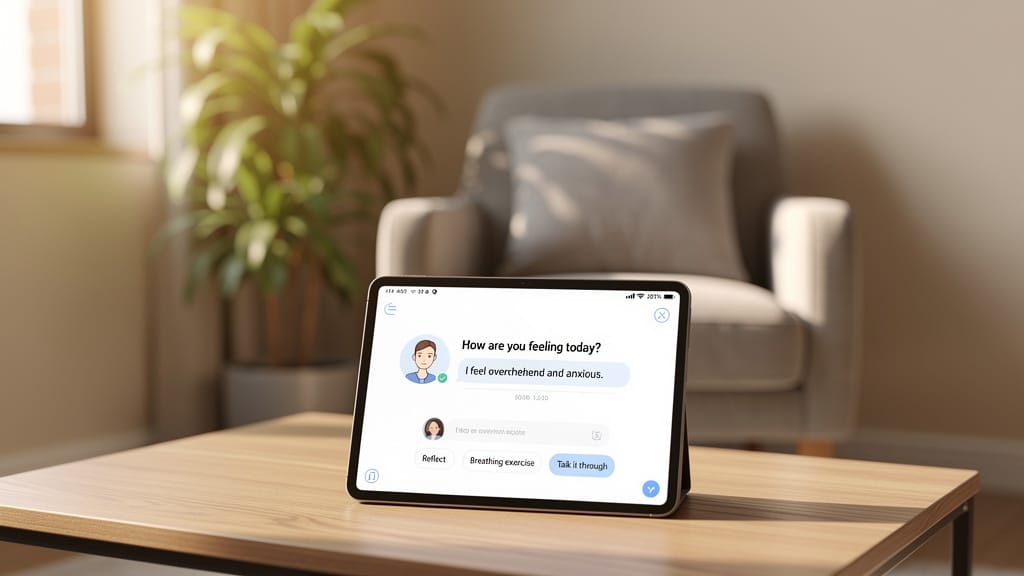
For some users, a mental health AI chat tool may be the first time they have ever described their anxiety in full sentences. That is not trivial. Friction is one of the biggest barriers in mental healthcare.
Where ai in mental health genuinely helps
There are several practical wins already:
- Daily check-ins that notice mood patterns over time
- Gentle prompts for breathing, sleep hygiene, and journaling
- Fast explanations of therapy concepts like CBT or grounding
- Reminders to follow through on routines that support recovery
- A nonjudgmental space to articulate stress before talking to a person
For people navigating work stress, this is especially relevant. Anxiety around layoffs, career instability, and economic uncertainty has become a mental health issue in its own right. We have already seen how AI reshapes professional life in pieces like AI and the Job Market: Disruption and New Rules and AI-Driven Job Market Changes: Chaos, Anxiety, and New Opportunity. That pressure feeds directly into the demand for accessible emotional support tools.
Where the danger starts
The trouble begins when convenience creates false confidence.
An ai mental health chatbot may respond with calm, polished language that feels deeply reassuring, even when it is subtly wrong. It might fail to detect suicidal intent hidden in sarcasm. It might overstate what mindfulness can fix. It might flatten grief, trauma, bipolar symptoms, or psychosis into generic wellness advice.
That is the central consumer risk in ai for mental health. The better the interface sounds, the easier it becomes to mistake simulation for expertise.
What Others Missed About Google, Search, and Mental Health AI Chat
Most coverage treats mental health AI as a health-tech story. It is bigger than that. It is also a search story, an interface story, and a trust story.
When AI becomes the default layer between you and information, companies gain unusual influence over vulnerable moments. They are not just indexing mental health resources. They are shaping the first response a person receives when distressed.
The business logic behind ai in mental health
Why are companies so interested in this space? Because emotional support is sticky. Users return often, create high-frequency engagement, and generate rich behavioral signals. A person who uses an AI assistant for check-ins, journaling, and life organization is not just using a feature. They are building dependence.
That does not mean the intent is malicious. It means incentives matter.
A company improving AI-generated captions in Maps, refining AI search answers, and experimenting with wellness features is building the same muscle over and over: becoming the system that interprets your life for you. In mental health, that becomes especially sensitive.
The hidden future consequence
The next phase of ai in mental health probably will not look like one standalone chatbot. It will show up as an ecosystem. Your phone may infer stress from sleep disruption, calendar overload, location patterns, and language use. Your assistant may suggest a break, summarize your week emotionally, or recommend content that sounds therapeutic.
Some of that will be genuinely useful. Some of it will feel invasive. The line between support and surveillance is thinner than most product demos admit.
Real Examples of AI Mental Health Apps in Everyday Life
A student dealing with panic before exams might use an ai mental health app to track sleep, note triggers, and get breathing exercises before a test. That is a legitimate, practical benefit.
A remote worker spiraling from burnout could use a mental health AI chat tool to organize racing thoughts before deciding whether to seek therapy. In that case, AI acts like a bridge, not an endpoint.
A parent with no time for appointments might rely on short evening check-ins from an ai mental health chatbot to identify mood deterioration over several weeks. If the app then nudges that person toward a clinician, it has done something valuable.
But now flip those examples.
That same student might describe self-harm in coded language the bot misses. That burned-out worker might get generic productivity advice instead of help recognizing depression. That parent might trust a polished app too much and delay medical care. This is why ai mental health apps should be judged less by how comforting they sound, and more by how safely they escalate serious cases.
Pros and Cons of AI in Mental Health
Pros
- Expands access for people who avoid or lack traditional care
- Offers immediate, low-cost support at any hour
- Helps with journaling, education, habit tracking, and reflection
- Reduces stigma for first-time help seekers
- Can support clinicians with summaries and between-session continuity
Cons
- Can miss crisis signals or serious psychiatric symptoms
- May create emotional overreliance on a non-human system
- Often lacks context, nuance, and true clinical judgment
- Raises privacy concerns around deeply sensitive personal data
- Risks replacing care in systems already short on human providers
Conclusion on AI in Mental Health
AI in mental health is promising precisely because it makes support easier to reach. But easy access is not the same thing as safe care, and polished empathy is not the same thing as expertise.
Expect ai in mental health to become a standard layer in phones, apps, and search over the next few years. The winners will not be the tools that talk the most like therapists, they will be the ones that know when to stop pretending and send you to a real one.
Sources
About the Author