

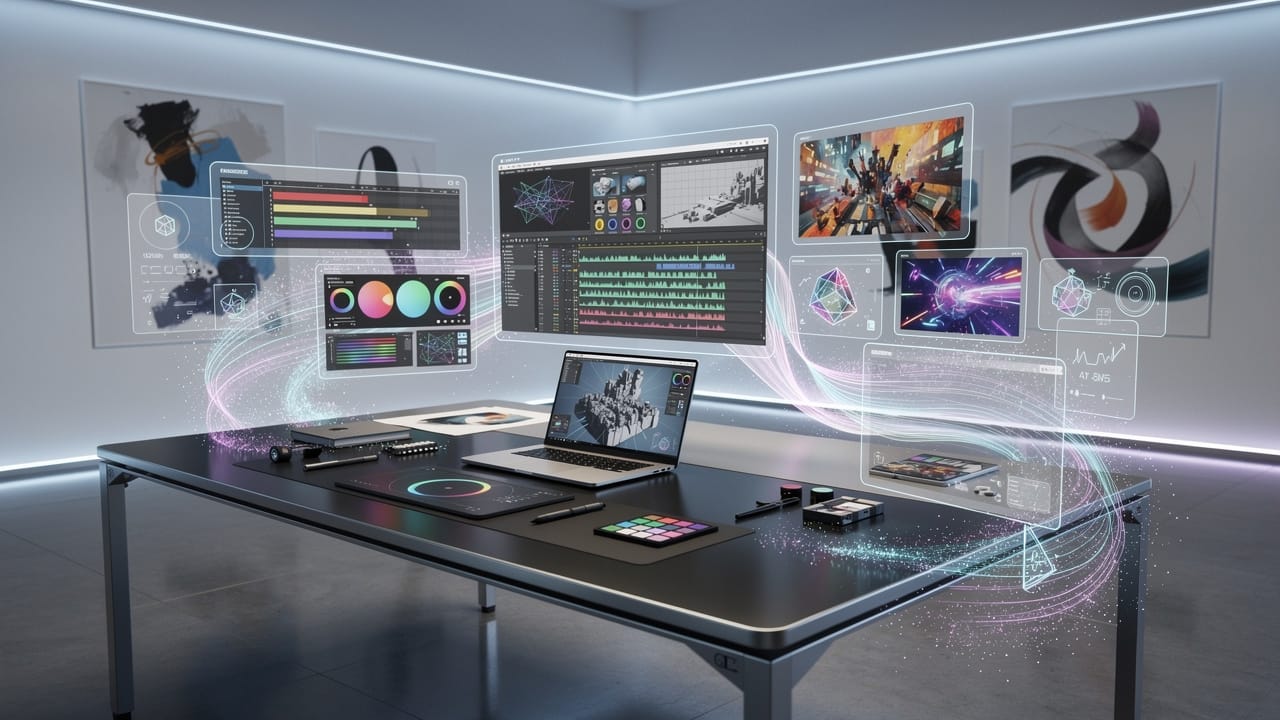
The biggest lie in the current AI boom is that it exists to “unlock creativity.” In practice, ai in creative industries is becoming a fight over speed, trust, labor, and who gets to decide what counts as original work.
Quick Summary
- AI in creative industries is moving from experimental novelty to operational necessity, especially in gaming, media, and marketing.
- The pressure is economic as much as artistic, with cited production costs reaching $1 million per minute for a major Hollywood film and audiences consuming up to 12 hours of video a day across devices.
- Companies like Adobe are pushing AI as a way to scale branded content without losing consistency, but that raises bigger questions about authorship and trust.
- In games, the reveal of Unreal Engine 6 through a refreshed Rocket League points to a future where AI-assisted pipelines can speed visual upgrades, live-service content, and asset iteration.
- The darker side of ai in the media and creative industries is emotional manipulation and synthetic intimacy, highlighted by ongoing scandals around romantic AI bots.
- The real winners will be teams that use AI to amplify skilled human work, not replace it blindly. The losers will be companies that automate first and ask ethical questions later.
What Happened With AI in Creative Industries and Game Development
This week’s conversation around ai in creative industries sharpened from multiple angles at once. One thread came from MIT Technology Review’s look at large-scale content production, which argued that the basic economics of modern media now favor AI-assisted workflows. Audiences are consuming huge amounts of content, budgets are stretched, and every brand increasingly behaves like a publisher.
Another thread came from gaming. IGN’s coverage of Rocket League running in Unreal Engine 6 was not framed as an AI story on its face, but the implications are obvious. New engines are no longer just rendering upgrades. They are becoming production systems built for faster iteration, procedural assistance, and integrated machine learning tools that can help studios create more content with smaller teams.
Then there is the warning sign that too many executives still treat as a side issue. Digital Trends highlighted another disturbing case involving romantic AI bots, a reminder that scaling synthetic content is not automatically the same thing as building healthy digital experiences. AI in the creative industries is not only about making things faster, it is about what happens when machines become persuasive performers.
Key Details on AI in the Media and Creative Industries
MIT’s core argument is blunt: content demand has exploded, but time and money have not. The article cites people consuming as much as 12 hours of video daily, often across multiple platforms and devices. At the same time, a big-budget Hollywood production can reportedly start around $150 million, with costs around $1 million per finished minute. Prestige streaming may be cheaper, but still runs in the hundreds of thousands per minute.
That math matters. It explains why executives now treat ai in creative industries less like a research lab curiosity and more like infrastructure.
Why the economic case is getting hard to ignore
If every company has to produce tutorials, ads, social clips, product visuals, translated variants, and personalized campaigns, then human-only production pipelines start to look slow and expensive. This is where companies like OpenAI and Adobe have found their opening. They are not only selling image or text generation. They are selling throughput.
That helps explain a broader shift in ai in the media and creative industries. The product is no longer just “make a picture” or “write a caption.” The product is brand consistency at scale.
Gaming fits neatly into this story. IGN’s report on Rocket League in Unreal Engine 6 focused on visuals, but the more important subtext is pipeline modernization. A new engine means new ways to generate environments, optimize assets, test variants, and potentially integrate AI support into live content creation. Today that may look like a cleaner stadium, sharper lighting, or a refreshed logo. Tomorrow it could mean seasonal content produced faster and cheaper.
Trust is becoming the real bottleneck
MIT’s reporting also pointed to a crucial reality: AI amplifies what is already there. If a team has a weak creative strategy, AI can mass-produce weak content faster. If brand rules are messy, AI can multiply inconsistency. That is the part many executives skip when they talk about the benefits of ai in creative industries.
The real advantage is not infinite output. It is controlled output.
That distinction is why conversations around provenance, approvals, and training data are becoming central. It is also why this topic keeps surfacing at events and boardrooms, and why an ai in creative industries summit would likely spend as much time on governance as on flashy demos.
What AI in Creative Industries Means for You
If you work in game development, film, design, publishing, or marketing, this shift is personal. AI will probably not replace the best creative professionals outright. It will, however, change what employers expect one person to produce in a day.
More output, same headcount, higher expectations
For artists and writers, the most immediate change is not disappearance. It is compression. Teams will be asked to produce more versions, more faster, and more cheaply. Storyboards, concept passes, marketing copy, UI mockups, and promo assets are all obvious targets.
That can be useful. It can also be brutal.
The benefits of ai in creative industries are real when AI removes repetitive work, speeds up rough ideation, or helps small teams punch above their weight. But the downside is just as real when management uses those gains to squeeze labor instead of improving creative quality. We already explored part of that labor tension in this look at how AI’s impact on industries is becoming a workforce shake-up.
For players and audiences, the effects will show up differently. Games may get refreshed more often. Live-service titles may ship more cosmetics, events, or localized materials. Marketing will feel more tailored. But consumers may also get buried under synthetic sludge: more content, less point of view.
What potential benefits does generative AI offer in creative industries?
The strongest use cases are practical, not magical:
- faster previsualization
- multilingual adaptation
- rapid asset variations
- on-brand campaign production
- support for smaller studios that cannot afford giant art or marketing departments
A tool like ChatGPT becomes valuable in that context not because it “creates genius,” but because it reduces friction between idea, draft, revision, and delivery.
Still, there is a line between assistance and dilution. If every studio uses similar generative tools trained on similar material, then a lot of output starts to look suspiciously alike. That sameness is one of the most underappreciated risks in ai in creative industries.
What Others Missed About AI in Creative Industries
Most coverage still treats AI creativity as a culture-war argument: humans versus machines, artists versus executives, innovation versus theft. That framing is too shallow.
The real battle is over systems, not prompts
The real power shift is in workflow design. Whoever controls the toolchain controls the pace of production, the approval gates, the metadata, and the economic leverage. That is why this moment matters so much for games. Engines, asset managers, collaboration suites, and generative assistants are merging into one stack.
Unreal Engine 6 matters here less as a flashy reveal than as a symbol. The future of creative work will be shaped by integrated platforms, not isolated AI tricks. A game studio that can generate variations, test performance, localize assets, and ship content inside a unified environment will beat a studio that still treats every step as a manual handoff.
Another blind spot is emotional risk. Digital Trends’ story about romantic AI bots is extreme, but not irrelevant. When synthetic systems become more conversational, more personalized, and more expressive, the question is no longer whether they can make content. It is whether they can manipulate attachment. That matters in entertainment too, especially in games built around companions, NPCs, or parasocial live-service ecosystems.
We touched on the backlash dimension in our earlier piece on Roblox and why AI in gaming is hitting a nerve. Players do not only care whether AI is efficient. They care whether it feels cheap, deceptive, or disrespectful to the humans behind the work.
Real Examples of AI in Creative Industries Right Now
In game development, AI can already help teams generate placeholder dialogue, early quest drafts, texture variants, marketing copy, and moderation tools. That does not mean fully AI-made games are about to dominate. It means studios can prototype faster and polish selectively.
In media and advertising, the near-term use case is even clearer. A global brand might need one campaign adapted into 20 formats, 12 languages, and several visual styles. Human teams still set direction, but AI can accelerate adaptation and compliance.
For individual creators, ai in the creative industries looks less glamorous and more everyday. It is editing rough cuts faster. It is searching huge libraries by description. It is using ChatGPT to draft alternate headlines, rewrite scripts for different platforms, or pressure-test a pitch before sending it to a client.
The danger is obvious too. If the industry normalizes machine-generated first drafts everywhere, clients may start paying less for the judgment that makes those drafts worth using.
Pros and Cons of AI in the Creative Industries
Pros
- Speeds up repetitive production tasks
- Helps smaller teams compete with larger studios
- Makes localization and content variation cheaper
- Can improve workflow efficiency across games, media, and marketing
- Supports faster experimentation before expensive final production
Cons
- Risks homogenized output and weaker originality
- Can intensify labor pressure instead of reducing it
- Raises trust issues around authorship, consent, and training data
- Makes manipulation easier in emotionally driven products
- Encourages executives to value volume over vision
Conclusion on AI in Creative Industries
AI in creative industries is not a side tool anymore. It is becoming the operating system for how modern content gets made, approved, shipped, and monetized.
That does not mean human creativity is dead. It means taste, trust, and direction are becoming more valuable precisely because cheap output is everywhere.
What Happens Next (2026-2030)
Between now and 2030, the companies that win will be the ones that combine AI speed with strong human editorial control. Mid-size game studios and creative agencies could benefit most if they use AI to close the gap with giants, but only if they protect quality and avoid obvious automation slop. Workers who can direct systems, refine outputs, and defend a clear creative point of view will stay valuable. Everyone else faces a harsher market where “doing more with less” stops being a slogan and becomes the job description.
Sources
About the Author