
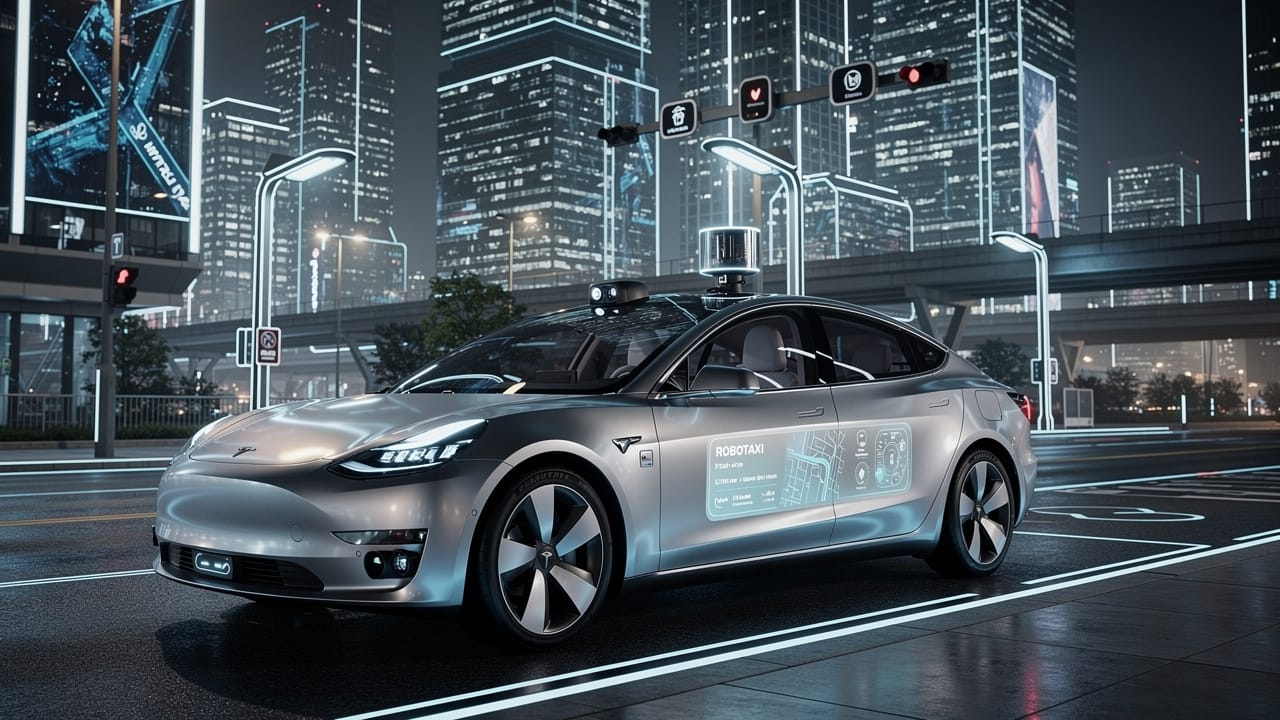
Tesla robotaxi technology is being judged against a brutal standard that no marketing event can beat: floodwater, construction cones, and the split-second decision to do nothing. That is why the latest setbacks in robotaxis matter more than another glossy demo, because the companies closest to commercial success are now running into the messy parts of the real world.
Quick Summary
- Tesla robotaxi technology is trending because the entire robotaxi market is entering a harder phase, moving from demos and limited launches into public scrutiny over safety and reliability.
- Waymo has temporarily paused service in multiple cities after some vehicles struggled with flooded roads, a problem serious enough to trigger a recall tied to a San Antonio incident on April 20.
- The company also halted robotaxi freeway operations in several major markets while it improves behavior around construction zones, another reminder that edge cases are still the business.
- Nuro is making the opposite bet, arguing that being a second mover in robotaxis could be an advantage because it can learn from other companies’ expensive mistakes.
- For riders, regulators, and investors, the takeaway is simple: autonomous driving is no longer a pure technology story. It is now an operations, liability, and trust story.
- The winners in the next phase will not be the companies with the boldest launch claims, but the ones that know when their vehicles should slow down, pull over, or stay home.
What Happened to robotaxis as Tesla robotaxi technology grabs headlines
The latest robotaxi news did not come from a breakthrough. It came from a pause.
Waymo temporarily stopped robotaxi operations in several US cities after vehicles had trouble identifying when flooded roads were too dangerous to enter. According to reporting from the BBC and TechCrunch, the pause initially affected Atlanta and four Texas cities, and then widened. One incident in San Antonio on April 20 involved an empty vehicle that entered floodwater and was swept into a creek, serious enough to help prompt a recall.
At nearly the same time, the company also suspended robotaxi use on freeways in places including San Francisco, Los Angeles, Phoenix, and Miami while it worked on performance issues in construction zones. In other words, robotaxis are simultaneously becoming more visible and more conditional. That tension is exactly why Tesla robotaxi technology is under the microscope too, even when the headlines mention a rival.
Key Details on Tesla robotaxi technology and the broader autonomous vehicle race
The most important fact here is not that robotaxis failed. It is where they failed.
The hard problem is not driving, it is judgment
Robotaxis can look impressive in ideal conditions. They can handle lane keeping, turns, and mapped routes well enough to convince many riders that the future has already arrived. But the current setbacks point to a tougher issue: situational judgment under uncertainty.
Flooded roads are a perfect example. A human driver may still make a bad choice, but humans also know that standing water can hide a washed-out lane, a curb, or a current strong enough to move a car. An autonomous system must infer all of that from sensors, software rules, and probabilistic models. If it gets the confidence threshold wrong, the car moves when it should not.
Construction zones pose a different version of the same problem. Temporary lane markings, cones, worker movements, and unusual traffic patterns often break the assumptions that self-driving systems prefer. TechCrunch reported that Waymo paused freeway operations in four major metro markets to improve performance there. That is not a minor tweak. It is an admission that some of the most lucrative, scalable routes still need tighter control.
Why the Nuro “second mover” argument matters
The Verge’s interview with Nuro adds a revealing counterpoint. Nuro believes coming later can be an advantage because first movers spend heavily to discover where the real landmines are, technically, commercially, and regulatorily.
That is a sharper argument than it sounds. In autonomous driving, the first company to launch does not just get data. It also inherits public backlash, legal exposure, local political fights, and the cost of retraining the public after every high-profile mistake. A second mover can study all of that and design around it.
This is where Tesla robotaxi technology becomes a bigger story than any one launch window. Tesla is not entering a blank market. It is entering a market where rivals have already shown that scale alone does not solve weather, infrastructure chaos, or public trust.
What Tesla robotaxi technology means for riders, regulators, and investors
For regular people, the robotaxi debate is becoming much less theoretical.
If you want to ride one
If you live in a city with robotaxi service, availability may increasingly depend on conditions, not just geography. Heavy rain, flooding risk, freeway travel, and major construction could all become reasons for reduced service or route restrictions. That makes the product safer, but also less magical than the pitch.
Consumers should expect robotaxis to behave more like airlines than elevators. They will not simply be “on” everywhere all the time. They will operate inside carefully managed envelopes, and those envelopes may expand slowly.
That matters for Tesla robotaxi technology because Tesla’s public image has long leaned on the idea that software can move fast and improve quickly. In transportation, however, every improvement has to survive real streets, public records, insurance questions, and city oversight.
If you regulate or invest in the sector
Regulators are getting evidence that the real challenge is not whether a robotaxi can complete most trips. It is whether the system reliably recognizes the small percentage of trips it should refuse. That distinction will shape permitting, reporting requirements, and operational limits.
Investors should also pay attention to where costs move next. The expensive part may no longer be just AI research. It may be safety operations, remote assistance, weather restrictions, HD mapping upkeep, claims handling, and market-by-market compliance. That tracks with a broader point we made recently in The Real Challenges in AI Development Are No Longer Technical, They’re Economic, Ethical, and Human. Robotaxis are turning that abstract idea into a balance-sheet problem.
And yes, this also raises the stakes in Texas. Our earlier piece on Tesla Robotaxi service just got bigger in Texas, and that should make regulators nervous now looks less like a hot take and more like the obvious next debate.
What others missed about Waymo, Nuro, and Tesla robotaxi technology
A lot of coverage treats setbacks like this as embarrassing detours. That misses the deeper truth.
The product is not autonomy, it is constrained autonomy
The industry keeps selling a dream of universal capability, but the actual business is selective deployment. Companies are learning that profitable autonomy may come from operating very well in tightly managed zones, under specific conditions, with lots of fallback rules. That can still be a huge business. It is just a different business than the one many people imagined.
The existence of Waymo Robotaxi Service in public streets proves the category is real. Its pauses prove the category is still fragile. Those two facts are not contradictory. They are the market.
Why “second mover” could be smarter than “first everywhere”
Nuro’s position deserves more attention because it reflects a maturing industry. In the early phase, companies won headlines by promising scale. In the next phase, they may win by being choosy, slower, and operationally boring.
That sounds unimpressive until you remember what is at stake. A robotaxi company does not get judged like a typical app. It gets judged like transit, aviation, and product liability all at once. One stranded car in floodwater can undo months of confidence-building.
This is also where Tesla robotaxi technology faces an unusual burden. Tesla has enormous brand recognition and a loyal customer base, but it also carries a reputation for shipping ambition before the rest of the system is fully ready. In cars that people hail on public roads, that reputation cuts both ways.
Real Examples of how Tesla robotaxi technology affects everyday transportation
Imagine three normal scenarios.
First, an airport trip during a summer storm. If robotaxis cannot reliably judge pooled water on unfamiliar streets, service may be delayed, rerouted, or unavailable right when demand spikes.
Second, a downtown commute through roadwork. A human driver might negotiate around an unexpected cone pattern with hand signals from a worker. A robotaxi may need to disengage, avoid the area, or take a much longer route. For a rider, that means time lost and higher uncertainty.
Third, a freeway connection between suburbs and city centers. If freeway operation is restricted in key markets, the service can still exist, but it becomes less useful for many premium trips. That limits revenue upside and makes a fleet look more like a niche urban shuttle than a broad replacement for ride-hailing.
These examples explain why the Waymo Robotaxi Service is both impressive and incomplete. They also show why Tesla robotaxi technology will not be judged on launch-day excitement. It will be judged on whether it can handle ugly, ordinary days.
Pros and Cons of the current robotaxi push
Pros
- Robotaxis can reduce some forms of human error and provide consistent driving behavior in controlled conditions.
- They may improve mobility access in dense cities, especially where driver supply is inconsistent.
- Companies that learn disciplined deployment could build a durable transportation business over time.
Cons
- Weather and road anomalies remain a serious weakness.
- Service pauses can damage trust faster than launches build it.
- Regulatory scrutiny is likely to intensify, especially after visible failures.
- The economics may be tougher than expected once safety operations and restricted service areas are fully priced in.
Conclusion on Tesla robotaxi technology and the road ahead
The robotaxi story is no longer about whether autonomous vehicles can drive at all. It is about whether they can behave wisely when the world stops being neat. Tesla robotaxi technology may still become a major force, but the companies that survive this market will be the ones that master caution, not just capability.
What Happens Next (2026-2030)
From 2026 to 2030, the likely winners are companies that operate in limited zones with strict weather rules, strong remote support, and close regulator relationships. The losers will be firms that promise general autonomy but keep running into edge cases that are not really edge cases at city scale. Expect more expansion headlines, but also more quiet operational restrictions behind the scenes. The market will grow, but not as a universal robo-chauffeur revolution. It will grow as a patchwork service that works extremely well in some places, and disappoints in others.
Sources
About the Author