

The fight over AI in workplaces is no longer about whether employees will use smarter tools. It is becoming a much bigger argument about time, pay, power, and what a normal job should look like.
Quick Summary
- AI in workplaces is moving from software experiment to management strategy, with companies now debating shorter workweeks, job redesign, and productivity targets.
- OpenAI has floated the idea that firms should test four-day weeks as AI takes over more routine tasks.
- A key unanswered question is not just whether AI replaces work, but whether lower costs create enough new demand to generate new jobs.
- Sectors built around human interaction, including healthcare, education, and childcare, may become more important as AI handles more screen-based work.
- The real risk in AI in workplaces is not instant mass unemployment, but uneven gains, harder performance tracking, and pressure to do more in fewer hours.
- Evidence from places experimenting with workplace AI, including discussions around AI in Dutch workplaces and AI usage in Finnish workplaces, suggests adoption will vary sharply by culture, regulation, and trust.
What Happened With AI in Workplaces and the Four-Day Week Debate
AI in workplaces took a notable turn this week when OpenAI argued that employers should seriously consider trialing four-day workweeks as businesses adapt to more capable AI systems.
That matters because it shifts the conversation away from the usual extremes, panic about job loss on one side, breathless productivity promises on the other. Instead, the question becomes practical: if AI cuts the time needed to complete certain tasks, do workers get some of that time back, or do companies simply raise expectations?
At the same time, reporting highlighted a second, less flashy issue. Economists are increasingly focused on whether AI’s effect on jobs depends on a deceptively simple metric, how demand responds when AI makes services cheaper. If costs fall but demand barely rises, fewer workers may be needed. If cheaper services unleash much more demand, the labor picture changes dramatically.
Key Details on AI in Workplaces, Productivity, and Job Pressure
The first important detail is that the four-day week idea is not being pitched as a social perk alone. It is being framed as one possible adjustment to a world where AI compresses task time. That is a major distinction. It suggests some industry leaders now accept that generative AI in real world workplaces will not just assist employees, it will force companies to rethink how work is measured.
The economics behind AI in workplaces
A lot of bad coverage treats AI as a simple replacement machine. The more serious debate is about productivity redistribution. If one employee can produce in four hours what used to take eight, management has choices:
- keep hours the same and expect more output
- reduce staff
- shorten the workweek
- reassign workers to higher-touch tasks
- create entirely new services
That is where the economic idea of price elasticity becomes central. If AI makes legal research, coding assistance, customer support, marketing copy, or data analysis cheaper, do customers buy a little more, or much more? That answer will shape whether AI in workplaces creates a squeeze on white-collar roles or opens new layers of demand.
Why people-facing work may gain value
Another detail getting less attention is the renewed focus on human-centered sectors. As AI gets better at document-heavy, digital, repetitive work, jobs rooted in trust, care, and in-person judgment may become relatively more valuable. Childcare, teaching, nursing support, therapy, coaching, and frontline services could benefit, not because AI cannot touch them at all, but because people still want humans present when stakes are personal.
That argument aligns with what we have already explored in AI and the Job Market: Disruption and New Rules, where the biggest shift is not simply job destruction, but a rewriting of which kinds of labor command premium value.
What AI in Workplaces Means for You Right Now
For workers, the near-term impact of AI in workplaces will probably feel less like a robot takeover and more like a management reset. Your employer may not eliminate your job tomorrow. It may instead ask why the same role still needs 40 hours if AI can draft, summarize, classify, schedule, or troubleshoot part of the workload.
If you are an employee
Expect three changes first.
First, your job will be measured more granularly. AI tools generate usage data, turnaround times, revision rates, and output comparisons. That makes it easier for companies to benchmark workers in ways that were previously fuzzy.
Second, “AI fluency” becomes a workplace skill even outside technical jobs. The advantage will not only go to people who know how to prompt a chatbot. It will go to workers who know when not to trust it, how to edit it, and how to combine speed with judgment.
Third, the pressure to absorb extra work may rise before any benefit such as a shorter week arrives. That is the dirty little secret of workplace automation. Productivity gains often show up as stretched expectations long before they show up as better quality of life.
If you are a manager or business owner
This trend is a trap if handled badly. Leaders who deploy AI only to cut labor may get a short-term margin boost, but they also risk morale collapse, poorer service, and hidden error costs. Generative AI in real world workplaces Microsoft discussions have often centered on copilots and efficiency layers, but the harder challenge is organizational design, not software licensing.
The better question is: what should humans do once AI handles the low-value middle? Companies that answer that well can redesign roles around relationship-building, oversight, creativity, and faster customer response. Companies that answer it badly will just create digital Taylorism, with employees monitored more closely and trusted less.
Why geography matters more than people think
National work culture will shape the outcome. Conversations around AI in Dutch workplaces often intersect with strong labor protections and an established openness to flexible schedules. By contrast, AI usage in Finnish workplaces may be shaped by high digital readiness, public-sector modernization, and different norms around trust and workplace autonomy.
That means there will not be one AI future. There will be many, and regulation, management culture, and worker bargaining power will decide which version wins.
What Others Missed About AI in Workplaces
Most coverage still treats AI as a technology story. It is increasingly a labor politics story.
The real battle is over who captures the gains
If AI lets firms produce more with the same headcount, somebody benefits. The central question is who. Shareholders? Executives? Customers through lower prices? Employees through fewer hours? This is why the four-day week idea is so provocative. It quietly challenges the assumption that all efficiency should flow upward.
That is also why the public debate around AI in workplaces keeps feeling unstable. People are not only worried about job loss. They are worried that AI will intensify work without improving life.
AI in workplaces may split offices in two
Another undercovered point is internal inequality. The biggest divide may not be between companies using AI and companies avoiding it. It may emerge inside the same office.
One group will use AI to eliminate drudgery and gain leverage. Another will be left doing exception-handling, cleanup, and emotional labor for systems that still make mistakes. In practice, that can mean junior employees lose training opportunities, while senior workers spend more time validating machine output.
We have seen the outlines of that tension before in AI Impact on Jobs Is Getting Harder to Ignore, and the Real Story Is Bigger Than Layoffs. The headline fear is layoffs, but the deeper shift is fragmentation, where some workers become AI-amplified and others become AI-buffered.
Real Examples of How AI in Workplaces Is Playing Out
Look at a typical office day.
A recruiter uses AI to draft job descriptions, screen resumes, and summarize candidate interviews. That speeds the paperwork, but it also changes the recruiter’s role into exception handling and relationship management.
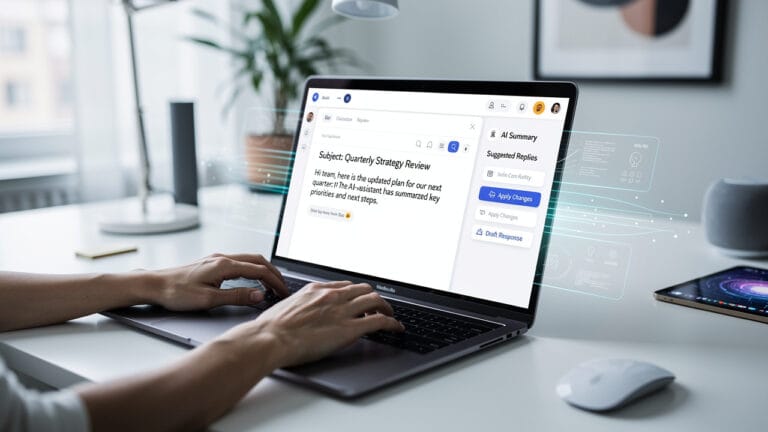
A marketing team uses generative tools to produce ad variants, social captions, and first-draft campaign briefs. Output increases fast. So does the amount of review needed to protect brand tone, legal compliance, and factual accuracy.
A customer support department adds AI assistants that suggest responses in real time. Agents can close tickets faster, but management can also push for more tickets per hour, tighter scripts, and stricter quality scoring.
A hospital administrator may use AI for scheduling, coding support, and document summaries, while nurses and clinicians still carry the human burden that no chatbot can absorb. That is why the promise of AI in workplaces will feel very different in a spreadsheet-heavy job than in a care-based one.
And yes, four-day week pilots may appear in some knowledge-work settings first, especially where output can be tracked clearly and where employers want to recruit top talent. But many workers will get a very different version, five days of work with six days of expectations packed inside.
Pros and Cons of AI in Workplaces
Pros
- Can remove repetitive digital tasks and free time for higher-value work
- May support shorter workweeks in some roles
- Helps smaller teams produce at a larger scale
- Could increase the relative value of human-centered professions
- Makes some services cheaper and more accessible
Cons
- Productivity gains may be captured by employers, not workers
- Can intensify surveillance and performance tracking
- May shrink entry-level learning opportunities
- Risks widening inequality between AI-augmented workers and everyone else
- Error-checking and accountability still fall on humans
Conclusion on AI in Workplaces
The next chapter of AI in workplaces will not be defined by the tools alone. It will be defined by whether companies use those tools to make jobs better, or just faster and harsher.
The four-day week idea sounds radical, but it points at the real issue: if AI gives us back time, somebody will decide who keeps it. Expect that fight to define the workplace far more than any new chatbot release.
Sources
About the Author