

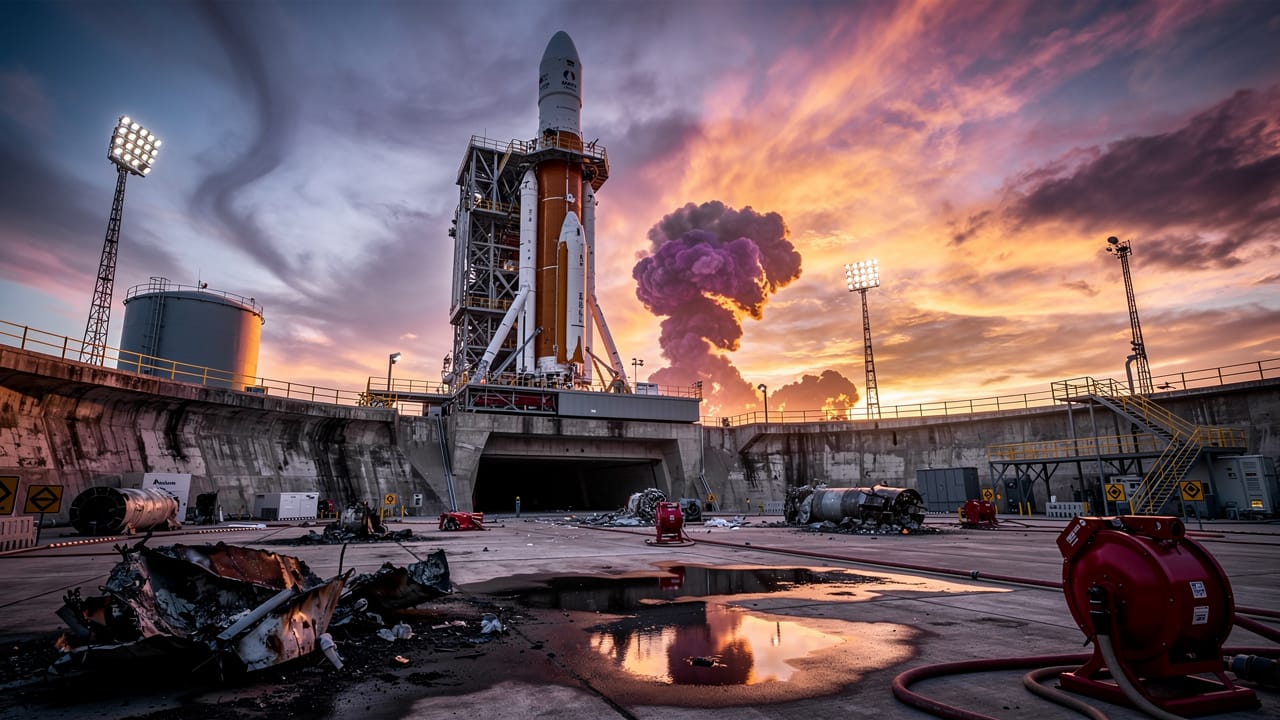
The uncomfortable truth about rocket launch failures is that a mission can look half-successful on video and still be a major business problem on paper. Blue Origin just proved that again, because landing a reusable booster means far less when the payload ends up in the wrong orbit and regulators step in.
Quick Summary
- Blue Origin pulled off an important reusable-booster milestone on New Glenn’s third flight, but the mission was still marred by an upper-stage problem.
- The Federal Aviation Administration has ordered an investigation, which means New Glenn cannot fly again until the review is completed.
- The rocket reportedly delivered its satellite to the wrong orbit, turning what could have been a breakout moment into one of 2026’s most watched rocket launch failures.
- New Glenn is central to Blue Origin’s plans to scale launches this year and strengthen its challenge to SpaceX in heavy-lift and commercial missions.
- The incident matters beyond one company, because launch delays ripple into satellite operators, government customers, insurers, and NASA-linked schedules.
- This is also a reminder that modern rocket launch failures are often subtler than the fiery disasters people see in a typical rocket launch failures compilation.
What Happened With Blue Origin’s Rocket Launch Failures Problem
On Sunday, Blue Origin launched its heavy-lift New Glenn rocket from Cape Canaveral and appeared to score a major technical win. The company reused an orbital-class booster for the first time, then landed that booster again on a drone ship at sea. For any launch company, that is a serious achievement.
But the mission did not finish cleanly. The upper stage apparently failed to perform as required, and multiple reports indicate the payload was delivered to the wrong orbit. That transformed a promising test into one of the more consequential rocket launch failures of the year, because orbital accuracy is not optional, it is the mission.
The FAA’s response was immediate and predictable. It instructed the company to investigate the mishap before New Glenn can return to flight. For Blue Origin, that is not just a technical headache. It threatens the cadence the company needs to become a credible rival in the commercial launch market.
Key Details on New Glenn, the FAA Probe, and Rocket Launch Failures
The details matter here, because this was not a simple explosion-on-the-pad story. New Glenn is a 321-foot-tall heavy rocket, or about 98 meters, and on this flight its seven BE-4 engines on the first stage performed well enough to get the booster back for another successful landing attempt. Ars Technica noted each engine produces more than a half-million pounds of thrust, which gives a sense of the scale involved.
That is the good news. The bad news is more important commercially. The upper stage, powered by two BE-3U engines, appears to have underperformed or malfunctioned during the part of the mission that actually determines whether a customer gets usable service. In practical terms, a flawless booster recovery does not make up for an off-target delivery.
Why this counts among serious rocket launch failures
People often think of early rocket launch failures as dramatic fireballs from the dawn of the space age. Modern failures can be more deceptive. A launch can clear the tower, separate stages, land hardware, and still fail where it counts most, orbital insertion. That is exactly why this incident will likely end up on any serious list of rocket launch failures, even if the footage looks far less catastrophic than classic accidents.
There is also a regulatory consequence. Once the FAA opens a mishap investigation, flight operations stop until the agency is satisfied that the cause is understood and corrective actions are in place. TechCrunch reported that Blue Origin had ambitions to fly as many as 12 more New Glenn missions this year. That goal now looks far more fragile.
Why NASA and commercial customers care
This is not just another private-space embarrassment. New Glenn is tied to Blue Origin’s broader role in U.S. space operations, including work connected to NASA’s Artemis ecosystem. That is why searches like rocket launch failures NASA and NASA rocket launch failures spike whenever a major U.S. launcher stumbles, even when NASA is not the operator. The same industrial base, launch infrastructure, suppliers, insurers, and mission planners are often interconnected.
What Rocket Launch Failures Mean for Customers, NASA, and You
For the average person, a rocket delivering a satellite to the wrong orbit may sound niche. It is not. Every launch delay or failure can hit industries people use daily, including broadband, Earth observation, defense communications, mapping, weather data, and scientific missions.
The biggest losers from rocket launch failures
The first losers are satellite customers. Buying a launch is already expensive and time-sensitive. If your spacecraft misses its target orbit, you may need to burn extra onboard fuel to compensate, assuming that is even possible. That can shorten the satellite’s useful life and damage the economics of the entire project.
The second losers are companies trying to diversify away from SpaceX. Many customers want alternatives for pricing leverage and schedule flexibility. Blue Origin’s appeal was supposed to rest on scale, reusability, and a growing launch manifest. A grounding interrupts all three.
Government programs also feel the pain. Even when NASA is not directly flying on a specific mission, major launch disruptions affect procurement assumptions and confidence in the supplier base. That is one reason interest in rocket launch failures NASA stories stays high, because the public understands that commercial and government spaceflight are no longer separate worlds.
Why the market still rewards partial success
Oddly enough, Blue Origin did not leave this launch empty-handed. Reusing and recovering the booster is a meaningful step toward lower costs over time. If the company fixes the upper stage quickly, the market may treat this less like a disaster and more like an expensive but normal maturation phase.
Still, there is a limit to investor patience and customer tolerance. The launch business is brutal because a mission is only as good as its weakest phase. One successful landing cannot erase one failed delivery.
What Others Missed About Blue Origin’s New Glenn Mishap
The easiest take is that Blue Origin had a bad day. The more useful take is that this mission exposed a deeper truth about how launch companies are judged in 2026.
Reusability is not the same as reliability
Blue Origin wants to compete in the same conversation as SpaceX, and that means proving reusability. Sunday’s booster recovery helps. But the market ultimately buys reliability, not spectacle. A launch provider is paid to place cargo precisely where it belongs, on time and predictably. If a company nails the flashy part and misses the contractual part, customers notice.
That distinction gets lost in mainstream coverage. A lot of readers see a booster landing and assume the mission mostly worked. In reality, upper-stage performance is often the more commercially decisive metric.
This is why rocket launch failures are so hard to explain
Public understanding of rocket launch failures is still shaped by explosions, countdown aborts, and dramatic archives from the Cold War. But the most consequential failures today are often operational and financial. Wrong orbit. Delayed certification. Grounded fleet. Insurance questions. Missed customer windows. Those problems do not always make for viral clips, but they can do more lasting damage than a visible explosion.
If you ever browse a rocket launch failures compilation, you mostly see the violent failures because they are visually memorable. What you miss are the quieter failures that wreck launch manifests for months.
Real Examples of How This Affects the Space Industry
Consider a satellite internet company waiting on deployment. A grounded launch vehicle can force it to reshuffle schedules, split missions across other providers, or accept delays that hurt coverage plans.
Think about military or civil Earth-observation customers. Missing a launch window can delay imaging capacity, disaster response tools, or surveillance upgrades. In a market where orbital slots and timing matter, a few months can be costly.
There is also an insurance angle. High-profile rocket launch failures can harden underwriting conditions for future launches, particularly for newer vehicles still building a track record. That means higher costs for satellite operators, not just the launch company itself.
This is where the story connects to the broader industry conversation. We have written before about how launch bottlenecks can reshape satellite economics, and the Blue Origin case fits that pattern perfectly. It also overlaps with the bigger question of whether the U.S. launch market truly has enough credible heavy-lift competition, or whether customers are still effectively designing around a single dominant provider.
Pros and Cons of Blue Origin’s “Partial Success”
Pros
- Blue Origin proved it can reuse an orbital-class booster, a major technical milestone.
- The company demonstrated meaningful progress in hardware recovery and turnaround potential.
- Even flawed missions can generate the data needed to improve future reliability.
Cons
- The payload outcome is what matters most, and this mission appears to have fallen short.
- FAA grounding means schedule disruption, lost momentum, and possible customer concern.
- This will reinforce skepticism that Blue Origin is still behind where the market needs it to be on dependable heavy-lift service.
Conclusion on Rocket Launch Failures and Blue Origin’s Real Problem
Blue Origin did something impressive and something unacceptable on the same day. It brought back a booster, but it failed at the part customers actually pay for, which is why this belongs in any serious conversation about rocket launch failures.
What Happens Next (2026-2030)
Blue Origin’s next few years will hinge less on flashy milestones and more on whether it can make New Glenn boring, consistent, and insurable. SpaceX benefits if this grounding drags on, because every delayed competitor mission strengthens its grip on commercial launch demand. NASA and other government customers will keep backing multiple providers in principle, but in practice they reward the companies that hit orbit correctly, every time. By 2030, the winners in heavy launch will not be the companies with the best highlight reels, they will be the ones that turn fewer missions into entries on a list of rocket launch failures.
Sources
About the Author