

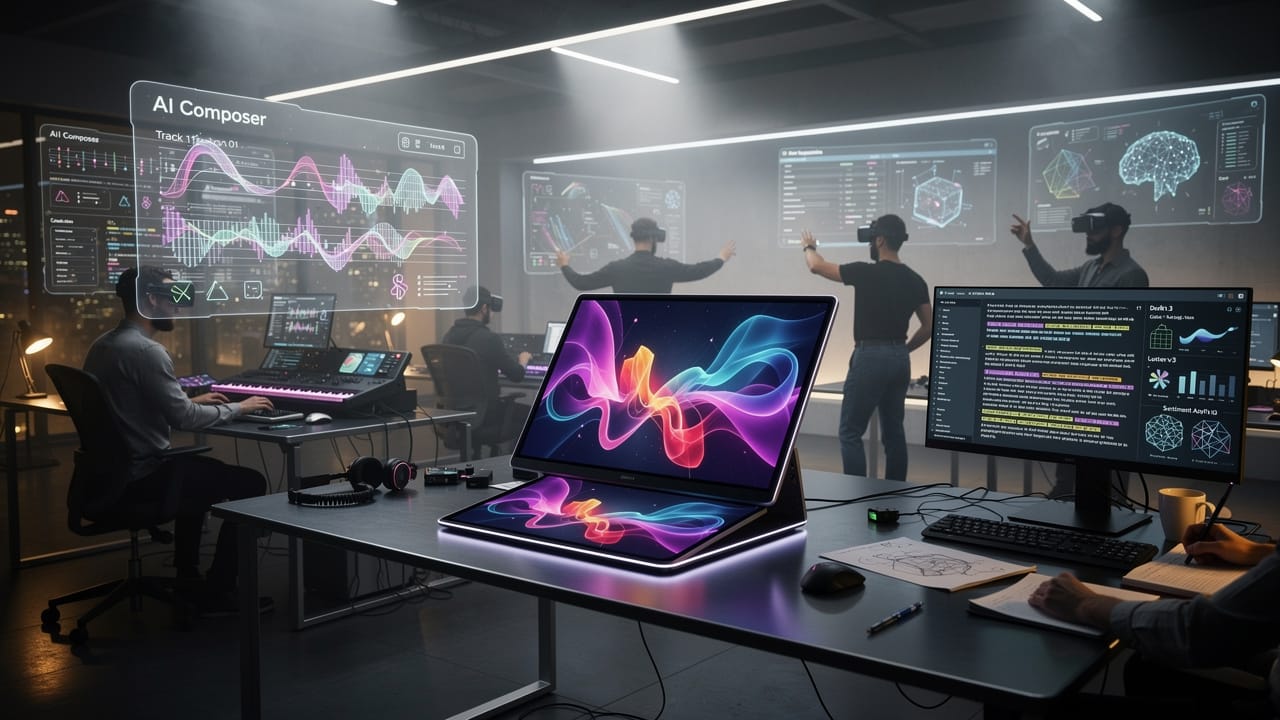
AI is not just changing how companies work, it is giving them a cleaner excuse to slow hiring while spending more on software and infrastructure. The impact of AI on creative industries is starting to look less like a productivity story and more like a budget reshuffle with real human consequences.
Quick Summary
- Match Group says it is slowing hiring while ramping up spending on AI tools and employee training.
- That decision matters beyond dating apps, because it reflects a broader shift in the impact of AI on creative industries and knowledge work.
- At the same time, investors are pouring serious money into the hardware side of AI, including a $140 million round for floating ocean-based compute nodes and roughly $200 million in broader backing for the idea.
- The pattern is becoming clear: companies want AI everywhere, but they do not want rising headcount to pay for it.
- This is part of the wider impact of AI on different industries, from media and marketing teams to infrastructure, operations, and hiring.
- The next fight is not whether AI arrives, it is who absorbs the cost, workers, customers, or margins.
What Happened With Match Group and the Impact of AI on Creative Industries
Match Group, the parent company behind Tinder and other dating platforms, used its latest earnings discussion to send a message that should make workers across digital businesses pay attention. The company is pushing hard to make employees use AI more broadly, and it is moderating hiring partly to help fund that shift.
That matters because Match is not a chip company or a lab building frontier models. It is a consumer internet business. When a company like this starts saying AI spending deserves room in the budget that might otherwise go to new employees, it tells you the economics of adoption are changing.
The same week, another piece of the AI economy came into focus. According to Ars Technica, startup Panthalassa is pursuing floating AI data centers powered by ocean waves, backed by major investors and a fresh $140 million round. The bigger theme is hard to miss: software companies are buying more AI capability, while infrastructure companies race to build radically new ways to power it.
Key Details on the Potential Impact of Generative AI on Industries
The comment from Match Group’s finance chief was revealing because it was unusually direct. The company is not only handing employees access to cutting-edge AI systems, it is paying for training and trying to become what executives describe as an “AI-native” organization. That is a strategic choice, but also a financial one.
In plain English, companies are discovering that widespread AI adoption is not cheap. Licenses, internal deployment, compliance controls, model usage fees, training, and workflow redesign all add up. So when executives talk about efficiency, that does not automatically mean lower costs in the short term. Sometimes it means shifting money away from labor growth and toward software spend.
The infrastructure bill is getting bigger
This is where the second story matters. Panthalassa’s plan, covered by Ars Technica, is not a quirky side project. It is a sign that demand for AI compute is intense enough to justify far more experimental infrastructure bets. The company’s latest $140 million raise is meant to support a pilot manufacturing facility near Portland, Oregon, and accelerate deployment of ocean-based “nodes.” The broader wager, valued at around $200 million, reflects how difficult it has become to build enough AI computing capacity on land.
That has a direct connection to the question, what is the potential impact of generative AI on industries? One answer is simple: every industry adopting AI will eventually run into the real cost of power, chips, networking, and inference capacity. This is not only a software revolution. It is a capital expenditure revolution.
The impact of AI on creative industries is also a cost story
For media, design, entertainment, marketing, and app companies, the impact of artificial intelligence AI on media and creative industries is often framed around speed. Faster copy drafts. More image variants. Better personalization. Smarter recommendations. All true.
But there is another side to it. The more a company leans on generative systems, the more it may decide that fewer junior roles are necessary, fewer agencies are needed, and fewer experimental hires can be justified. That does not mean whole departments vanish overnight. It means hiring gets tighter at the exact moment executives claim output is improving.
What This Means for You, and Why the Impact of AI on Creative Industries Feels Uneven
If you are an employee, especially in digital content, product marketing, support, design, or operations, the signal is clear. AI may make you more productive, but it may not make you more secure. In many companies, the first financial benefit of adoption is not a four-day week. It is slower hiring.
That is why the impact of AI on creative industries is becoming such a loaded issue. Creative work used to enjoy a kind of protection because taste, language, storytelling, and visual judgment seemed hard to automate. Now those same fields are among the first to be partially restructured by AI-assisted workflows.
For workers, “AI enablement” can mean tougher competition
When every employee gets access to advanced AI systems, management expects more from the same headcount. A marketer can produce more campaign variants. A product manager can draft faster. A support team can resolve more tickets. A designer can generate more concepts in less time.
In theory, that makes people more valuable. In practice, it can also raise the performance bar and reduce the case for adding new people. We have already seen this anxiety building in the labor market, and our earlier reporting on AI and the Job Market: Disruption and New Rules mapped out how “augmentation” quickly turns into a headcount debate.
For businesses, the potential impact of generative AI on industries is operational, not just creative
Executives asking what is potential impact of generative AI on industries often focus on customer-facing features. They should look harder at internal operations. AI spending now touches training, procurement, legal review, cybersecurity, cloud bills, and infrastructure planning. That is one reason even non-tech-facing businesses are starting to resemble software companies in how they allocate budget.
This is also why the impact of AI on different industries will not arrive evenly. A dating app can slow hiring to fund AI tools. A news publisher may use AI to stretch a thin staff. A studio may use generative systems in pre-production but still need expensive human talent for final output. The pressure lands differently depending on margins and bargaining power.
What Others Missed About the Impact of AI on Creative Industries
A lot of coverage still treats AI adoption as a simple story of innovation. That misses the more uncomfortable reality: AI is becoming a line item that competes directly with labor.
The Match Group example is useful because it says the quiet part out loud. Companies are not merely “experimenting” with AI. They are reorganizing budgets around it. Once that starts, the conversation changes from “Should we use AI?” to “What hiring can we delay because we use AI?”
This is not just automation, it is leverage
The impact of AI on creative industries is not limited to replacing tasks. It changes negotiating power inside companies. Teams that once argued for more staff may now be told to prove they cannot do the work with AI assistance first. That alters promotions, hiring plans, contractor use, and even internship pipelines.
This dynamic is already showing up more broadly across business. Our analysis in The Real Impact of AI on Business Is Bigger Than Automation, and It’s Not Slowing Down made the point that AI is increasingly a management system, not just a toolset. That distinction matters. Management systems reshape organizations.
The hardware story will shape the labor story
The Panthalassa story also hints at something many executives would rather ignore: if AI requires novel data center designs, offshore power generation, and giant capital raises, then this technology stack is still expensive and unstable. Businesses may act as if AI is now basic infrastructure, but the underlying economics are still volatile.
That is why the question, what is the potential impact of generative AI on industries, cannot be answered only with demos and product launches. It has to include power demand, compute bottlenecks, and who pays when usage scales.
Real Examples of the Impact of AI on Different Industries
In media, AI can draft headlines, summarize transcripts, localize content, and test audience targeting faster than a traditional team. The upside is speed. The risk is a flood of low-quality sameness and fewer entry-level editorial jobs.
In marketing and design, one manager with AI tools can now create ad copy, image concepts, audience personas, and testing plans that once involved a wider mix of specialists. That is efficient, but it can hollow out junior roles that used to train future creative leaders.
In consumer apps like dating platforms, AI can improve moderation, recommendation systems, customer support, and profile optimization. Users may notice better matching or faster safety responses. Workers may notice fewer open roles.
In infrastructure, the story is even more dramatic. When investors are willing to back wave-powered floating AI nodes in the Pacific, it tells you the demand curve is no longer hypothetical. AI’s appetite is now reshaping where computing happens and how energy gets delivered.
Pros and Cons of the Impact of AI on Creative Industries
Pros
- Higher output per employee
- Faster experimentation in content, design, and product work
- Better personalization and support in consumer apps
- New infrastructure investment and new technical jobs
Cons
- Slower hiring and tighter entry-level opportunities
- Rising pressure on workers to do more with the same pay
- Expensive compute and software costs that can squeeze budgets
- Lower-quality creative output when companies over-automate
Conclusion on the Impact of AI on Creative Industries
The impact of AI on creative industries is no longer a future debate. It is showing up in hiring plans, software budgets, and even the physical geography of computing. Companies love to describe this as empowerment, but in many cases it is also a quiet labor strategy.
What Happens Next (2026-2030)
Between now and 2030, the winners will be firms that can pair AI adoption with genuinely better products, not just lower headcount. The losers will be workers stuck in roles that can be partially automated but not easily repositioned upward. Expect more companies to freeze or slow hiring while expanding AI subscriptions, internal training, and inference-heavy products. Also expect the infrastructure scramble to intensify, because if AI usage keeps growing, compute and energy constraints will become as important as model quality.
Sources
About the Author