

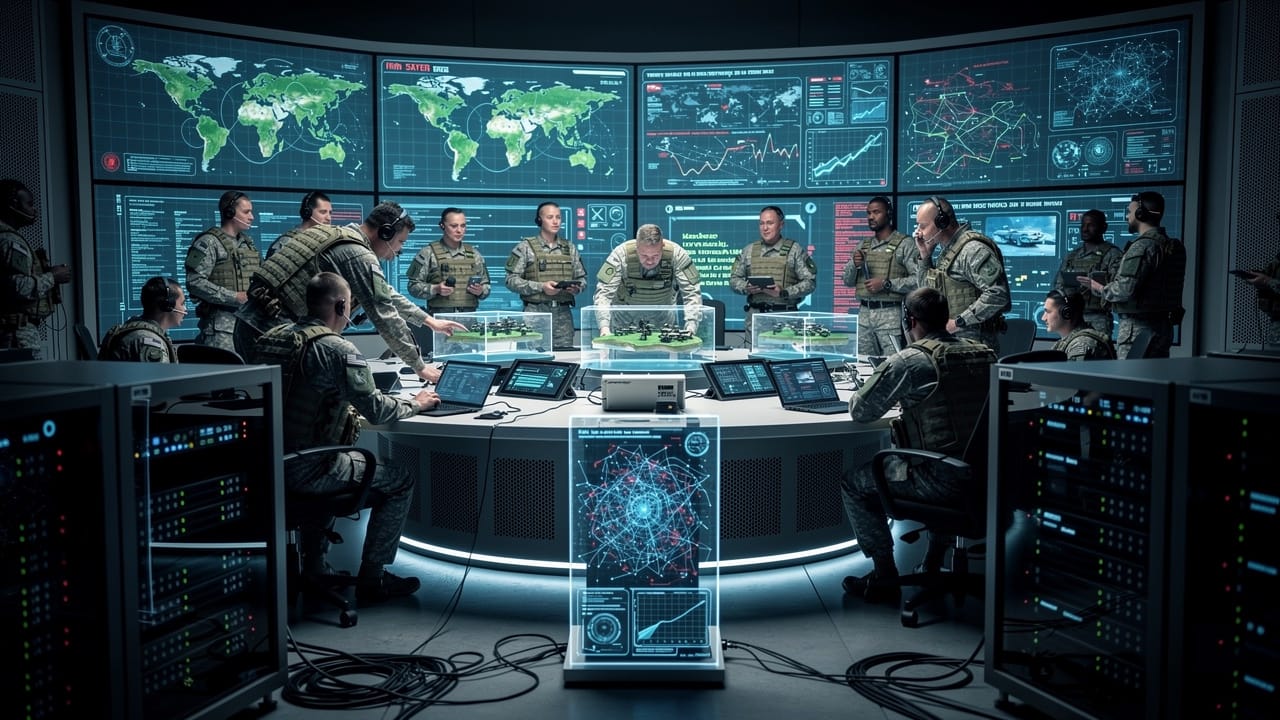
AI in military operations is no longer a pilot project or a PowerPoint fantasy. The Pentagon has now put some of the world’s biggest tech companies on a path straight into classified systems, which means the debate is no longer whether AI will shape warfare, but how few guardrails will exist when it does.
Quick Summary
- The Pentagon has signed new AI agreements with major tech vendors to run AI tools on classified networks for what it calls lawful operational use.
- The move deepens the military’s push to become an AI-first fighting force, not just a research organization experimenting on the edges.
- Nvidia, Microsoft, Amazon Web Services, Google, OpenAI, Oracle, SpaceX, and Reflection AI are now part of a fast-expanding defense AI stack.
- The absence of Anthropic matters, because its dispute with the Pentagon exposed a central fault line, whether military customers accept limits on surveillance and autonomous weapons.
- This is part of a broader global race in ai in military operations, where speed, targeting, logistics, and intelligence processing are becoming software problems.
- The biggest unanswered question is not technical capability. It is accountability when AI systems influence lethal decisions.
What Happened in AI in Military Operations
The Pentagon announced a fresh set of agreements with Nvidia, Microsoft, Amazon Web Services, and Reflection AI, adding to earlier deals with Google, OpenAI, SpaceX, and Oracle. The key shift is not just who signed on. It is where the technology will run, on classified military networks rather than isolated testing environments.
That changes the story. AI in military operations is moving from “assistive” software on the sidelines into systems used in real planning, intelligence, and command workflows. The Defense Department says the tools will support lawful operations and improve decision superiority across domains, which is Pentagon language for faster judgments in air, land, sea, cyber, and space.
There is also a political subtext. The Pentagon’s AI supplier list is growing partly because one major AI company, Anthropic, pushed back on terms it considered too permissive. That fight, now in court, revealed how badly the U.S. government wants broad access to frontier models, and how reluctant some labs are to be linked to uses they cannot tightly control.
Key Details on the Pentagon’s Classified AI Push
The most important number in this story is eight. That is how many agreements the Pentagon says now form the backbone of this new AI procurement wave, covering Google, OpenAI, Amazon, Microsoft, SpaceX, Oracle, Nvidia, and Reflection.
Another key detail is the phrase “classified networks.” Plenty of companies have sold cloud and analytics tools to defense agencies before. What is different here is that large AI models and related infrastructure are being positioned for use inside secure environments where operational intelligence and mission planning happen. That is a much more consequential step than a chatbot answering unclassified admin questions.
Why vendor diversity matters in ai in military operations
The Pentagon is not betting on one company. It is building redundancy on purpose. That tells you two things.
First, no one yet trusts a single model maker to become the military’s operating system for war. Second, the Defense Department wants leverage. If one company imposes restrictions, raises prices, or becomes politically toxic, the Pentagon can route around it.
That is exactly why the Anthropic clash matters. According to the reporting, the disagreement centered on unrestricted use versus guardrails around domestic mass surveillance and autonomous weapons. In plain English, the Pentagon wanted fewer limits than Anthropic was willing to accept. That is not a side dispute. It is the central ethical battle of AI in military operations.
The hardware angle is bigger than it looks
This is also a win for the compute layer. AI in military operations is not just about models from OpenAI or Google. It depends on chips, secure cloud environments, hardened deployment pipelines, and networking that can survive contested environments. That makes Nvidia particularly important, because military AI does not function at scale without accelerators and inference infrastructure.
It also explains why tools like GenAI.mil matter. The pitch is not flashy consumer AI. It is deployable AI services that can run in controlled, sensitive environments where latency, reliability, and chain of custody matter more than consumer convenience.
What AI in Military Operations Means for You
Most civilians hear “Pentagon AI” and imagine autonomous killer robots. That is dramatic, but incomplete. The nearer-term impact is subtler and arguably more important: AI will shape how targets are identified, how risks are scored, how logistics are routed, how surveillance data is filtered, and how commanders decide what deserves human attention.
That matters because people tend to over-trust machine outputs when those outputs arrive fast and look confident. A recommendation engine inside a classified system can influence action long before anyone labels it autonomous.
Faster war, thinner accountability
The strongest argument for ai in military operations is speed. Military organizations are drowning in data from satellites, drones, signals intelligence, and battlefield sensors. AI can sort, summarize, translate, and rank information much faster than human teams. In a real conflict, minutes matter.
But faster decisions are not automatically better decisions. If an AI system incorrectly flags a vehicle, a building, or a pattern of movement, the human operator may become the legal checkpoint without being the true source of judgment. That is how accountability gets blurred.
There is also an economic angle. Companies that once sold cloud contracts are now selling strategic capability. If this trend continues, defense budgets will flow not just to missiles and aircraft, but to model hosting, inference, chips, and data pipelines. The private sector winners could be enormous, which is one reason this market is heating up so quickly. It fits a much bigger pattern in tech spending, where infrastructure is becoming the real prize, something we also saw in our look at AI technology advancements in 2025 and the staggering cost behind them.
Who benefits, who loses
The obvious winners are major cloud providers, AI infrastructure companies, and defense integrators. The likely losers are smaller firms that cannot meet classified deployment requirements, and civil liberties groups that have little visibility into how these systems are actually used once they disappear behind national security secrecy.
The public also loses something harder to measure, the ability to know when software meaningfully shaped a lethal decision. That concern gets sharper when you look abroad. Discussions around whether israel quietly embeds ai systems in deadly military operations have already pushed this issue into global view. The technology is often framed as “decision support” right up until the moment its recommendations become operationally decisive.
What the Media Missed About Nvidia, Microsoft, and the New War Stack
A lot of coverage treats this as another contract story. It is more than that. The Pentagon is effectively standardizing a marketplace for military AI, where multiple vendors compete to become indispensable layers in a secure national security software stack.
This is platform lock-in for war
Once AI in military operations is embedded inside classified workflows, replacing it gets hard. Data formats, security approvals, model tuning, personnel training, and operational habits all create stickiness. That means today’s “lawful operational use” agreements could become tomorrow’s permanent architecture.
It also means the moral arguments are shifting from “Should the military use AI?” to “Which company gets to define the safe version of military AI?” That is a very different debate, and one the public has barely started having.
Another overlooked point is that the Pentagon may actually prefer vendor disagreement. If one model company draws ethical lines, another may not. Competition can lower prices, but in this context it can also weaken restraint. When one supplier says no, the government can shop elsewhere.
And while the U.S. focus dominates headlines, the phrase israel quietly embeds ai systems in deadly military operations keeps surfacing in policy debates for a reason. Military AI diffusion does not happen only through one giant public announcement. It often happens incrementally, inside intelligence fusion, targeting workflows, and battlefield software updates that outsiders only understand after the fact.
Real Examples of How AI in Military Operations Could Show Up
Think less “robot army,” more software everywhere.
A drone analyst could receive AI-ranked video clips instead of manually reviewing hours of footage. A logistics officer could get automatic recommendations on fuel, parts, and route changes. Cyber teams could use models to summarize threats and prioritize likely intrusions. Intelligence units could query huge classified databases in natural language instead of waiting for specialist analysts to stitch together answers.
That kind of deployment would make products like GenAI.mil valuable because the military does not just need smart models, it needs models that can be packaged, audited, and pushed into secure environments without breaking compliance.
The commercial spillover is real too. Tools hardened for defense often reshape enterprise software later. Secure inference, on-prem AI deployment, and low-latency edge processing all have civilian uses in hospitals, utilities, and critical infrastructure. If you want a preview of how quickly frontier AI moves from headline to budget line, watch defense procurement first.
Pros and Cons of AI in Military Operations
Pros
- Faster analysis of huge intelligence and sensor datasets
- Better coordination across domains, from cyber to battlefield logistics
- Reduced workload for analysts and operators handling repetitive tasks
- Stronger resilience through multi-vendor sourcing instead of one-provider dependency
Cons
- Higher risk of over-trusting flawed model outputs in high-stakes settings
- Weak public oversight once systems operate on classified networks
- Blurred responsibility when humans approve machine-shaped recommendations
- Incentives for vendors to loosen ethical limits to win defense business
Conclusion: The Bottom Line on AI in Military Operations
The Pentagon’s latest deals make one thing unmistakable, ai in military operations is now an infrastructure story, not a futuristic theory. The most important battle is no longer whether AI enters the chain of command, but whether democratic oversight can keep pace once it does.
What Happens Next (2026-2030)
Between now and 2030, the winners will be companies that can offer secure, classified-ready AI systems at scale, especially those controlling chips, cloud, and deployment tooling. The losers will be vendors that insist on tight ethical restrictions if competitors are willing to be more flexible. Expect “decision support” systems to spread first, then gradually become embedded deeply enough that separating human judgment from machine influence becomes almost impossible. And yes, debates over whether israel quietly embeds ai systems in deadly military operations will continue to matter, because they preview the global norm the U.S. may eventually normalize at home and abroad. By the end of the decade, the defining military AI question will not be capability. It will be who gets blamed when the software is wrong.
Sources
About the Author