

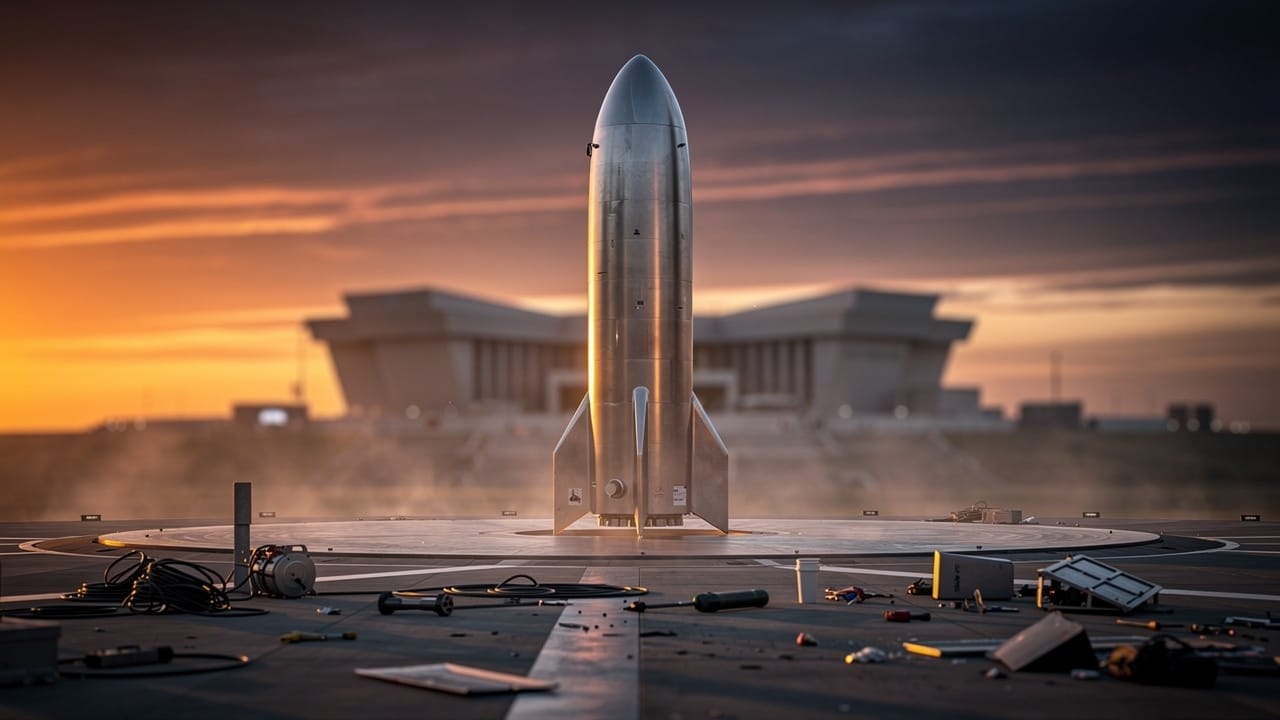
The latest news for SpaceX is not a simple story about rockets going up. It is a story about power concentrating in one company, even as regulators force that same company to slow down.
Quick Summary
- SpaceX faces an FAA-ordered investigation after a Super Heavy booster failed during the May 22 Starship Flight 12 test.
- The setback likely delays further Starship testing and could narrow the timeline before the company’s anticipated mid-June IPO window.
- At the same time, the U.S. Space Force confirmed a $2.29 billion contract for SpaceX to build the backbone of a new military data transport network in low-Earth orbit.
- That contrast explains why SpaceX in the news feels unusually intense right now, commercial launch risk is rising just as government dependence is deepening.
- Another piece of news on SpaceX came from outside the company itself, NASA has outlined three uncrewed Moon missions this year, a reminder that the broader space calendar is accelerating even while Starship hits turbulence.
- The real takeaway is simple, SpaceX is no longer just a launch company. It is becoming infrastructure, and that changes the stakes of every failure.
What Happened in the Latest News for SpaceX
The headline item in the latest news for SpaceX is the Federal Aviation Administration’s decision to require an investigation into the May 22 Starship Flight 12 mishap. According to the regulator, the problem involved the Super Heavy booster after stage separation, during its return trajectory toward the Gulf of America. There were no reports of injuries or public property damage, but the event was serious enough for the regulator to classify it as a mishap and pause future test flights until the review is completed and approved.
That would already be important on its own. But this week’s SpaceX news also includes a very different development. The U.S. Space Force has now confirmed that SpaceX won a $2.29 billion firm-fixed-price contract to build the Space Data Network Backbone, a low-Earth-orbit communications layer meant to move sensing and targeting data quickly through military systems.
So the company is taking a hit in one arena while tightening its grip in another. That is why news about SpaceX right now matters well beyond rocket fans.
Key Details on SpaceX in the News
The most immediate operational issue is the FAA investigation. The agency is not merely asking questions from a distance. It said it will oversee the SpaceX-led review and be involved step by step. In practical terms, that means no additional Starship test launch until the findings satisfy regulators.
Why the Starship V3 setback matters
This is where Starship V3 becomes more than a prototype story. Starship is central to SpaceX’s long-term business case, deep-space ambitions, and public-market narrative. A grounded test campaign, even temporarily, puts pressure on the idea that engineering velocity alone can bulldoze through hardware risk.
Timing matters here. TechCrunch reported the pause reduces the chances of another Starship test before the company’s expected mid-June IPO milestone. If that timing holds, investors evaluating news SpaceX will be forced to weigh a familiar tension, astonishing technical ambition against the stubborn reality of launch failures.
The Pentagon contract is the other half of the story
Now for the bigger strategic development. Ars Technica reported that Space Systems Command selected SpaceX for the Space Data Network Backbone contract, worth $2.29 billion. Officials described it as a way to accelerate a resilient, high-speed space communications network and as the backbone of a reworked military architecture after earlier Pentagon efforts stumbled.
That matters because it pushes SpaceX deeper into the defense stack. This is not just about putting satellites in orbit. It is about moving critical data between sensors and decision-makers fast enough to matter in combat conditions. In plain English, SpaceX is becoming a communications and targeting infrastructure provider, not just a launch vendor.
Meanwhile, MIT Technology Review noted that NASA has laid out plans for three uncrewed Moon missions this year. That is not directly about SpaceX, but it adds context to the pace of the broader space sector. Governments are pushing timelines forward, not backward. Any company expected to power that agenda will face more scrutiny, not less.
What This Means for You, Beyond the News for SpaceX
If you are an investor, customer, policymaker, or just a person who uses services built on orbital infrastructure, this wave of news for SpaceX has very real consequences.
For investors and markets
The biggest message is that SpaceX now lives in two worlds. In one world, it is still doing frontier engineering where explosive setbacks are part of the game. In the other, it is becoming a quasi-utility for governments and communications networks. Markets usually reward one of those profiles and discount the other. Combining them in one company can create a premium, but it can also create confusion.
That is partly why the company’s public-market story has become so charged. We explored that dynamic in SpaceX’s IPO and the Trillion-Dollar Question, where the central issue is not just launch cadence, but whether investors start valuing SpaceX like infrastructure rather than aerospace.
For national security and public policy
For the Pentagon, the upside is speed. The downside is concentration. A military data backbone run by SpaceX may be fast to deploy because the company already has launch capacity, spacecraft production, and orbital experience. But it also means the U.S. is leaning harder on a single private operator for missions that are becoming strategically vital.
That is not a small shift. It means every future piece of news on SpaceX, whether it is a launch anomaly, a regulatory clash, or a business dispute, could echo into defense planning.
For the broader space economy
The practical effect is that competitors face a tougher hill. If SpaceX controls launch at scale, satellite deployment, and key networking layers, rivals are no longer just competing with a rocket company. They are competing with a vertically integrated platform.
That is why discussion of orbital computing and communications keeps resurfacing. Our earlier piece on Space Data Centers Are the New Frontier for SpaceX connects directly to this moment. Once a company owns transport and connectivity in orbit, higher-margin data services are the obvious next step.
What Others Missed About News SpaceX
A lot of coverage treats these developments as unrelated, one story about a failed booster, another about a defense contract. That misses the larger pattern.
Failure is becoming more expensive
In the past, a Starship test failure mostly meant engineering delays and bad headlines. Now it means something else too. As SpaceX moves deeper into defense, telecom, and possibly public markets, each mishap carries reputational spillover into businesses that are supposed to feel stable and institutional.
That changes how regulators, military customers, and investors react. The company may still tolerate technical risk internally, but the outside world is less willing to shrug.
SpaceX is turning into a layer, not a company
This is the bigger hidden angle in the current news for SpaceX. SpaceX is starting to resemble a foundational layer of the modern space economy. Launch is one layer. Starlink-style connectivity is another. Military data transport is another. Lunar logistics may follow.
That kind of position creates extraordinary leverage, but it also invites political heat. Once a company becomes too essential, every contract starts to look like dependency.
The Moon timeline raises the pressure
NASA’s plan for three uncrewed Moon missions this year sharpens the point. The space sector is entering a period where governments want delivery, not just demos. If Starship is meant to play a serious role in future lunar and deep-space logistics, the tolerance for repeated delays shrinks quickly.
Real Examples of How SpaceX News Hits the Real World
Consider what this means in practical terms.
A delayed Starship test campaign can affect launch planning, supplier schedules, and how quickly new heavy-lift capabilities become available. That matters for satellite operators, for NASA-adjacent programs, and for companies building products that assume cheaper mass-to-orbit is around the corner.
The military network deal is even more concrete. A sensor-to-shooter data chain is not abstract jargon. It means faster movement of surveillance and targeting information between satellites and operational users. If SpaceX executes, commanders get lower-latency links and more resilient communications in orbit.
For ordinary consumers, the downstream effect is subtler but still real. A company building out massive orbital communications infrastructure can spread fixed costs across government and commercial systems. That can improve service economics over time, but it can also entrench one provider’s dominance. Better products often arrive hand in hand with fewer meaningful competitors.
Pros and Cons of the Current SpaceX News Cycle
Pros
- The Pentagon gets a potentially faster path to a modern space communications backbone.
- SpaceX continues proving it can win business far beyond launches.
- The FAA process, while frustrating for the company, is exactly how high-risk flight testing is supposed to be governed.
Cons
- Starship delays could slow progress on heavy-lift ambitions at a critical moment.
- Greater government reliance on one private company creates strategic concentration risk.
- Investors following news about SpaceX may get a more volatile picture of the business than the infrastructure narrative suggests.
Conclusion, the Bottom Line on News for SpaceX
The most important news for SpaceX this week is not that a booster failed or that a contract was signed. It is that both happened at once. SpaceX is now powerful enough that its setbacks and victories are starting to reshape the same industry in real time.
What Happens Next (2026-2030)
Expect SpaceX to keep winning government work because no rival currently matches its combination of launch cadence, manufacturing speed, and orbital reach. Expect regulators to scrutinize Starship more aggressively, not because they want to stop it, but because the consequences of getting it wrong are growing. The biggest winners will be governments and customers that can plug into SpaceX’s expanding infrastructure early. The biggest losers may be mid-tier competitors stuck between legacy procurement systems and a company moving faster than the market can comfortably absorb.
Sources
About the Author