
From Science Fiction To “Physical AI”
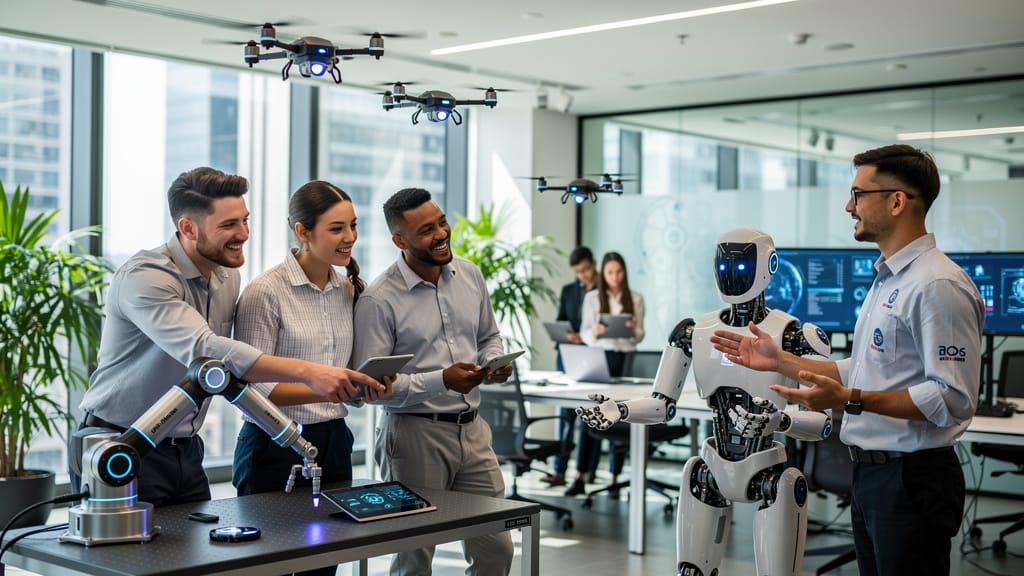
Robots are no longer just industrial arms in car plants or cute gadgets in sci‑fi movies. A new wave of physical AI is starting to handle everyday, often tedious, work in homes, warehouses, and critical infrastructure. Instead of simply crunching data in the cloud, physical AI systems sense, move, and manipulate the world.
According to reporting from TechCrunch, Japan is treating this as a major industrial frontier. With a rapidly shrinking workforce and rising pressure to maintain productivity, Japanese policymakers and companies are treating robots less as job thieves and more as urgently needed reinforcements that can step into roles people are unwilling, or simply unavailable, to fill.
At the same time, robot technology is becoming visible in much more ordinary places, such as the backyard. As Wired notes, robot lawn mowers used to be luxury curiosities. Today they are slowly crossing into the mainstream as prices drop and capabilities improve.
Behind all of this is an unexpected workforce. Gig workers across more than 50 countries are strapping smartphones to their heads and recording themselves doing chores so that humanoid robots can learn basic skills. As MIT Technology Review reports, this emerging data labor sector is crucial to training robots that can eventually function in factories and homes.
Together, these trends reveal what robot technology is actually doing in 2026, and why it is trending.
Japan’s Physical AI Push: Filling Jobs That Sit Empty
Japan offers one of the clearest windows into how physical AI is likely to spread. The country faces a severe demographic crunch, with fewer young workers available to support an aging population. According to Japan’s Ministry of Economy, Trade and Industry, the government now aims to build a domestic physical AI sector strong enough to capture 30 percent of the global market by 2040.
Japan already has deep roots in industrial robotics. The ministry reports that Japanese manufacturers accounted for about 70 percent of the global industrial robotics market in 2022. That foundation gives the country a powerful starting point as it shifts from traditional factory robots to more adaptable and AI‑driven machines.
Rather than focusing primarily on replacing existing workers, Japanese companies are using robots where labor is in short supply. Physical AI systems are increasingly deployed in factories, logistics centers, and critical infrastructure where staff are hard to recruit or retain. This approach frames robots as a solution to structural workforce gaps instead of an automated competitor to human jobs.
Japan’s ambition also illustrates a broader industrial race. The TechCrunch reporting highlights how investors see physical AI as one of the next big technology battlegrounds, with Japan, the United States, and China each exploring different strategies. Where some ecosystems sprint to ship hardware quickly, Japan is leaning on long experience in robotics hardware and its urgent domestic need for automation.
Robot Mowers: Automation Rolls Onto The Lawn
The same forces that are pushing robots into factories are quietly reshaping household chores. Lawn care is a perfect example. It is repetitive, time‑consuming, and weather dependent, which makes it an attractive target for automation.
In a detailed guide, Wired reviews some of the best robot lawn mowers currently on the market, after three years of testing. Models such as the Husqvarna Automower 450X EPOS and more budget‑friendly options like the Anthbot Genie 3000 show how far the technology has come. These machines can patrol yards on their own, trimming grass while their owners relax in a hammock, sip iced tea, or simply stop worrying about weekly mowing schedules.
Robot mowers are still expensive compared with pushing a traditional mower yourself, although prices are falling and deals appear regularly. A midrange or premium robot mower represents a significant upfront investment, but for many households it converts into time savings and a consistently tidy lawn without ongoing effort.
The Wired testing also makes clear that robot mowers are no longer just crude, bump‑and‑turn gadgets. They incorporate smarter navigation, improved safety features, and more refined cutting performance. At the same time, they remain imperfect. Buyers need to understand installation requirements, maintenance, limitations in complex yards, and what features are actually worth paying for.
Robot vacuum cleaners already normalized the idea of autonomous machines quietly maintaining our living spaces. Robot mowers extend that logic outdoors, moving physical AI further into everyday life.
The Hidden Workforce Training Tomorrow’s Humanoids
While robot mowers and industrial machines are already useful, a more ambitious vision is emerging: general‑purpose humanoid robots that can work wherever humans do. The problem is that these robots do not know how to do anything when they are first built. They must be trained, and that is where a new kind of gig job comes in.
MIT Technology Review describes how people like Zeus, a medical student in central Nigeria, are turning their homes into training labs. Zeus comes home from the hospital, turns on a ring light, straps an iPhone to his forehead, then slowly records himself making his bed, folding laundry, or washing dishes. He moves with deliberate care so that his hands always stay visible in the camera’s field of view.
Zeus is contracted by Micro1, a Palo Alto company that collects real‑world video data and sells it to robotics firms that are racing to build humanoids. These robots are designed to resemble and move like humans in environments such as factories or homes. To learn human‑like skills, they need huge amounts of footage of actual people performing everyday tasks from a human perspective.
Micro1 has hired thousands of workers across more than 50 countries, including India, Nigeria, and Argentina. Many of these workers are young and tech savvy, and for them the pay is competitive relative to local job markets. This flow of income is helping to support local economies and creating an unusual kind of remote work.
However, the arrangement is complicated. Workers film inside their own homes, sometimes capturing private spaces or family life. That raises significant questions around privacy and informed consent. Do workers fully understand how long this data will be stored, who will use it, or how it might be combined with other data sets in the future?
There is also an emotional and social aspect. The work can be physically awkward and even surreal, as people repeatedly act out mundane tasks for a faceless robotic audience. That strangeness is part of the price of giving robots the rich behavioral data they need in order to make decisions in the physical world.
Why Robot Technology Is Trending Now
Taken together, these developments explain why robot technology is attracting so much attention. Several forces are converging at once:
- Demographic and labor pressures in countries like Japan are turning robots into practical necessities, not optional luxuries.
- Consumer‑grade robots, such as advanced robot lawn mowers, are finally good enough that ordinary people can see clear value and are beginning to adopt them.
- Data‑hungry humanoid systems depend on global networks of gig workers, which ties robot progress to questions about digital labor rights, privacy, and fair compensation.
Far from a single, monolithic story about “robots taking jobs,” the current trend looks more like a patchwork of targeted automations and new human‑robot collaborations. In Japanese factories, robots are filling roles that otherwise stay vacant. In suburban yards, they are trading manual labor for leisure time. In apartments from Nigeria to India, people quietly record their own movements so that future humanoids can learn how to operate in human spaces.
Robot technology is trending because it has moved from the lab and science fiction into messy, everyday reality. It is now shaped as much by demographic change, global gig work, and consumer expectations as it is by advances in AI algorithms or mechanical engineering.
Sources
About the Author