

A New Kind of Automation Anxiety
Conversations about robots and work usually focus on a single fear, that machines will take human jobs and leave workers behind. Yet the reality unfolding in some countries is more complicated and often less dramatic than the nightmare scenario suggests.
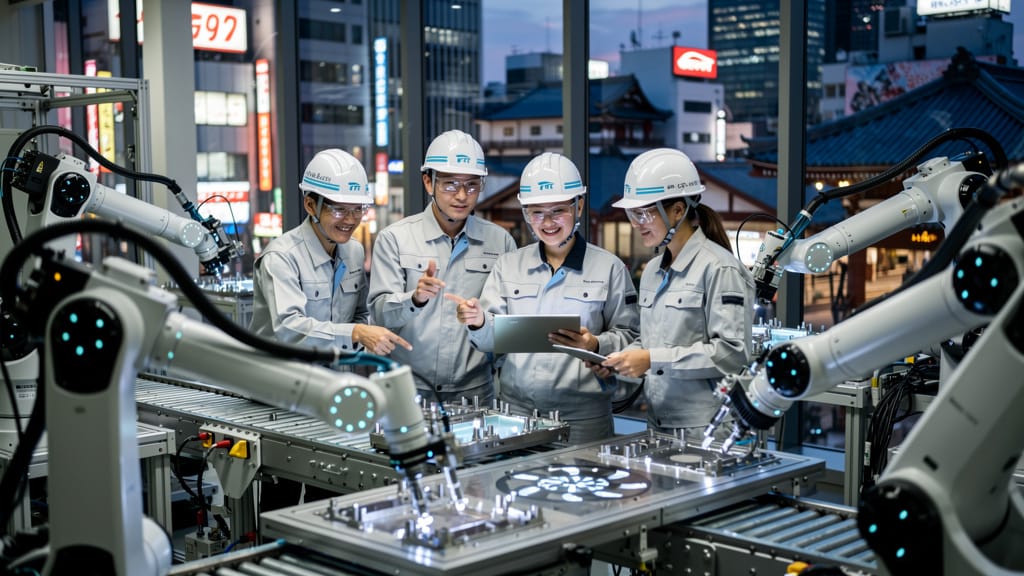
In Japan, physical AI and robotics are expanding quickly, but not primarily as a way to replace people in desirable roles. Instead, companies are using robots to cover positions that are increasingly hard to staff at all. At the same time, incidents like a recent mass robotaxi malfunction in China are showing that handing critical tasks to machines carries its own risks.
Taken together, these trends hint at where robotics and employment are really heading, and what trade‑offs societies will face as automation moves from the lab into streets, warehouses, and infrastructure.
Japan’s Physical AI Push Is About Survival, Not Hype
According to Japan’s Ministry of Economy, Trade and Industry, the country is not treating physical AI as a speculative bet. It is a response to a demographic crunch that is already here. Japan’s population is aging, its workforce is shrinking, and businesses are under growing pressure to keep productivity up despite fewer available workers.
That pressure is driving a national strategy. The ministry has publicly stated that it wants to build a domestic physical AI sector robust enough to win about 30% of the global market by 2040. This goal sits on top of a foundation Japan has already laid in industrial robotics, where its manufacturers held roughly 70% of the worldwide market in 2022, according to the same ministry.
In other words, Japan is not starting from scratch. It is trying to turn decades of dominance in industrial robots into an advantage in a future where robots are not just fixed arms on factory floors, but mobile systems that interact with messy, unpredictable real‑world environments.
Filling the Jobs That Humans Are Walking Away From
The headline debate, whether robots will take “our” jobs, misses a key feature of Japan’s situation. In many sectors, there is no “our” to begin with. Vacancies go unfilled because younger workers do not want certain roles, older workers are retiring, and populations in some regions are declining.
Against that backdrop, AI‑powered robots are being deployed in:
- Factories and warehouses, where labor shortages make round‑the‑clock human staffing unrealistic
- Critical infrastructure, where inspection, maintenance, and safety tasks are essential yet often unattractive or physically demanding
The framing is not “robot vs worker,” it is “robot vs no one at all.” Companies and policymakers are looking at automation as a tool to keep vital systems functioning when enough people simply are not available or willing to do the work.
That shift in emphasis matters for the broader jobs conversation. If robots are primarily entering roles that are already empty or deeply undersubscribed, then, at least in Japan’s current phase, automation is less about displacement and more about plugging gaps.
Experimental Physical AI Meets the Real World
Japan’s robotics push also marks a transition from the lab to live deployment. What some investors call “experimental physical AI” is now being tested and used in the field, in environments that do not behave like controlled test beds.
This move into the real world brings opportunity. Robotics firms can refine their systems with real data, prove economic value, and identify the most promising use cases. It also introduces new questions: how to guarantee safety, who is responsible when systems fail, and how to build public trust.
Those questions are not theoretical. Other countries are already dealing with the consequences when large fleets of autonomous machines malfunction at once.
Wuhan’s Robotaxi Pileup: A Warning From the Streets
In the Chinese city of Wuhan, a mass outage of Baidu’s Apollo Go robotaxi service showed what can happen when widely deployed autonomous systems fall out of sync with reality.
According to local police, a system malfunction caused at least a hundred self‑driving taxis to stop in the middle of traffic. Videos posted to social media appeared to show vehicles frozen on busy streets, and one clip suggested the disruption led to a highway collision. Police reported no injuries, and passengers were able to exit the vehicles safely, but traffic was severely affected.
Baidu, which operates Apollo Go, did not immediately respond to requests for comment at the time of the report. The incident reignited debate in China and beyond about the safety and reliability of fully driverless vehicles, especially when they operate at scale in dense urban environments.
Several implications stand out:
- Systemic risk, when many machines rely on the same software stack, one failure can propagate quickly
- Public perception, one highly visible malfunction can undermine confidence in autonomous systems as a whole
- Regulatory scrutiny, authorities must decide how much testing, redundancy, and oversight is needed before large fleets are allowed on public roads
The Wuhan outage does not mean robotaxis are unworkable. It does show that, as more physical AI systems launch at scale, societies need robust ways to handle rare but high‑impact failures.
Different Countries, Different Robotics Stories
The contrast between Japan’s factory‑focused robotics expansion and China’s aggressive rollout of robotaxis highlights an important point. Automation is not a single global story unfolding the same way everywhere. It is shaped by:
- Demographics and labor markets, Japan’s aging population drives robots into essential but undersubscribed roles
- Policy goals, Japan is targeting global market share in physical AI, while China has treated autonomous vehicles as a showcase for national AI progress
- Risk appetite, some sectors and cities tolerate more experimentation in public spaces, others confine early deployments to controlled industrial environments
For workers, this means the impact of robotics on employment will vary widely by country and industry. The question, “Will robots take our jobs?” should probably be broken into many smaller questions: “Which jobs? In which sectors? Under what conditions?”
From Job Replacement to Job Design
Japan’s current trajectory suggests a different way to frame the conversation about robots and work. If physical AI is primarily being used to perform tasks that humans cannot or will not do, then the real challenge is not just protecting existing jobs, but designing new roles around automation.
Those roles might involve:
- Overseeing and maintaining fleets of industrial robots
- Managing safety, compliance, and quality control for AI‑driven systems
- Coordinating between human teams and automated infrastructure
At the same time, incidents like Wuhan’s robotaxi malfunction underscore that these systems are not infallible. Human expertise will remain essential, not only to keep machines running, but also to govern when, where, and how automation should be trusted with critical tasks.
The future of robotics and employment is likely to be negotiated job by job and sector by sector. Japan’s strategy of using robots to fill the jobs nobody wants, and China’s very visible experiments with autonomy on public roads, are both early signals of how complex those negotiations will be.
Sources
About the Author