

A trillion‑dollar question in orbit
SpaceX is reportedly preparing for an initial public offering that aims to raise around $75 billion at a valuation of $1.75 trillion. That number would not only reshape public markets, it would also help make Elon Musk a candidate for the title of first trillionaire. To justify a figure like that, investors are looking for more than rockets and satellite internet.
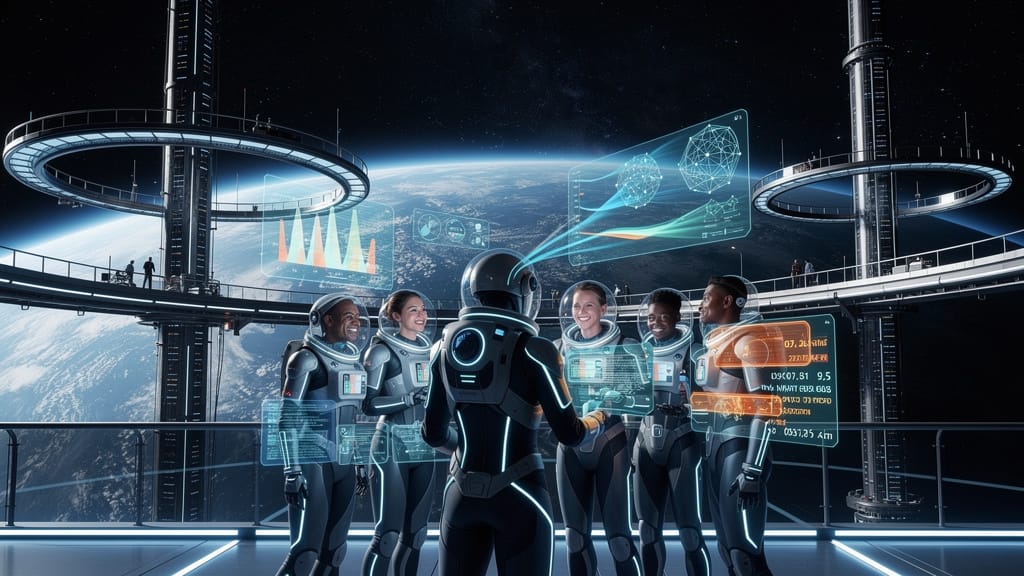
One answer Musk is offering: orbital data centers. In other words, data centers in space that could power the next wave of artificial intelligence and cloud services.
At the same time, other major players are circling the same idea. Jeff Bezos has spoken about moving large scale computing off planet. Google is preparing a test constellation of data processing satellites. Startup Starcloud has already lofted a high performance Nvidia H100 GPU into orbit to experiment with space based AI computing.
Space data centers have jumped from science fiction to boardroom slide decks, and they sit right at the intersection of space exploration, climate concerns, and the economics of AI.
Why put data centers in space at all?
The backdrop is simple. The current AI boom is pushing energy grids and water resources hard. High end AI training and inference systems consume massive amounts of electricity and require intensive cooling. Traditional data centers are under growing scrutiny from local communities that worry about higher power prices, water use, and environmental impact.
According to TechCrunch, even industry insiders are asking whether the tougher challenge is engineering, or public resistance on the ground. As stricter zoning rules and community pushback slow new facilities, it is not surprising that executives are considering the possibility that building in orbit might eventually be easier than winning local permit battles.
In January, SpaceX filed paperwork with the US Federal Communications Commission to support a stunning ambition, up to one million data center units in orbit, according to MIT Technology Review. The stated goal is to unlock AI’s full potential without triggering an environmental crisis on Earth.
The argument in favor of space based data centers usually rests on a few points:
- Access to abundant solar energy above the atmosphere
- No need for freshwater based cooling
- Physical distance from communities that object to large industrial sites
- Potential for global coverage when integrated with constellations like Starlink
The question is not whether the idea is bold. It is whether it can be made to work at scale and at a cost that fits even the rosiest revenue projections.
The emerging orbital computing race
SpaceX is not alone in betting on off‑planet computing.
- Jeff Bezos has pitched a long term vision in which heavy industry and large scale computing gradually move into space, leaving Earth more residential and less industrial.
- Google plans to launch a test constellation of about 80 data processing satellites as early as next year, an early step toward cloud infrastructure that extends beyond the stratosphere.
- Starcloud, a Washington State startup, launched a satellite carrying a Nvidia H100 GPU in November. This is one of the first tests of an advanced AI chip in orbit, and the company imagines data centers in space that match the scale of terrestrial facilities by around 2030.
Together, these efforts sketch a picture of what might come next after basic satellite broadband, remote sensing, and navigation. Data centers in orbit could turn low Earth orbit into a new layer of the global cloud.
From the perspective of an IPO investor trying to evaluate a valuation on the order of $1.75 trillion, this kind of long range growth story is critical. If SpaceX can dominate launch, satellite networking, and orbital computing, it begins to look less like a transportation company and more like a full stack space and data infrastructure platform.
Four big hurdles between here and orbital clouds
Turning that vision into hardware will not be easy. As MIT Technology Review explains, there are at least four broad categories of challenge that must be solved before data centers in space can scale.
1. Ultra reliable, space‑grade computing hardware
Earth based data centers already struggle with heat, power fluctuations, and hardware failures. Orbit adds vacuum, radiation, and extreme temperature swings. Most cutting edge AI chips were never designed to handle ionizing radiation or years in space without repair.
Companies will need:
- Radiation tolerant versions of high end GPUs
- Architectures that can degrade gracefully when some components fail
- Automated ways to monitor and reconfigure systems from the ground
Starcloud’s single satellite test with an H100 GPU is a proof of concept, not an operational blueprint. Scaling to millions of units would require a new generation of space optimized compute hardware and robust in orbit maintenance strategies.
2. Affordable, repeatable launch and deployment
Even with reusable rockets, lifting heavy, power hungry data center hardware into orbit is expensive. Launch costs, deployment complexity, and satellite lifetimes all feed into the economics.
Here, SpaceX has an obvious advantage. If it can keep lowering the cost per kilogram to orbit using vehicles like Starship, the company can effectively sell launch capacity to itself. The more it integrates rockets, satellites, and data services, the more room it has to design business models around marginal cost rather than market rate launch prices.
That integration is part of what makes orbital data centers such an attractive narrative for a sky high IPO valuation. It suggests a future in which launch is not just a commodity service, it is a lever that supports a vertically integrated cloud in space.
3. Energy and thermal management in orbit
Solar power in orbit avoids weather and nighttime, but converting sunlight into the stable, high quality electricity needed for data centers is not trivial. Even more challenging is cooling.
On Earth, data centers push heat into the atmosphere or nearby water, often consuming large amounts of water for evaporative cooling. In space, there is vacuum rather than air, so heat can leave only through radiation. This demands:
- Large, lightweight radiators
- Highly efficient power electronics
- System designs that keep thermal loads manageable
The climate argument for orbital data centers only works if these systems can run efficiently enough that the total energy and material footprint beats comparable facilities on the ground.
4. Networking, latency, and integration with Earth
A data center is only as useful as the network that connects it to users. For some applications, such as batch AI training, extra latency might not matter much. For interactive services, every extra millisecond counts.
Here, large constellations like Starlink are key. An orbital data center system that can route traffic through thousands of satellites might offset some latency penalties and bring compute physically closer to remote regions that lack terrestrial infrastructure.
The FCC filing to support up to a million orbital data units suggests SpaceX is thinking about a dense, networked system rather than isolated platforms. Whether that architecture proves practical is still an open question.
Can orbital data centers support a $1.75 trillion SpaceX?
As MIT Technology Review’s newsletter notes, SpaceX’s planned IPO would be the largest ever, and it comes at a time when rivals are rising across multiple fronts. Investors will not base their decisions only on Starlink subscriber numbers or launch cadence. They will look at whether SpaceX has credible paths into new, defensible profit pools.
Orbital data centers fit that bill. They align with:
- The booming demand for AI computing
- Growing backlash against resource intensive infrastructure on Earth
- SpaceX’s existing strengths in launch and satellite networking
- The broader narrative, shared by figures like Bezos, that heavy industry will eventually migrate off planet
At the same time, they are still conceptual. The first Starcloud GPU experiment, Google’s planned 80 satellite test constellation, and SpaceX’s own regulatory filings are early steps, not evidence of a mature market.
For now, orbital data centers are both a technological moonshot and a financial story. They are part of how Musk and SpaceX can argue that the company is not only today’s dominant launch provider, it is also a foundational layer of tomorrow’s space based cloud.
If that story holds up as hardware is launched and tested, space exploration will no longer be just about rockets, habitats, and science missions. It will also be about where the world’s most powerful computers live, and whether the cloud of the future will literally be above the clouds.
Sources
About the Author