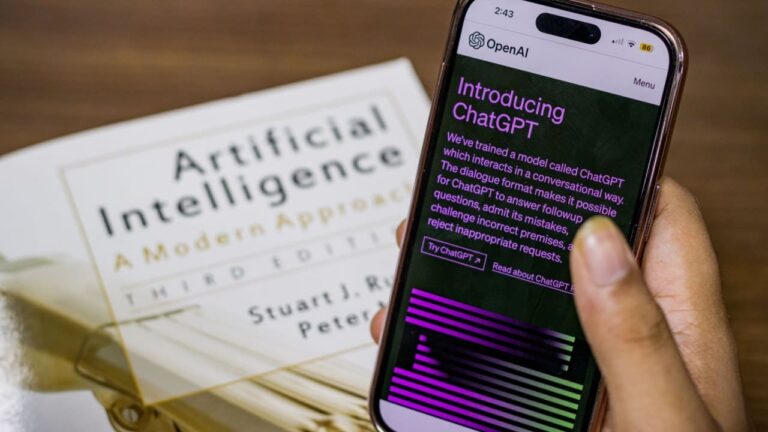


The biggest risk in classrooms and labs is no longer students cheating with ChatGPT, it is institutions quietly lowering their standards because policing AI is harder than pretending everything is fine. The ethics of AI in education now sits at the center of a deeper credibility crisis, one that stretches from homework to published science.
Quick Summary
- arXiv says authors who submit papers showing clear signs they did not verify AI-generated work can be banned for one year
- The move is not just about bad papers, it is about whether readers can still trust research before peer review
- Concerns over the ethics of AI in education are growing alongside fears that hype around AI could push people away from learning technical skills
- New examples of AI exposing private phone numbers and exploiting people’s images show that sloppy AI use is not merely academic, it has real human costs
- Schools and universities face a harder question than “Should students use AI?” They now have to define when AI assistance becomes academic fraud, negligence, or reputational damage
- The institutions that adapt best will be the ones that treat AI ethics in education as a governance problem, not just a plagiarism problem
What Happened With arXiv and the Ethics of AI in Education
Preprint repository arXiv is drawing a much harder line on AI-generated research. Its computer science leadership signaled that if a submission contains unmistakable evidence that the authors failed to check what a large language model produced, the penalty can be severe, including a 12-month ban from posting.
That matters because arXiv is not some obscure database. In fields like computer science, mathematics, and AI, it is one of the main places where new ideas spread before formal peer review. If low-effort machine-written papers flood that system, the damage travels fast.
This is why the ethics of AI in education is no longer confined to essays, exams, and student discipline. Research itself is part of the educational pipeline. Graduate students learn from papers, professors build courses around them, and labs chase trends that begin in preprint culture. If the upstream knowledge gets polluted, the classroom downstream gets polluted too.
Key Details on AI Ethics in Education and Research Quality
arXiv’s move follows earlier attempts to slow low-quality submissions. The repository had already tightened posting rules, including endorsement requirements for first-time submitters in some cases, partly to reduce spam and weak papers. Now the message is sharper, if AI generated text or results and the human authors did not verify them, trust collapses.
Why arXiv’s warning matters beyond one repository
A preprint server is not a journal, but it still acts like infrastructure. Researchers use it to circulate work quickly. Recruiters, students, journalists, and investors often read those papers long before peer review catches up. A bad journal article is a problem. A bad preprint ecosystem is an accelerant.
This is where the ethics of AI in education becomes practical rather than philosophical. If universities allow AI use without clear accountability, they risk training students to believe that fluent output equals understanding. arXiv is effectively saying the opposite, fluency without verification is worthless.
The timing also fits a broader backlash against AI overreach. In a recent BBC interview, Raspberry Pi boss Eben Upton warned that inflated claims about AI could discourage people from pursuing tech careers at exactly the wrong moment, when economies still need more skilled human workers, not fewer. That point lands squarely in the ethics of using AI in education. If students are told coding, writing, analysis, and problem-solving will soon be automated away, some will stop building those skills. That is not efficiency. It is disarmament.
The same trust problem is showing up outside academia
MIT Technology Review recently highlighted two ugly examples of generative AI failure with real-world consequences: AI systems surfacing people’s real phone numbers, and deepfake systems exploiting the bodies and likenesses of adult creators without meaningful consent. Those stories are not about lecture halls, but they are directly relevant to AI and ethics in education.
Why? Because they reveal the same pattern. AI tools are often deployed first, normalized second, and governed last. In academia, that sequence leads to fake citations, unverifiable claims, and shallow scholarship. In the wider public, it leads to privacy violations and exploitation. The underlying issue is not just misuse. It is a culture of casual adoption before institutions decide what responsibility looks like.
What the Ethics of AI in Education Means for Students, Teachers, and Researchers
Students should pay attention to this because the ground is shifting under them. A year ago, many schools treated AI like a new calculator, useful, inevitable, and mostly manageable. That analogy is breaking down. A calculator does not fabricate a source, invent a theorem proof, or produce a polished paragraph that sounds authoritative while being wrong.
For students, “AI-assisted” is no longer a safe label
In practice, the ethics of AI in education is becoming a question of proof. Can you explain the work? Can you defend the logic? Can you reproduce the result without the tool doing the thinking for you? If not, “I used AI to help” may not protect you.
That matters most in high-stakes programs such as computer science, medicine, law, and research training. Students who rely too heavily on AI may graduate with weaker core skills while believing they are more capable than they are. Employers will notice. So will graduate advisors.
For teachers, enforcement is the easy part, redesign is harder
Faculty can punish obvious abuse, but that alone will not solve much. The real challenge is redesigning assignments so students must show process, judgment, and revision. Oral defenses, handwritten problem walkthroughs, iterative drafts, lab notebooks, and in-class application exercises all become more valuable.
This is also where internal policy has to mature. As we argued in our piece on the real challenges in AI development, the core bottlenecks are increasingly economic, ethical, and human, not merely technical. Education is now living that reality in public.
For researchers, reputational risk is rising fast
The old assumption was that publication volume signaled productivity. In the age of generative AI, volume can signal the opposite. A lab that produces suspiciously fast output may invite scrutiny rather than admiration. One careless submission can stain co-authors, departments, and even whole research areas.
That is why the ethics of AI in education increasingly overlaps with professional survival. Universities that fail to define acceptable AI use will end up adjudicating scandals one by one, usually after reputations are already damaged.
What Others Missed About the Ethics of AI in Education
Most coverage treats this as a cheating story. It is bigger than that. The real fight is over who carries the burden of verification.
AI lowers the cost of producing text, not the cost of producing truth
That distinction is everything. Generative AI can make papers, essays, feedback, and summaries appear complete at astonishing speed. But truth still requires checking sources, rerunning methods, understanding assumptions, and accepting responsibility for mistakes. The ethics of AI in education becomes murky when institutions confuse polished output with validated knowledge.
There is also a labor politics angle. Schools under budget pressure may be tempted to use AI to grade more, advise more, and teach more with fewer people. That sounds efficient until errors pile up and accountability disappears. If a student is misgraded by a model, misadvised by a chatbot, or misled by AI-generated research material, who owns the harm?
That question is surfacing well beyond campus. Our recent look at AI legal issues getting personal made a similar point, once AI systems begin affecting reputations, privacy, and opportunities, “the tool made a mistake” stops sounding like an excuse.
The hype cycle may be doing educational damage already
Eben Upton’s warning deserves more attention than it got. If students hear nonstop claims that AI will replace programmers, analysts, writers, and designers, some will rationally avoid those fields. That would be a serious own-goal for economies already worried about skills shortages.
In other words, AI in education ethics is not just about preventing dishonesty. It is about preserving ambition. A generation that sees human expertise as obsolete will invest less in becoming expert.
Real Examples of AI and Ethics in Education in Everyday Life
A computer science student uses a coding assistant to finish an assignment. The code runs, but the student cannot explain why it works. That looks like success until a technical interview, or an exam, exposes the gap.
A graduate researcher uses an LLM to draft a literature review. It produces plausible citations, except some are wrong or invented. If that draft reaches a supervisor or preprint server unchecked, the error becomes a credibility problem, not a formatting problem.
A university administrator deploys an AI chatbot to answer student questions. It gives one student outdated financial aid advice, and another a private contact detail scraped from the web. Suddenly the ethics of using AI in education is not abstract policy language, it is a student missing tuition deadlines or having personal information exposed.
Then there is the cultural spillover. When students see deepfake abuse, privacy leaks, and AI-generated junk everywhere online, they bring that distrust back into the classroom. Institutions cannot preach responsible use while adopting irresponsible systems themselves.
Pros and Cons of Stricter AI in Education Ethics Rules
Pros
- Protects trust in research, grading, and academic credentials
- Pushes students and scholars to verify claims instead of outsourcing judgment
- Discourages low-effort AI spam in preprints and coursework
- Gives institutions clearer standards before bigger scandals hit
Cons
- Rules can become vague, unevenly enforced, or overly punitive
- Legitimate assistive uses of AI may get swept into blanket suspicion
- Students with fewer resources may lose access to tools that can help with drafting or tutoring
- Faculty and administrators may lack time to enforce nuanced policies well
Conclusion on the Ethics of AI in Education
arXiv’s warning matters because it says, plainly, that human responsibility cannot be outsourced to a chatbot. That principle should not stop at research repositories. The ethics of AI in education will define whether schools produce informed graduates or just fluent users of unreliable machines.
What Happens Next (2026-2030)
Expect more universities, journals, and research platforms to adopt rules that focus less on whether AI was used and more on whether humans can prove they understood and checked the work. The winners will be institutions that redesign teaching around verification, process, and accountability. The losers will be schools that keep treating AI as a plagiarism side issue while quietly automating core educational functions. By 2030, the most trusted degrees and research outputs will likely come from places that can show not just innovation, but disciplined skepticism.
Sources
About the Author