
Tesla Robotaxi service is expanding fast enough to impress investors, but not fast enough to answer the harder question, can a company scale driverless rides before it proves they are consistently safe. Dallas and Houston are the kind of flashy expansion markets that look like momentum, yet they also raise the stakes for every mistake.
Quick Summary
- Tesla Robotaxi service is now rolling out in Dallas and Houston, expanding beyond Austin.
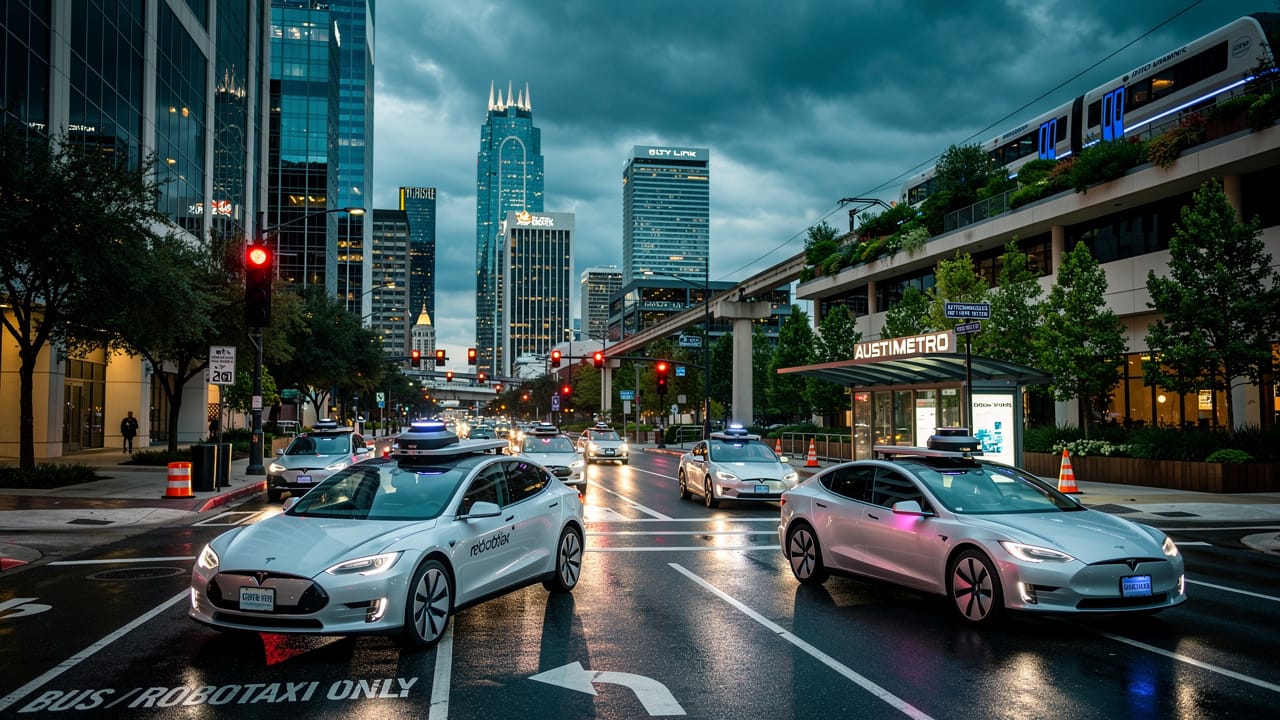
- The company’s driverless launch footage showed vehicles operating without a human in the front seat.
- That means Tesla now has robotaxi operations in three Texas cities, with Austin still the most established market.
- In a February filing, Tesla said its Austin fleet had been involved in 14 crashes since launch, a number that will intensify scrutiny as the service grows.
- Crowdsourced tracking suggests the early Tesla Robotaxi service area in Dallas and Houston may be tiny so far, with one vehicle logged in each city, versus 46 active vehicles in Austin.
- The bigger story is not just expansion, it is whether the Tesla Robotaxi service rollout can outpace concerns about safety, oversight, and the economics of running a real urban mobility network.
What Happened With the Tesla Robotaxi service rollout
Tesla has pushed its robotaxi program into Dallas and Houston, according to the company’s own social post announcing the launch. The message was short, but the implication was large, Tesla is no longer testing the waters in a single city. It is trying to look like a multi-market autonomous transportation business.
That matters because Tesla Robotaxi service Austin was the company’s first real proving ground in Texas. After launching there last year, Tesla began offering rides without safety drivers in January 2026. Now the company is taking that same playbook into two of the state’s biggest metro areas.
What Tesla has not shown yet is scale. Early public tracking data suggests these are extremely small deployments, at least for now. In practical terms, the initial Tesla Robotaxi service area in Dallas and Houston may be more of a beachhead than a citywide launch.
Key Details on the Tesla Robotaxi service area
The headline is simple, three Texas cities. The fine print is where things get more interesting.
Tesla’s announcement included a brief video of cars moving without visible human monitors in the front seat. That visual is not just marketing. It is Tesla signaling that it wants the public to treat this as true driverless service, not an advanced driver assistance demo with a babysitter behind the wheel.
Austin remains the real test case
The strongest data point still comes from Austin, not Dallas or Houston. Tesla disclosed in a February filing that its Austin robotaxis were involved in 14 crashes since launch. That figure does not, by itself, tell you fault, severity, or how it compares with human-driven ride-hail vehicles. But it does tell you something crucial, Tesla Robotaxi Austin service safety concerns are no longer theoretical.
Austin also appears to be where most of the actual fleet lives. A crowdsourced tracker logged 46 active vehicles in Austin, compared with just one in Dallas and one in Houston at the time cited. So while Tesla can say the service is live in three cities, the operating reality looks uneven.
The Tesla Robotaxi service area may start small by design
This is probably intentional. Autonomous vehicle companies typically begin with constrained geofenced zones, simpler routes, and favorable conditions. That means the early Tesla Robotaxi Austin service area likely offered Tesla a controlled environment before expansion. Dallas and Houston will almost certainly follow the same pattern, even if the branding makes it sound broader.
Tesla also continues to offer a more limited ride service with human drivers in the San Francisco Bay Area. That split strategy matters. It suggests the company is still balancing ambition with operational caution, even if its public messaging leans heavily toward speed.
For readers trying to parse what is real versus promotional, the most useful lens is this, the Tesla Robotaxi service rollout is expanding geographically faster than it is scaling operationally.
What Tesla Robotaxi service means for riders, cities, and competitors
For riders, the promise is obvious. A mature Tesla Robotaxi service could eventually mean lower-cost trips, wider availability, and less reliance on human driver supply at peak times. In cities where ride-hail pricing can become absurd during events or storms, a functioning autonomous fleet could be a real consumer advantage.
But consumers are not buying a concept. They are buying trust.
Safety is the real product
The biggest practical issue is whether ordinary people feel comfortable stepping into a car with no human driver after reading about 14 Austin crashes. Even if many incidents turn out to be minor, crash counts shape public perception more than launch videos ever will. This is why Tesla Robotaxi Austin service safety concerns are not a side issue, they are the business model.
For cities, the calculus is more complicated. Officials want innovation, investment, and headlines about being a future-facing tech hub. They do not want emergency responders, traffic agencies, and local politicians cleaning up after a badly supervised rollout. A tiny Tesla Robotaxi service area is manageable. A larger one with unclear oversight becomes a governance problem.
Winners and losers in the Tesla Robotaxi service rollout
If Tesla executes well, incumbents in ride-hailing have a problem. Human-driver platforms depend on labor availability and incentive spending. A software-driven fleet, at scale, attacks both weaknesses. That is why every new city matters symbolically, even if the fleet count is still small.
The losers could include human drivers over time, but not immediately. Right now, limited deployment means autonomous rides are more showcase than replacement. In the near term, the real pressure falls on regulators and local transportation agencies, which must figure out how much evidence they need before broad access is justified.
This is also where the Tesla Robotaxi narrative gets tricky. Investors may cheer expansion announcements long before riders see reliable, everyday utility.
What others missed about Tesla Robotaxi service austin and Texas expansion
Most coverage will focus on the obvious angle, Tesla added two cities. The more revealing angle is why Texas keeps being the map.
Texas offers large roads, car-centric urban design, business-friendly politics, and a culture that is generally more welcoming to transportation experiments than many coastal cities. For an autonomous fleet operator, that combination is gold. It is easier to frame expansion as progress when you are launching in places structurally built around driving.
This is as much a political strategy as a product strategy
By concentrating on Texas, Tesla is not just choosing cities, it is choosing a regulatory climate. That matters because robotaxis do not succeed on engineering alone. They succeed when lawmakers, city officials, and state agencies tolerate uncertainty long enough for the technology to improve.
There is also a branding advantage. Saying the service is active in Dallas, Houston, and Austin sounds like state-level momentum. It creates the impression of inevitability. Even if the real Tesla Robotaxi service area in each city is limited, the market hears “expansion,” not “small pilot.”
Scale is still the unanswered question
The gap between 46 vehicles in Austin and one each in Dallas and Houston should temper the hype. A robotaxi business is not proven when it can launch. It is proven when it can maintain uptime, handle edge cases, survive public scrutiny, and earn repeat usage across dense urban trips.
That is the part many headlines miss. The most difficult challenge is not getting a driverless car onto a street. It is turning that street demo into a dependable transportation network that cities and riders accept as normal.
Real examples of how the Tesla Robotaxi service area affects daily life
If you live in Austin, this expansion probably changes perception before it changes convenience. Seeing Tesla move into Dallas and Houston makes the service feel less experimental, even if your own experience with wait times, route limits, or service boundaries stays the same.
In Dallas and Houston, early users may face a familiar autonomous rollout pattern, restricted pickup zones, selective availability, and a lot of curiosity from bystanders. That is common when a Tesla Robotaxi service area opens before fleet density catches up.
Think about the everyday use cases that actually matter:
- Airport runs where pricing consistency matters more than luxury
- Late-night rides when driver supply is limited
- Commutes inside a narrow downtown geofence
- Short trips during big events, where traditional ride-hail often surges
If Tesla can handle those reliably, adoption grows. If riders deal with awkward edge cases, confusing boundaries, or safety anxiety, the novelty wears off fast.
Near the end of the day, most consumers will not care whether a company calls it artificial intelligence, autonomy, or the future of mobility. They will care whether the Tesla Robotaxi shows up on time, takes the right route, and does not make them feel like unpaid beta testers.
Pros and Cons of the Tesla Robotaxi service rollout
Pros
- Expands autonomous ride access beyond a single launch city
- Could reduce dependence on human driver supply over time
- Gives Tesla more real-world operational data across different urban environments
- Strengthens Texas as a major testbed for autonomous transportation
Cons
- Tesla Robotaxi Austin service safety concerns will follow the service into every new market
- Early deployment numbers suggest limited availability despite the big-city branding
- Public trust can evaporate quickly if crashes or service glitches pile up
- Cities may be asked to absorb the risk before the economics and safety case are fully proven
Conclusion on Tesla Robotaxi service in Dallas and Houston
The expansion of Tesla Robotaxi service into Dallas and Houston is a serious strategic move, but it is not yet proof that robotaxis have “arrived.” Right now, Tesla has momentum, attention, and a bigger Texas footprint. What it still needs is the one thing launch videos cannot manufacture, confidence.
What Happens Next (2026-2030)
Expect Tesla Robotaxi service to spread to more cities before it becomes truly dense in most of them. The biggest winners will be companies that can combine autonomy with disciplined operations, not just flashy announcements. Riders will benefit only if safety improves visibly and pricing becomes meaningfully better than conventional ride-hailing. If that does not happen, the next few years will produce a lot of autonomous headlines and far fewer transportation revolutions than promised. The Tesla Robotaxi brand could either become the default image of driverless mobility, or the case study for why scaling too fast is the most expensive mistake in transportation.
Sources
About the Author