

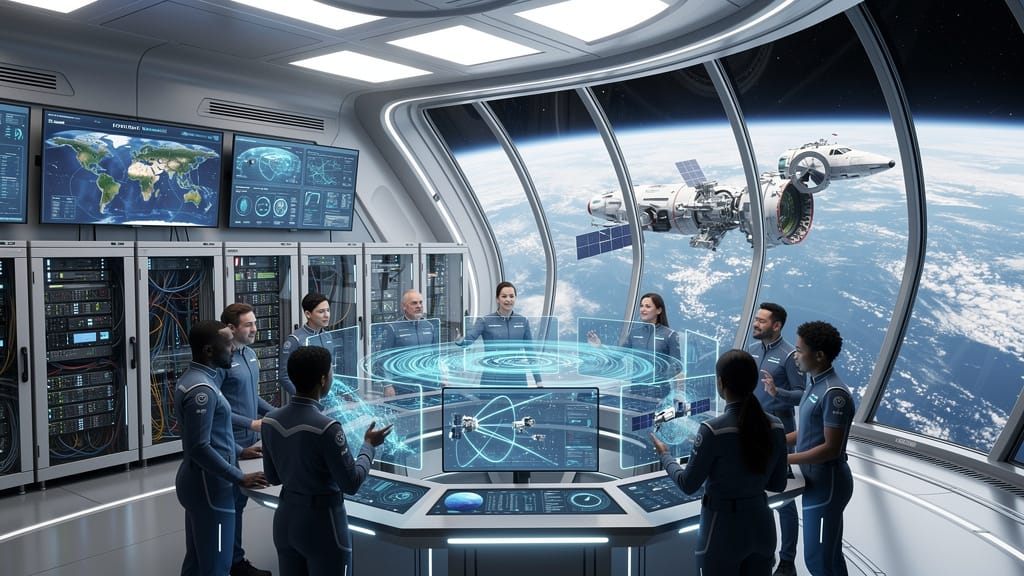
Space exploration meets cloud computing
Space exploration and commercial spaceflight are no longer just about satellites and astronauts. They are colliding with one of the most powerful trends in technology, the explosive growth of artificial intelligence and the data centers that power it. At the center of this convergence sits Elon Musk, his company SpaceX, and a bold new idea, building data centers in orbit.
SpaceX has reportedly filed confidential paperwork for an initial public offering that could value the company at around $1.75 trillion, according to TechCrunch. Separate reporting cited by BBC Technology suggests the public listing could make SpaceX worth more than $1 trillion, which would instantly place it among the most valuable companies in the world.
To support such a towering valuation, SpaceX needs more than rockets and internet satellites. The company is pointing to a new long term ambition as a key growth driver, orbital data centers on a massive scale.
The big bet: a million data centers in orbit
In January 2026, SpaceX filed an application with the US Federal Communications Commission to deploy up to one million data center units in Earth orbit, according to MIT Technology Review. The idea is to host computing infrastructure in space and use it to process the enormous workloads created by AI.
The motivation is not only commercial. The current AI boom is putting huge pressure on terrestrial energy grids and water supplies. Large data centers consume vast amounts of electricity and need significant quantities of water for cooling. Communities that live near these facilities have raised concerns over resource use, local environmental impact, and infrastructure strain.
On a recent episode of TechCrunch’s Equity podcast, the hosts noted that public resistance to new data centers is becoming an important factor. As one of them put it, for executives like Musk and Jeff Bezos, the engineering required to build orbital data centers might actually be easier to tackle than the social and political opposition that comes with building many more giant server farms on the ground.
In other words, if you cannot easily put another hyperscale facility in someone’s backyard, you might try to put it above everyone’s backyard instead.
Space is getting crowded with tech giants
SpaceX is not alone in treating space as the next big platform for computing.
Jeff Bezos, founder of Amazon, has publicly suggested that large scale computing will gradually shift to space. That fits neatly with Amazon’s role as a global leader in cloud services and with Bezos’s own long standing investments in space infrastructure through Blue Origin, even though the article does not detail specific orbital data center projects by that company.
Google also appears in the mix. The company is planning a constellation of satellites that will perform data processing in orbit, with an initial test fleet of around 80 satellites that could launch as early as next year, according to MIT Technology Review. This is a more modest start than SpaceX’s million node vision, yet it points in the same direction, an orbital layer of computing that works alongside ground based cloud regions.
Startups are already testing the concept as well. Starcloud, a company based in Washington State, recently sent up a satellite equipped with an Nvidia H100 GPU, one of the highest performance chips used in AI training today. This launch, which took place in November, marked what MIT Technology Review describes as the first orbital test of an advanced AI chip. Starcloud is aiming for orbiting data centers that could eventually reach the size and capability of major terrestrial facilities by around 2030.
The picture that emerges is not of a single outlandish SpaceX project, but of an emerging sector where multiple tech giants and startups see the same opportunity.
Why move data centers off the planet?
Proponents of orbital data centers make several arguments in their favor.
First, there is the energy and environment problem. Training and running large AI models consumes huge amounts of power. As detailed in MIT Technology Review’s coverage of AI’s energy footprint, the full story of how much electricity and cooling water AI will require is only beginning to be appreciated. Space based infrastructure would not remove the need for power, but it could tap into future space based solar concepts or reduce pressure on local grids by shifting power intensive workloads off planet.
Second, there is the cooling advantage. Space is a cold vacuum, and in principle that environment could help radiate heat away from hot chips. Major engineering challenges remain, since conventional cooling with water cannot be used in the same way, but the physical environment offers new design space for thermal management.
Third, there are the social and regulatory pressures on the ground. Large scale data centers bring jobs and tax revenue, but they also bring heavy trucks, land use conflicts, and concern over water tables and emissions. As the TechCrunch podcast discussion highlighted, community opposition is growing in several regions. Orbital infrastructure sidesteps many of these local political battles, even if it raises new questions in space law and orbital traffic management.
Finally, there is a latency and coverage dimension. Space based computing could sit close to existing satellite networks, such as SpaceX’s Starlink constellation, and potentially handle data where it is generated rather than routing everything to Earth. That could be valuable for global connectivity and applications that rely on continuous coverage.
Trillion dollar valuations and trillion dollar questions
SpaceX’s confidential IPO filing sets the stage for one of the most closely watched market debuts in years. BBC reporting notes that once public, the company’s value is expected to exceed $1 trillion, and that Musk’s stake could put him on a path to become the world’s first trillionaire.
To sustain that kind of market capitalization, investors will look beyond launch contracts and satellite internet subscriptions. Orbital data centers provide a narrative of virtually unlimited growth in AI related infrastructure, tied to a company that already has launch capabilities, experience deploying large satellite constellations, and a track record of ambitious engineering.
Yet the challenges are formidable. MIT Technology Review points out that even the first generation of orbital data centers will require advances in several areas, from reliable space rated hardware and sophisticated cooling systems to on orbit servicing, debris mitigation, and secure communications back to Earth. The article frames this as a list of core requirements that must be met before orbital computing can scale.
Moreover, the economics are far from proven. Launch costs have dropped significantly, partly thanks to companies like SpaceX, but hardware in space must still survive radiation, extreme temperature cycles, and the difficulty of repair. Any advantage in social acceptance or environmental impact will have to be weighed against these technical and financial hurdles.
From science fiction to infrastructure
The idea of huge computing platforms in orbit would have sounded like science fiction only a decade ago. Today it is moving rapidly into the strategic plans of some of the most influential companies in technology.
Whether SpaceX’s vision of up to one million orbiting data center units becomes reality, or whether more modest constellations from players like Google and Starcloud define the market, the direction is clear. The competition to build the digital backbone of the AI era is expanding into space.
That shift ties the story of space exploration and technology ventures directly to the future of cloud computing, energy systems, and environmental policy on Earth. As SpaceX prepares for a landmark IPO and other tech giants sharpen their own orbital strategies, the next chapter of the space race may be written not by astronauts, but by servers circling the planet.
Sources
About the Author