

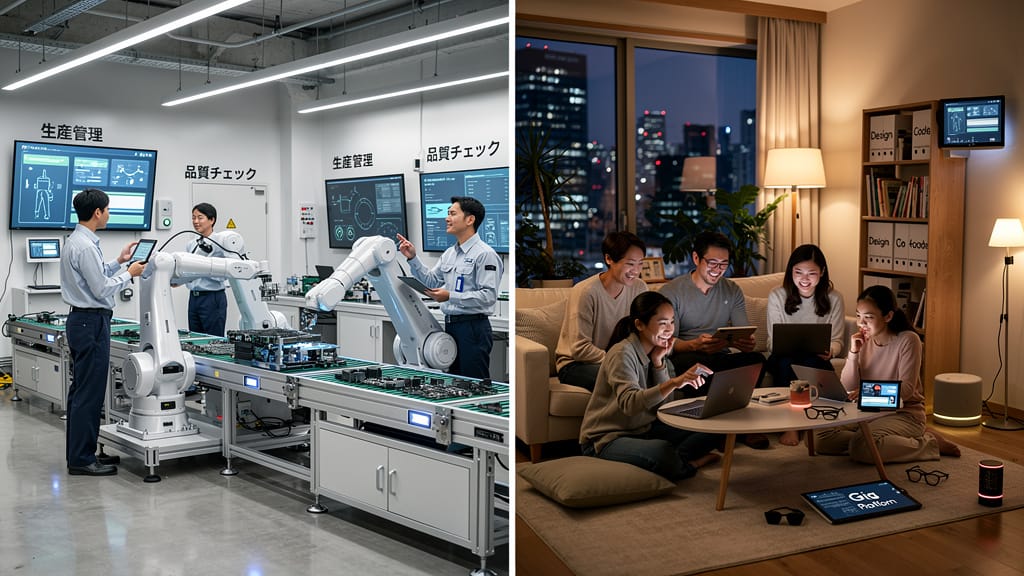
A quieter automation revolution
Public debate about AI and automation often swings between extremes. In one vision, robots arrive to eliminate human jobs. In another, they become our tireless helpers. The reality emerging in 2026 is more complex and more specific to local conditions.
In Japan, physical AI is increasingly deployed not to replace workers, but to keep the economy running as the workforce shrinks. At the same time, in countries such as Nigeria and India, gig workers are strapping smartphones to their heads and recording everyday chores so that future humanoid robots can learn to move and act like people.
Together, these trends reveal a crucial shift. AI and automation are not just abstract software systems anymore. They are tied to real bodies, real movements, and real labor markets in very different parts of the world.
Japan’s push into physical AI
Japan has long been a leader in industrial robotics, and it still dominates many global manufacturing lines. According to the country’s Ministry of Economy, Trade and Industry, Japanese manufacturers already accounted for about 70% of the global industrial robot market in 2022. Now the government wants to turn that historical strength into a new industry around physical AI, which refers to robots and automated systems that can sense, move, and act in the physical world with autonomy.
The ministry recently set an ambitious target. By 2040, it aims for Japan to capture 30% of the global market for physical AI. This push is driven less by hype and more by demographic reality. Japan’s workforce is shrinking, and companies face intense pressure to maintain productivity. In many sectors, especially factories, warehouses, and critical infrastructure, there simply are not enough people to fill open roles.
In this context, the robot is not framed as a job stealer. Instead, it is seen as a way to fill unwanted or unfillable roles, particularly repetitive or physically demanding work. Automation becomes a tool to sustain output, not a shortcut to cut headcount in a labor surplus environment.
This framing is important. It shapes how companies introduce AI systems and how workers perceive them. Japan’s approach is less about replacing people wherever possible and more about targeting gaps that human labor markets can no longer cover on their own.
Humanoids trained in living rooms
On the other side of the world, a very different piece of the automation puzzle is taking shape. Companies like Tesla, Figure AI, and Agility Robotics are racing to build humanoid robots, machines designed to look and move roughly like humans so that they can operate in existing spaces such as factories and eventually homes.
To do that, they need enormous amounts of real-world data that show how humans perform everyday tasks. This is where Micro1, a US based startup in Palo Alto, has identified an opportunity. As reported by MIT Technology Review, Micro1 hires thousands of contract workers in more than 50 countries, including India, Nigeria, and Argentina. These workers record videos of themselves doing basic household chores such as folding laundry, washing dishes, or cooking.
One Nigerian medical student, nicknamed Zeus, comes home from the hospital, straps an iPhone to his forehead, turns on a ring light, and films himself carefully making his bed. He moves slowly and keeps his hands in frame because the quality of the footage matters to the algorithms that will later learn from it.
This work is part of a growing gig ecosystem that provides locally competitive pay and new income streams for tech savvy young people. Many find out about it through platforms such as LinkedIn or YouTube. For them, recording chores can feel like a futuristic side job that connects their tiny apartments to cutting edge robotics labs.
Yet this model also raises thorny questions. Workers are recording intimate spaces in their homes. They may not fully understand how broadly their data will be used, how long it will be stored, or who will own the resulting datasets. The work itself can be physically awkward and mentally strange, since it turns private daily routines into structured training material for machines.
Broken benchmarks, real world stakes
As physical AI moves into factories and humanoids learn from domestic chores, another problem is becoming more obvious. Traditional AI benchmarks do not match the complex environments where these systems will actually operate.
For decades, AI progress has been measured by performance on isolated tasks compared to humans. Systems were judged by how well they recognized images, translated text, or answered questions in controlled tests. According to MIT Technology Review, this approach is no longer enough.
In real-world settings, AI operates inside messy, multi-person environments over long stretches of time. A warehouse robot might coordinate with human pickers, other machines, and software systems, adapting as conditions change. A future household humanoid must not just fold laundry correctly, it must interact with family members, navigate cluttered rooms, and respond to unexpected events.
Because benchmarks focus on narrow, one-off tasks, they can create a misleading impression of capability and risk. A system that scores highly in a lab might behave unpredictably once embedded in a complex workflow. The article argues that we need new types of benchmarks that evaluate AI within teams and organizations, over longer periods and in more realistic conditions.
Without such measures, policymakers, companies, and workers may misunderstand what AI systems can safely handle and where human oversight is still critical.
Global labor, local pressures
These developments highlight how deeply context shapes the impact of AI and automation on work.
In Japan, aging demographics and shrinking labor pools push companies toward physical AI as a survival strategy. Robots are positioned as reinforcements for an overstretched workforce, particularly in jobs that are hard to staff or physically demanding.
In countries like Nigeria and India, by contrast, young workers outnumber stable formal jobs. There, the growth of gig work that supplies training data for robots reflects the global reach of the AI economy. People in small apartments are effectively teaching machines how humans move and manipulate objects, even if the robots that benefit may never operate in their countries.
At the same time, the quality of our AI benchmarks will influence how safely and effectively these systems are deployed. If we evaluate them only in simplified settings, we risk pushing immature technology into high stakes environments such as hospitals, logistics hubs, or homes, where subtle failures can have serious consequences.
Rethinking what “job impact” really means
Discussions about robots taking jobs often ignore these nuances. The emerging picture is less about a single global story of replacement and more about interlinked labor dynamics.
- In some places, robots fill gaps where people are no longer available or willing to work.
- In others, people perform new types of work, such as data recording, that are created by the need to train those robots.
- Across all regions, we lack robust metrics that tell us how well AI systems function when they leave the lab and enter the complex social environments where jobs actually exist.
Understanding the impact of AI and automation on work therefore requires attention not only to which tasks can be automated, but also to who is training these systems, under what conditions, and using which standards of evaluation.
As physical AI and humanoid robots move from hype to deployment, the most important questions will not just be about what they can do. They will be about how their development is structured, who benefits economically, who takes on new risks, and how we measure real performance in real workplaces.
Sources
About the Author