
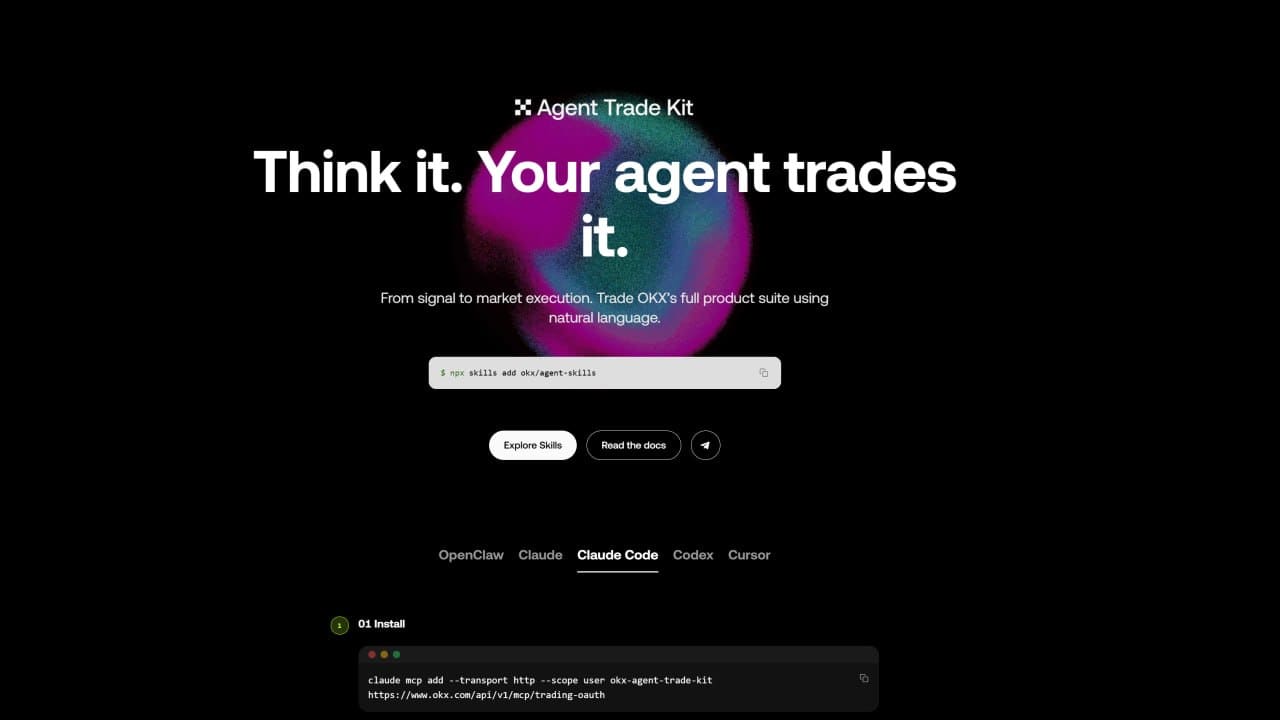
This is the part of the AI boom that makes people uneasy, because it is not about chatbots helping humans write emails. It is about software getting wallets, hiring other software, and moving money without asking you every five minutes.
Quick Summary
- OKX is launching a marketplace designed for AI agents crypto use cases, where agents can discover services, pay each other, and build on-chain reputations.
- The company says the platform opens to developers after a closed beta with 50 early AI service providers.
- OKX is pushing beyond exchange trading and betting on an agent economy where autonomous software becomes a customer class of its own.
- The pitch is not just convenience, it is infrastructure: identity, stablecoin payments, trust, and transaction history for non-human actors.
- With more than 150 million users globally, OKX is trying to get ahead of what it believes could become a major fintech market.
- The bigger story is that crypto AI agents may finally have a practical reason to exist outside speculation, if businesses actually let bots buy services from bots.
What Happened With OKX and the ai agents crypto push
OKX is rolling out a new marketplace aimed at developers building autonomous software. The idea is simple enough to sound obvious: if AI agents are going to do real work, they need a place to find tools, buy services, and prove they can be trusted.
According to TechCrunch, the company’s new marketplace lets agents interact economically, not just computationally. That means an agent could, in theory, hire another one to audit a wallet, pull market data, or execute a narrow task, then pay in stablecoins and leave behind a reusable reputation trail.
That marketplace, called OKX AI, is opening to developers after a closed beta. The launch matters because it turns a familiar crypto promise, programmable money, into something more operational: programmable workers.
Key Details on OKX AI, top ai agents crypto, and the agent economy
The most important fact here is not the product launch itself. It is the bet behind it.
OKX is saying the next wave of users may not be human. In the company’s view, autonomous agents will become participants in commerce, complete with wallets, transaction histories, and spending authority. That is a much more radical proposition than the usual chatter around AI agents for crypto trading, which mostly focuses on market analysis or automated order execution.
Why ai agents crypto needs wallets, identity, and trust
The company had already built pieces of that stack before this launch. The new marketplace sits on top of tools that let agents hold digital wallets, make stablecoin payments, and maintain persistent identities. Those features matter because a bot that can act independently still has three basic problems: how to pay, how to be recognized, and how to be trusted.
OKX’s executives are framing the answer as financial infrastructure for machines. Founder and CEO Star Xu argued, via TechCrunch, that traditional finance was built for people, while an agentic economy needs systems designed for software acting on its own. That is a sharp way to position AI agents crypto as a business category, not just a novelty.
There are also real numbers attached to the pitch. OKX says it has more than 150 million users globally. It also says the marketplace follows a closed beta involving 50 early AI service providers. And one of the company’s top executives believes agentic commerce could become a trillion-dollar market over the next five years, driven by micropayments and autonomous software, according to the reporting.
Early builders show where crypto ai agents may go first
The early use cases are telling. Security firm CertiK is building a service that lets AI agents assess wallet or token security before making a move. CoinAnk is also part of the early builder mix, indicating that market intelligence and transaction screening are likely to be among the first practical services.
That makes sense. The first successful entries on any best AI agents crypto stack will not be bots with grand ambitions. They will be narrow, boring, and useful. Risk checks. Data pulls. Price alerts. Compliance filters. Transaction simulations. The winners in this first phase will probably look less like digital employees and more like API workers with wallets.
This is also where the conversation overlaps with broader trends covered in OpenAI’s Big Week for agents in AI Is Really About Power, Trust, and Money. The important shift is not that agents are becoming smarter. It is that companies are trying to turn them into economic actors.
What This Means for You if ai agents crypto actually works
If you build software, trade crypto, run a one-person business, or sell digital services, this is not a quirky side story. It points to a possible change in how online work gets outsourced.
For developers, ai agents crypto could become a new app store
Developers may see this as a marketplace for components. Instead of building every function into one giant product, they could create specialized agents that sell one capability well. In that world, an ai agents crypto list starts to resemble a software supply chain: one agent handles wallet checks, another sources data, another executes transactions, another handles records.
That reduces friction for builders and creates a new way to monetize narrow tools. The upside is obvious. The catch is that every marketplace eventually becomes a gatekeeper. If OKX becomes the place where agents transact, it gains leverage over fees, discovery, and standards.
For solo businesses, the promise is scale without staff
OKX’s pitch to entrepreneurs is seductive for a reason. A single founder could assemble a team of software agents that source leads, analyze token risk, run support workflows, and trigger payments automatically. That is the dream behind many top AI agents crypto conversations: less hiring, more orchestration.
But the practical reality is messier. Giving software payment authority creates new attack surfaces. A bad employee makes mistakes. A bad agent can make thousands of them before breakfast.
For regular users, convenience comes with invisible risk
Most consumers will not touch this directly at first. They will feel it indirectly when products become more automated. A trading platform may use multiple bots behind the scenes. A DeFi interface may route tasks to specialized services. A wallet might soon have an embedded agent that checks counterparties before you approve anything.
That sounds helpful until something breaks. When agents hire other agents, accountability gets blurry fast. Who is responsible if a chain of autonomous services drains funds, pays the wrong vendor, or relies on poisoned data? Those questions are still barely settled for human-run crypto products, let alone bot-run ones.
What Others Missed About crypto ai agents and OKX’s strategy
The easy headline is that OKX built a bot marketplace. The deeper story is that exchanges are looking for life beyond trading fees.
Crypto exchanges know trading volume is cyclical, and retail enthusiasm is unreliable. Infrastructure is stickier. If OKX can become the default payments and identity layer for autonomous software, it is no longer just a venue for speculation. It becomes tollbooth, landlord, and payments processor at once.
The real bet is on distribution, not intelligence
The intelligence layer may not be the most defensible part of this market. Models improve quickly, and capabilities spread. Distribution is harder to copy. User base, wallet rails, liquidity, and compliance relationships matter more than flashy demos.
That is why the company’s 150 million-user footprint is a bigger signal than the bot-to-bot concept itself. If even a tiny fraction of those users adopt automated tools, OKX gets a head start in what could become the practical side of AI agents crypto.
There is another reason this matters. For years, crypto searched for a use case that was neither ideological nor purely speculative. An agent economy could be one of the first serious candidates. As we argued in Building Applications With AI Agents Is Suddenly a Jobs Story, an Infrastructure Story, and a Business Story, the real action is moving from model demos to workflow ownership.
Real Examples of ai agents for crypto trading and beyond
Imagine a trader sets rules for a portfolio agent. Before buying a token, that agent pings a security-checking service, requests liquidity data from another service, compares slippage estimates from a third, and only then executes the trade. Each task is paid for automatically in tiny increments.
Or picture a crypto startup with no operations team. Its treasury agent monitors balances, a compliance agent screens counterparties, a reporting agent logs activity, and a research agent watches governance proposals. None of these tools needs full human supervision every hour.
This is where OKX AI becomes more than a product page. It becomes a marketplace test for whether machine-to-machine commerce can move from demo theater to something businesses will actually trust.
You can also see how this could shape the next best AI agents crypto products. Not glamorous robo-traders, but practical services with narrow mandates and measurable output. That is probably healthier. In crypto, boring tools often create more value than clever ones.
Pros and Cons of the ai agents crypto model
Pros
- Faster outsourcing of repetitive digital tasks
- New revenue model for developers building narrow agent services
- Better fit for micropayments than legacy banking rails
- On-chain identity may create more portable reputation than closed platforms
Cons
- Security failures could compound at machine speed
- Reputation systems can be gamed, especially early
- Stablecoin payments do not solve fraud, bad data, or bad incentives
- Users may hand over financial authority before reliable safeguards exist
Conclusion: The bottom line on ai agents crypto and OKX
OKX is not just launching another crypto feature. It is trying to define a market where software workers need money, identity, and trust rails, and where the platform providing those rails takes a cut of the economy.
If that sounds ambitious, it is. But it is also one of the more concrete visions yet for what AI agents crypto might actually do in the real world, beyond generating hype and watching charts.
What Happens Next (2026-2030)
The near-term winners will be infrastructure companies that make autonomous payments, verification, and reputation usable at scale. The losers will be products that market “agent” magic without solving security and accountability. Expect OKX AI and similar platforms to attract developers first, then small businesses looking to automate narrow workflows. By 2030, the most valuable crypto AI agents probably will not look like robot traders, they will look like background financial services that quietly make decisions, move money, and leave humans to approve the exceptions.
Sources
About the Author