
AI data center growth is no longer a niche infrastructure story for chip investors and cloud executives. It is now strong enough to delay home construction, inflate labor costs, and expose a blunt truth, the AI boom is competing with ordinary life for physical resources.
Quick Summary
- AI data center growth is accelerating so fast that major construction markets are starting to feel labor shortages outside tech.
- In Texas, surging demand for electricians tied to data center projects is reportedly pushing homebuilding timelines out by about two months.
- This is one of the clearest real-world examples yet of AI driving data center growth beyond software and into housing, power, and local labor markets.
- Big players like OpenAI, Oracle, Meta, and Nvidia are all connected, directly or indirectly, to the broader buildout race.
- The next phase of ai data center growth will be constrained less by hype and more by electricity, permitting, grid upgrades, and skilled trades.
- If current trends hold, the ai data center growth forecast for 2026 to 2030 looks strong, but the winners may be utilities, equipment suppliers, and construction firms as much as AI model makers.
What Happened With AI Data Center Growth in Texas
The immediate story is simple, too many big AI-related projects are chasing too few skilled workers.
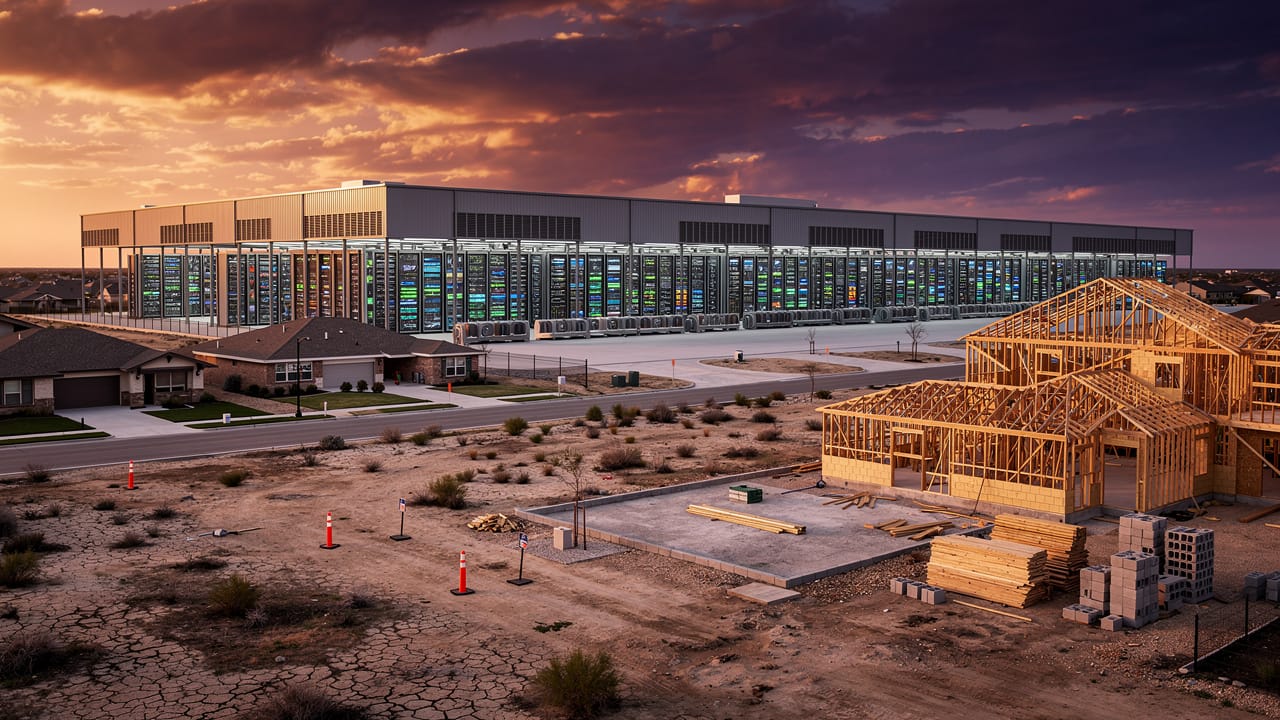
According to Tom’s Hardware, a wave of data center construction in Texas is soaking up electricians so aggressively that residential contractors are being priced out. The practical result is ugly and easy to understand, homes are taking roughly two months longer to finish because builders cannot secure the workers they need at rates they can afford.
That matters because ai data center growth is usually discussed in terms of chips, models, and cloud demand. What happened in Texas shows the boom has entered a more consequential stage. When data centers start competing with housing for labor, this stops being a future trend and becomes a present-day economic disruption.
Key Details on Central Texas AI Data Center Growth
Texas has become a pressure point because it offers the things hyperscalers and AI operators want most, land, a historically business-friendly environment, and large-scale power development. That helps explain the rise in central texas ai data center growth, especially as companies hunt for space to build out AI capacity quickly.
Why electricians became the bottleneck
A modern AI facility is not just a warehouse full of servers. It is a power-dense industrial site that needs complex electrical work, cooling systems, backup infrastructure, and interconnection planning. Those projects do not just need workers, they need specialized workers.
That distinction matters. You can buy more land. You can order more GPUs from Nvidia if your budget allows. You cannot instantly create thousands of experienced electricians, switchgear specialists, and power engineers.
Tom’s Hardware highlighted the labor effect in concrete terms, home construction timelines in affected Texas markets have stretched by around two months. That is a striking number because residential building is normally sensitive to small scheduling delays. When one specialized trade gets pulled away, everything downstream slows.
The bigger economics behind ai data center growth
The AI race has already become capital-intensive on a staggering scale. Recent industry reporting has shown that building enough compute for next-generation AI services requires tens of billions of dollars in infrastructure spending. We have already seen that logic show up in the spending plans around model training, cloud expansion, and chip procurement, something we explored in AI Investments Just Got a Lot More Expensive, and Google’s $40 Billion Bet Proves It.
That spending is now flowing into real estate and power systems. It is also why projects like the Stargate AI data center matter even when plans shift or negotiations stall. Even canceled, delayed, or restructured mega-projects reveal the same thing, demand expectations are enormous.
This is also where the ai data center power consumption growth story gets unavoidable. AI servers draw more power than conventional enterprise computing, and the cooling burden is higher too. That means every new facility puts pressure not just on labor but on substations, transmission planning, and local utilities.
What AI Data Center Growth Means for You
If you are not in tech, it is tempting to think this has nothing to do with you. That is already wrong.
For homebuyers, renters, and local communities
The Texas case shows how ai data center growth can ripple outward. If electricians move to higher-paying data center work, homebuilders either pay more or wait longer. Both outcomes raise costs. Delays also hit apartment construction, renovations, and public projects that rely on the same labor pool.
For communities, the tradeoff is messier than the usual “jobs versus development” debate. Data centers can bring tax revenue and construction activity, but they can also absorb power, water, land, and scarce skilled labor without creating as many permanent jobs as a manufacturing plant would.
For businesses outside AI
Manufacturers, hospitals, schools, and municipalities all compete for the same categories of infrastructure talent. So when AI driving data center growth accelerates in one region, non-AI projects can get more expensive even if those organizations never touch generative AI.
This is one reason the current boom feels different from earlier cloud expansion cycles. AI is not just adding server racks. It is increasing density, power demand, and urgency. That changes who gets access to critical contractors first.
For investors and workers
The cleaner way to think about the market is this, AI may enrich model providers, but infrastructure scarcity enriches everyone else in the chain too. Equipment makers, electrical contractors, power management firms, and utilities are all positioned to benefit. That is why analysts keep circling names tied to cooling and power distribution in the ai data center growth forecast, including the narrative around vertiv holdings ai data center growth.
Workers in skilled trades may benefit the most in the near term. AI hype has made software engineers famous, but the next wage winners may be the electricians wiring the facilities.
What Others Missed About AI Driving Data Center Growth
Most coverage still treats data centers like passive containers for AI. That misses the central point. The facility itself is becoming part of the competitive moat.
AI data center growth is really a supply chain war
The winners will not just be the companies with the best models. They will be the ones that can secure power, labor, permits, cooling equipment, and stable operating partners. That is why the Stargate AI data center story is more revealing than it first appears. A mega-project can make strategic sense on paper and still struggle in the real world if reliability, economics, or partnerships wobble.
This is also why the AI market may consolidate faster than people expect. Smaller firms can rent cloud capacity. They cannot easily replicate a deep infrastructure stack or survive prolonged shortages.
The political backlash is coming
Once ai data center growth starts affecting housing, power bills, and construction timelines, local resistance gets easier to organize. Residents may tolerate abstract promises about innovation. They are less patient when a home closes late, a grid upgrade stalls, or water use becomes a public fight.
That political angle deserves more attention. We are likely moving from the era of “build more AI” to “who should bear the cost of building more AI?” That is a much harder argument for the industry to win.
If you want a sense of how quickly this wider anxiety is spreading, AI Development Trends Are Not Slowing Down, and That Should Make More People Nervous captures the mood well. The concern is no longer just what AI does online, it is what AI infrastructure demands offline.
Real Examples of AI Data Center Growth in Everyday Life
This trend sounds abstract until you map it onto ordinary situations.
A family waiting on a new house in Texas may face delays because subcontractors cannot lock in electrical crews.
A city planning school upgrades or utility work may suddenly encounter higher bids because the same skilled labor is being drawn toward better-paying private projects.
A business trying to lease industrial space in a hot market may see prices move because land near power access has become more valuable to data center developers.
Even consumer AI products are connected to this. Every new chatbot feature, image generator, coding assistant, or AI search response depends on physical infrastructure somewhere. When OpenAI expands services, when Meta pushes more AI into its apps, or when cloud partners supported by Oracle scale capacity, those software experiences trace back to buildings, substations, and massive hardware fleets. And much of that hardware ecosystem still runs through Nvidia.
The same logic extends further out. Even futuristic ideas like orbital server farms, discussed in Space Data Centers Are the New Frontier for SpaceX, come from the same basic pressure, terrestrial AI infrastructure is getting expensive, crowded, and resource-hungry.
Pros and Cons of the Current AI Data Center Growth Boom
Pros
- Creates high-paying work for skilled trades and infrastructure contractors
- Speeds investment in power systems, cooling, and grid modernization
- Expands capacity for AI products that businesses and consumers increasingly use
- Can generate tax revenue and secondary economic activity in host regions
Cons
- Worsens labor shortages in construction and related industries
- Pushes up costs for housing and non-tech infrastructure projects
- Intensifies ai data center power consumption growth, raising grid stress
- Concentrates benefits among large firms that can afford massive upfront spending
- Risks political backlash if communities feel they bear the costs without proportional benefits
Conclusion on AI Data Center Growth
AI data center growth is no longer just a technology trend. It is becoming a regional economic force that can delay homes, reshape labor markets, and shift power toward companies that control infrastructure rather than just algorithms.
The important takeaway is simple, the AI boom is not running into a lack of ambition. It is running into the physical world.
What Happens Next (2026-2030)
The next few years of ai data center growth will reward companies that lock down electricity, land, and skilled labor before rivals do. Utilities, power equipment firms, and infrastructure specialists may end up as some of the biggest winners, which is one reason the market keeps revisiting themes like vertiv holdings ai data center growth. Communities with abundant power and faster permitting will attract investment, while overstretched regions may push projects away through delays and local opposition. And unless the labor pipeline expands fast, the AI industry will keep colliding with housing, public works, and other parts of the real economy in ways executives can no longer dismiss as temporary.
Sources
About the Author