
The loudest AI hype is still about chatbots, but the money is quietly moving somewhere more consequential: ai for supply chain. If that sounds less glamorous than consumer apps, that is exactly the point, this is where AI starts making or costing companies real money.
Quick Summary
- Loop has raised $95 million in a Series C round to push deeper into predictive and prescriptive ai for supply chain tools.
- The funding was led by Valor Equity Partners and the Valor Atreides AI Fund, with backing from 8VC, Founders Fund, Index Ventures, and J.P. Morgan Growth Equity Partners.
- This is not just about visibility dashboards, Loop is betting companies want systems that can predict disruptions before they hit operations.
- The deal fits a broader pattern: investors are pouring bigger pools of capital into applied AI, including Sequoia’s roughly $7 billion new fund aimed at expanding its AI bets.
- Across industries, AI is becoming more specialized, not more generic, as shown by OpenAI’s closed-access biology model GPT-Rosalind.
- For businesses, ai and supply chain tools may become one of the fastest paths from AI experimentation to measurable return on investment.
What Happened With Loop and AI for Supply Chain
San Francisco startup Loop just raised $95 million, and that matters for a simple reason: investors are no longer satisfied with AI that merely summarizes meetings or writes marketing copy. They want software tied directly to business pain, and supply chain pain is expensive, visible, and constant.
Loop’s pitch is more ambitious than the old generation of logistics software. Instead of just showing companies where inventory sits or where shipments are delayed, the company wants to tell them what is likely to go wrong next, and what they should do about it. In other words, this is ai in supply chain moving from reporting into decision support.
That funding round also lands in a larger AI capital wave. According to TechCrunch reporting, Sequoia has raised roughly $7 billion for a new fund to broaden its AI exposure, especially in late-stage companies. The signal is hard to miss: serious money is hunting for AI businesses that can become infrastructure, not novelty.
Key Details on ai and supply chain Funding
Loop’s new round was led by Valor Equity Partners and the Valor Atreides AI Fund, with participation from 8VC, Founders Fund, Index Ventures, and J.P. Morgan’s late-stage Growth Equity Partners. Those are not casual names. They suggest investors think supply chain ai has a chance to become a durable enterprise category rather than a temporary AI wrapper trend.
Why investors suddenly care about ai for supply chain
The timing is not random. Supply chains have spent the last several years absorbing shocks from inflation, geopolitical tension, shipping bottlenecks, labor shortages, and demand volatility. Companies learned the hard way that “resilience” sounds abstract until one delayed component stalls an assembly line or empties a store shelf.
That is why predictive software has become more attractive than retrospective software. A dashboard that explains yesterday’s failure is useful. A system that flags tomorrow’s likely failure is much more valuable.
Loop is pushing toward that second category with Loop’s AI-powered supply chain disruption prediction platform. Its broader ambition appears to be prescriptive AI, not just predictive AI. That distinction matters. Prediction says a disruption is probable. Prescription says reroute this shipment, switch this supplier, or raise safety stock in this region.
AI is getting more specialized, and that is the real story
The other source material reinforces a trend many casual observers still miss: AI is fragmenting into industry-specific systems. OpenAI’s new biology-focused model, GPT-Rosalind, was built around biology workflows and scientific complexity, not generic chatbot use. The same pattern is now playing out in logistics, procurement, manufacturing, and planning.
That should change how people think about ai supply chain investments. The winners may not be the flashiest model companies. They may be the firms that understand messy domain-specific workflows well enough to turn AI into an operational tool.
What AI for Supply Chain Means for You
If you run operations, buy inventory, manage vendors, or work in manufacturing, ai for supply chain management is not just another software buzzword. It could change who gets blamed when things break, who gets hired, and which teams become strategically important.
For businesses, the upside is speed and fewer blind spots
The best case is obvious. Companies get earlier warnings about supplier risk, transport delays, changing demand, or inventory imbalance. That can mean fewer emergency purchases, fewer costly stockouts, and less dead inventory.
It also means better prioritization. In a fragile network, not every disruption matters equally. AI can help rank which issues are likely to cascade and which ones are just noise. That is a major leap from traditional enterprise tools that drown teams in alerts.
This is why ai and supply chain software is likely to attract more budget than many internal productivity tools. A CFO may hesitate to fund a shiny chatbot. They are far less likely to ignore technology that promises fewer missed orders and more reliable margins. As we argued in The Real Impact of AI on Business Is Bigger Than Automation, and It’s Not Slowing Down, the real AI story in business is often about control, forecasting, and leverage, not just labor replacement.
For workers, the picture is more complicated
The pitch sounds empowering, but software that recommends actions also shifts authority. Planners, buyers, and logistics managers may spend less time diagnosing problems and more time validating machine recommendations. Some roles get stronger because they can act faster. Others get reduced into exception-handling.
That tension is already showing up across the economy. In our earlier piece on AI-Driven Job Market Changes: Chaos, Anxiety, and New Opportunity, we noted that AI often does not eliminate an entire function at once, it narrows it first. Ai in supply chain will likely follow that pattern. Fewer people may be needed for manual monitoring, but more judgment will be demanded from the people who remain.
For customers, reliability may improve, but opacity will too
When supply chains work better, customers feel it in very ordinary ways: fewer “out of stock” messages, fewer shipping surprises, fewer random substitutions. The gains are real.
But there is also a transparency problem. If AI systems increasingly make or recommend purchasing and routing decisions, companies may struggle to explain why certain vendors were deprioritized or why certain orders were delayed. In heavily regulated sectors, that could become a real legal and compliance issue.
What Others Missed About Supply Chain AI
A lot of coverage treats this like one more funding announcement. It is not. It is a clue about where the enterprise AI market is maturing.
This is a move away from AI theater
For the last two years, many companies bought AI tools because boards wanted an AI story. That produced a lot of demos and not enough transformation. Ai for supply chain is different because the problem set is ugly, expensive, and measurable. You can actually tell whether the software prevented shortages, reduced delays, or improved forecast accuracy.
That makes this category much more dangerous to incumbents. Legacy supply chain software vendors have sold visibility, planning, and compliance for years. If newer AI-native firms can offer prediction plus action, the old dashboard-heavy model starts to look thin.
Venture money is chasing operational AI, not just model labs
Sequoia’s $7 billion fund is another tell. Late-stage AI investing has expanded because companies can scale quickly when they attach AI to an obvious business bottleneck. Logistics is one of those bottlenecks.
This is also why specialized models matter more than many people think. OpenAI’s biology model and Loop’s logistics focus point in the same direction: the next wave is not one AI to rule them all. It is many domain-tuned systems embedded inside high-value workflows.
The hidden risk is bad data, not bad marketing
Here is the unglamorous truth. Supply chain ai is only as good as the data flowing into it. Supplier records are often messy. Shipment updates can be inconsistent. ERP data is notorious for gaps and delay. If the underlying inputs are unreliable, AI can make companies more confident without making them more correct.
That is a bigger threat than whether a model sounds impressive in a product demo.
Real Examples of ai in supply chain in Everyday Business
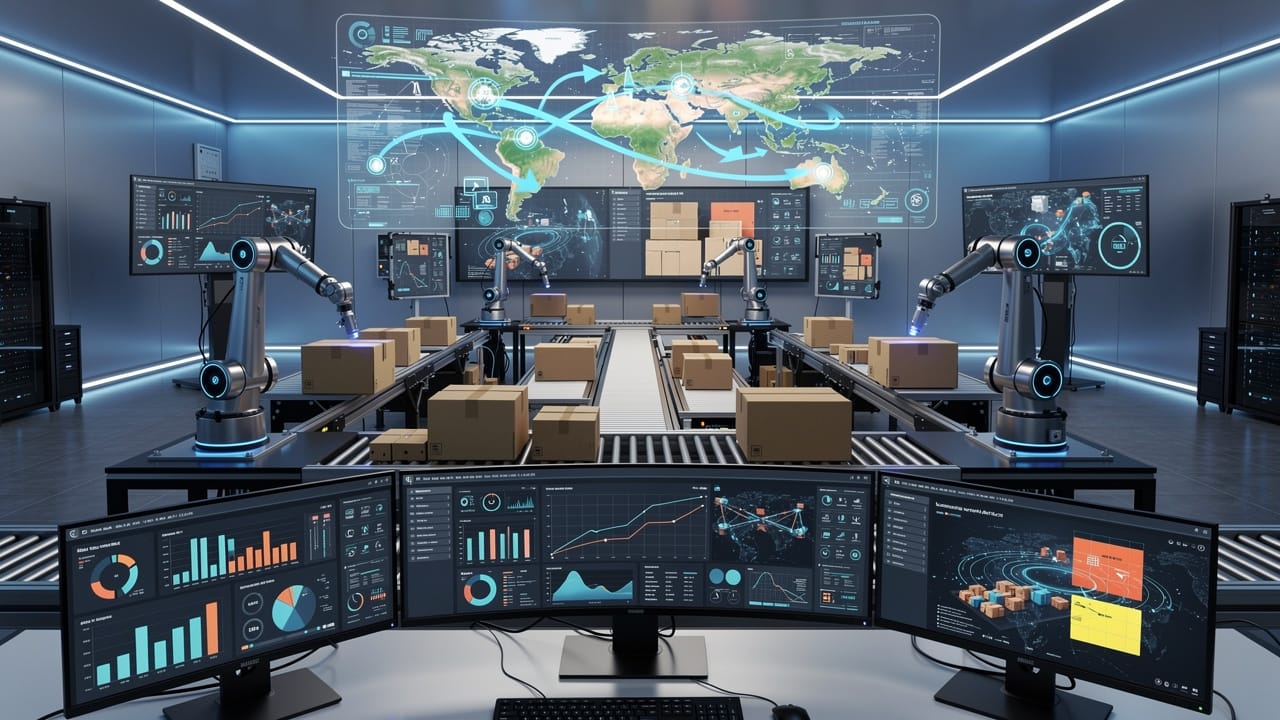
Think about a consumer electronics company waiting on a small but critical chip shipment. A conventional system may show the shipment is late after the delay is already obvious. A better ai for supply chain system might flag elevated risk earlier by connecting port congestion, weather, historical vendor performance, and production schedules. That gives the company time to reshuffle inventory or source an alternative part.
Or take a retail chain preparing for seasonal demand. Instead of dumping inventory broadly, an ai supply chain tool could identify which regions are likely to see stronger demand and which stores are overstocked. That changes markdown strategy, warehouse allocation, and transport planning in one move.
A pharmaceutical company offers another example. Drug manufacturing depends on tightly controlled inputs and timing. A delay in one ingredient can ripple through quality control, packaging, and distribution. In that environment, Loop’s AI-powered supply chain disruption prediction platform is not just a convenience layer, it could become part of risk management itself.
Near the end of this decade, many businesses may treat tools like Loop’s AI-powered supply chain disruption prediction platform the same way they treat cybersecurity software now: essential, costly, and impossible to ignore once operations depend on them.
Pros and Cons of ai for supply chain management
Pros
- Earlier detection of disruptions
- Better decision-making under uncertainty
- Lower inventory waste and fewer stockouts
- Stronger case for measurable AI ROI
- More resilient planning across suppliers and regions
Cons
- Heavy dependence on clean, timely enterprise data
- Risk of over-trusting flawed recommendations
- Potential job compression in planning and coordination roles
- Harder compliance and audit questions
- Expensive integration with legacy systems
Conclusion on ai for supply chain
The big AI money is starting to flow toward operational systems where mistakes cost millions, and ai for supply chain sits near the top of that list. Loop’s raise is less a standalone startup story than a sign that enterprise AI is shifting from spectacle to infrastructure.
What Happens Next (2026-2030)
Over the next few years, the companies that benefit most will be the ones with enough data discipline to make ai in supply chain actually useful, not just purchasable. Large manufacturers, retailers, and healthcare operators are likely winners because even small forecasting gains can translate into enormous savings. Legacy software vendors will either bolt on credible AI fast or get squeezed by specialists. Workers in operations will not disappear, but the job will change sharply, with less tolerance for slow manual analysis and much higher demand for people who can supervise, challenge, and improve machine-driven recommendations.
Sources
About the Author