
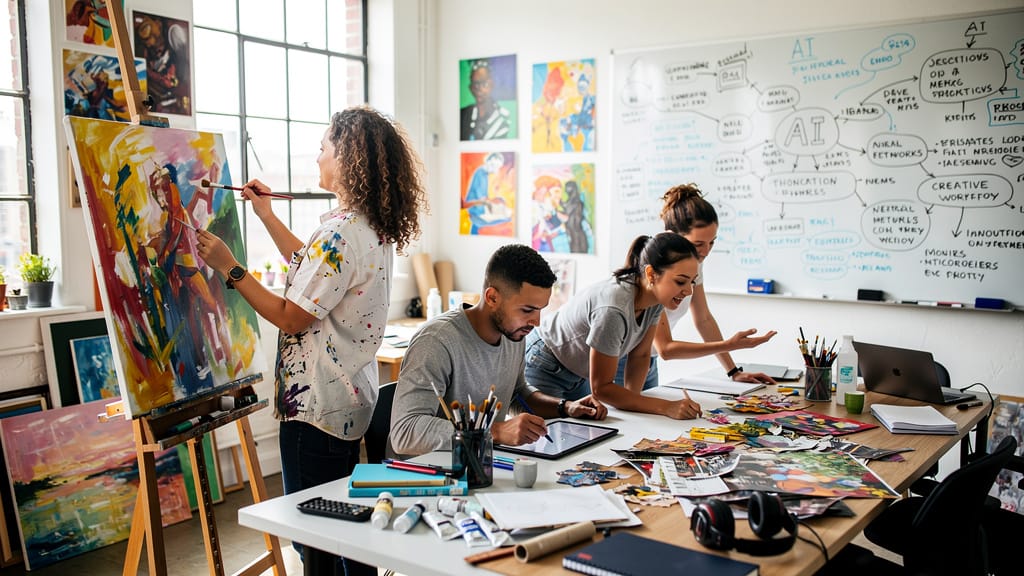
The New Reality of AI‑Generated Culture
Artificial intelligence is no longer a backstage tool that quietly optimizes search results or recommends playlists. It is now writing songs, painting portraits, drafting scripts, and remixing human voices at massive scale. As AI systems grow more powerful and more accessible, the old boundaries around copyright, authorship, and ownership are starting to blur.
Recent stories have pushed this tension into the spotlight. A folk musician found AI‑generated fakes uploaded under her name. A major reality show faced criticism for allegedly using AI in its promotional art. At the same time, large AI companies are reshuffling leadership and strategy as regulators and creators demand answers on data use and compensation.
AI is not just a technical shift, it is a legal and cultural turning point. The core question is simple, yet difficult to resolve: when machines learn from human creativity at scale, who gets to claim the rights to what comes out the other side?
When Your Voice Is Not Your Voice
In a case reported by The Verge, folk artist Murphy Campbell discovered songs on her streaming profile that she had never uploaded. They appeared to be her work, and the tracks used recordings she had originally made, but the performances sounded slightly off. The vocals seemed altered, as if a synthetic version of her voice had been placed over familiar material.
This situation illustrates several overlapping copyright and identity problems:
- Unauthorized distribution: Even if the underlying recording was based on Campbell’s own work, someone else uploaded and monetized it under her name without permission.
- AI‑manipulated vocals: If a model used her voice as training data, the resulting vocal line might not be a direct copy, yet it closely mimics her identity as an artist.
- Attribution and discoverability: Fans who see tracks on an official artist page reasonably assume the artist approved them. That damages trust if the songs are low quality or deceptive.
Here is the hard legal puzzle. Copyright traditionally protects specific recordings and compositions, not a person’s “style” or timbre. Voice and likeness rights exist, but they are mainly framed for advertising and endorsements, not for generative systems that can instantly create thousands of “almost you” performances.
The Campbell case hints at a future where artists might need mechanisms to verify official uploads, to flag impostor content, and to assert control over AI uses of their creative identity. That could mean new laws for voice rights or stronger platform rules for content provenance.
When Fan Culture Meets Synthetic Art
AI issues are not limited to music. They are beginning to reshape how audiences experience visual culture and fandom.
In a recent Mashable report, Season 18 of RuPaul’s Drag Race faced backlash when viewers suspected that promotional portraits of contestants were generated or heavily enhanced by AI. To many fans, drag is about meticulous craft, personal expression, and hand‑made transformation. The idea that debut images might be machine‑made felt like a betrayal of the show’s ethos.
This backlash highlights several key tensions:
- Consent and credit: If AI tools processed reference photos of real performers, did those performers agree to this use, and are the human artists who did the prompting properly credited?
- Labor and cost cutting: Audiences increasingly suspect that AI imagery is used to save money or speed up marketing workflows, which can be seen as undermining human photographers, makeup artists, and designers.
- Authenticity: Drag culture places a premium on individuality. When portraits feel generically “AI polished,” fans perceive a loss of realness, even if the underlying reference is the actual queen.
There might be no clear copyright violation in AI‑aided portraits, especially if the production team had the rights to the underlying photos. Yet the social backlash reveals a different type of harm: erosion of trust and a sense that human creativity is being treated as disposable.
The Corporate AI Pivot and IP Pressure
Behind these cultural flashpoints is a rapidly shifting AI industry. According to TechCrunch, OpenAI has adjusted its leadership structure, with Brad Lightcap taking on a new role overseeing “special projects.” At the same time, other senior leaders are stepping back or moving roles, as the company navigates growth, safety concerns, and public scrutiny.
Executive reshuffles might seem far removed from copyright disputes over folk songs and drag portraits, but they are connected. Major AI firms are now at the center of global debates about:
- How training data is collected: Are models built on scraped songs, artwork, scripts, and photos taken from the open web without permission?
- What compensation looks like: Should creators receive royalties when their work helps train models that then generate similar outputs?
- How liability is shared: If AI tools enable large scale infringement, from deepfake music profiles to unlicensed commercial designs, are the developers responsible or only the end users?
As regulators explore rules for AI transparency and content provenance, companies like OpenAI, Google, and others must design systems and policies that anticipate future copyright rulings, not just maximize short term capability.
Why Existing Copyright Law Struggles With AI
Most copyright regimes were built for a world where copying was relatively slow and detectable. You had to physically press a record, duplicate a film reel, or publish a book. AI turns that model on its head.
Key pressure points include:
- Training vs copying: Generative models do not store simple copies of works, they transform vast collections of examples into statistical weights. Yet they can sometimes reproduce output extremely close to their training data, particularly in niche styles or small datasets.
- Derivative works: If an AI model trained on a specific artist’s portfolio produces a new image that evokes that artist’s style, is that a derivative work or just influence? Human artists are influenced all the time, but machines can emulate with uncanny precision and scale.
- Authorship of AI output: When a user types a prompt and an AI system produces an image or a song, who is the author? Current law in many jurisdictions does not grant copyright to works created purely by machines. That leaves a gray area for mixed human plus AI workflows.
Courts and lawmakers are just beginning to test these issues. Different regions may reach different conclusions on where training is “fair use,” where it is infringing, and what kinds of outputs cross the line into unlawful copying.
Navigating the Next Phase: Practical Paths Forward
While the legal landscape evolves, creators, platforms, and AI companies can take steps to reduce conflict and build a more sustainable ecosystem.
For creators
- Track and verify your work: Use metadata, watermarks, and platform verification tools where available. It will not prevent misuse, but it can make disputes easier to prove.
- Set explicit terms: When you license your work, clarify whether AI training and synthetic derivatives are allowed. Contracts can move faster than legislation.
- Organize collectively: Unions, guilds, and rights groups can negotiate with AI firms for opt‑out databases, standardized licenses, or revenue sharing mechanisms.
For platforms
- Strengthen identity protections: Verified artist channels, content fingerprinting, and clear dispute processes can help address AI fakes that ride on real names.
- Label synthetic content: Visible tags for AI‑generated or AI‑assisted content can help audiences understand what they are seeing and hearing.
For AI developers
- Offer real choice: Provide opt‑out or opt‑in systems for datasets that include creative works, and respect takedown requests where feasible.
- Document data sources: Transparent information about high level training data categories can build trust and inform better policy decisions.
- Experiment with compensation models: For example, pooled licensing schemes, revenue shares tied to usage patterns, or partnerships with collecting societies.
The Cultural Question Behind the Legal One
At its core, the AI and copyright debate is not only about statutes and court decisions. It is about how much value we place on human craft, identity, and labor in a world where machines can cheaply imitate style, tone, and even a person’s voice.
The stories of Murphy Campbell’s altered songs, the AI‑tinged portraits of Drag Race contestants, and the strategic moves inside companies like OpenAI all point in the same direction. AI is moving from novelty to infrastructure. As that happens, copyright is becoming less of a niche legal specialty and more of a daily question for anyone who creates, shares, or consumes culture.
The challenge in the coming years will be to harness AI’s power without erasing the rights, credit, and livelihoods of the people whose work made these systems possible in the first place.
Sources
About the Author